
This post was originally published on this site.
- Tucker Carlson argued that the U.S. dollar’s “diminishing purchasing power” makes the case for a new global reserve currency.
- Carlson and Schiff clash over value creation in crypto and gold.
- Bitcoin faces mounting skepticism from prominent critics.
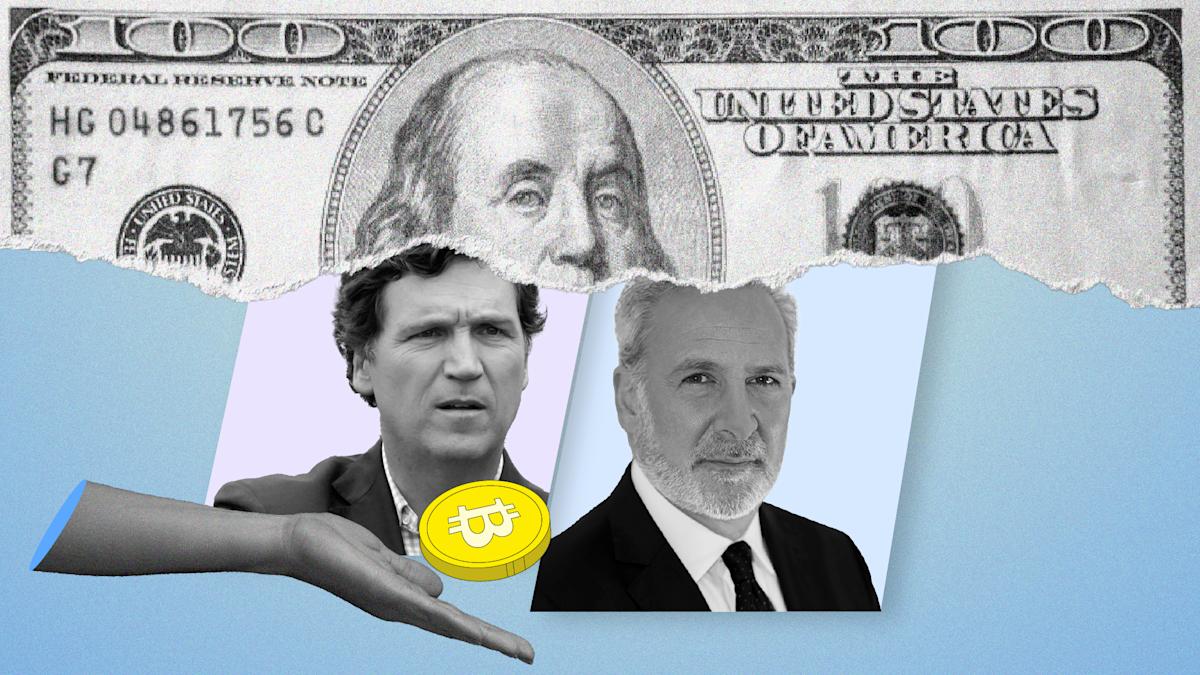
Media personality Tucker Carlson said Bitcoin (BTC) or Tether (USDT) could replace the U.S. dollar as the world’s reserve currency, arguing that the dollar’s purchasing power is eroding, during a new interview with economist and gold advocate Peter Schiff.
The remarks came as Carlson and Schiff clashed over gold’s rally and Schiff’s long-held opposition to cryptocurrencies, as a growing number of commentators echo the skepticism toward digital assets.
Earn Crypto with These Top Mining Apps
Sponsored
Disclosure
We sometimes use affiliate links in our content, when clicking on those we might receive a commission at no extra cost to you. By using this website you agree to our terms and conditions and privacy policy.



Tucker Carlson Makes Bold Bitcoin and Tether Claim
Carlson framed his argument around what he described as the decline of the U.S. dollar.
“It’s diminishing purchasing power,” Carlson said. “So clearly, there needs to be a new global reserve currency. You don’t want it to be one owned by a geopolitical rival.”
“So why wouldn’t Tether? Why wouldn’t Bitcoin be the new global reserve currency?”
The comments followed Peter Schiff’s X post warning of the erosion of the U.S. dollar.
“Trump may think the U.S. has the hottest economy in the world, but financial markets prove it’s the coldest,” Schiff wrote on Monday.
“Gold is surging above $5,020, silver is over $104.65, and the U.S. dollar is getting crushed against other fiat currencies, hitting a record low against the Swiss franc,” he added.
Carlson and Schiff Butt Heads Over Gold
In their long-awaited interview, Carlson and Schiff clashed over the economist’s long-time pushback against crypto.
“You meet all these people who’ve made hundreds of millions. You meet kids who’ve made real money from crypto,” Carlson said.
“Why is it throwing it away?”
Schiff rejected Carlson’s characterization and argued that crypto wealth does not stem from productive economic activity.
“Well, because where did they make it?” Schiff said.
“They didn’t make money in crypto because they produced products that we consume or provide services that improve our lives.”
“The people who have made money in crypto, and I know a lot of them, they’ve made money in because the crypto that they bought a long time ago went way up,” he added.
[embedded content]
Carlson challenged Schiff by comparing that same crypto speculation to gold investing.
“How’s that different from buying gold?” Carlson said.
Schiff responded: “Well, I don’t know a lot of people who got rich buying gold.”
Carlson countered: “‘I’ve done really well. Well, let’s be honest. And so have you.’”
Schiff replied by contrasting gold’s returns with Bitcoin’s rise.
“Okay, we’ve tripled our money. I’m talking about people who bought Bitcoin for $1 and now it’s $90,000 right?”
Carlson again hit out at gold, criticizing it as non-productive.
“But when you buy gold, which I do, I own a gold company, I’m totally for buying gold, but you’re not. It’s not a creative act,” he said.
“You’re not making anything, no, not making anyone’s life better. You’re not really adding to the sum total of the economy,” Carlson added.
“You’re not doing anything other than buying something low and holding it until it gets hot.”
Schiff’s Warnings Join Chorus of Bears
Last week, Schiff again issued a warning that both U.S. dollar assets and crypto would suffer significant losses in the months ahead.
“By the end of the year, holders of U.S. dollar–denominated assets and cryptocurrencies, including BTC, will be substantially poorer than they are today,” Schiff wrote.
“In contrast, holders of non-dollar–denominated assets and precious metals will be significantly richer. Which will you be?”
The warnings join a growing chorus of bearish outlooks on Bitcoin, including from economist Steve Hanke who reiterated his long-held view that Bitcoin has “zero fundamental value.”
Investor Michael Burry also echoed the sentiment, claiming Bitcoin’s move into six-figure territory represents a speculative mania.
Burry described the idea of Bitcoin at $100,000 as “ridiculous,” arguing that enthusiasm for the token has gone “too far.”
The investor went further, calling Bitcoin “worse than a tulip bulb,” and said the technology had enabled criminal activity to operate “deep under.”
Top Picks for Bitcoin