
This post was originally published on this site.
- The ink is barely dry on the European Union and India’s historic trade deal, announced Tuesday, but all eyes are now on President Donald Trump’s reaction to the agreement.
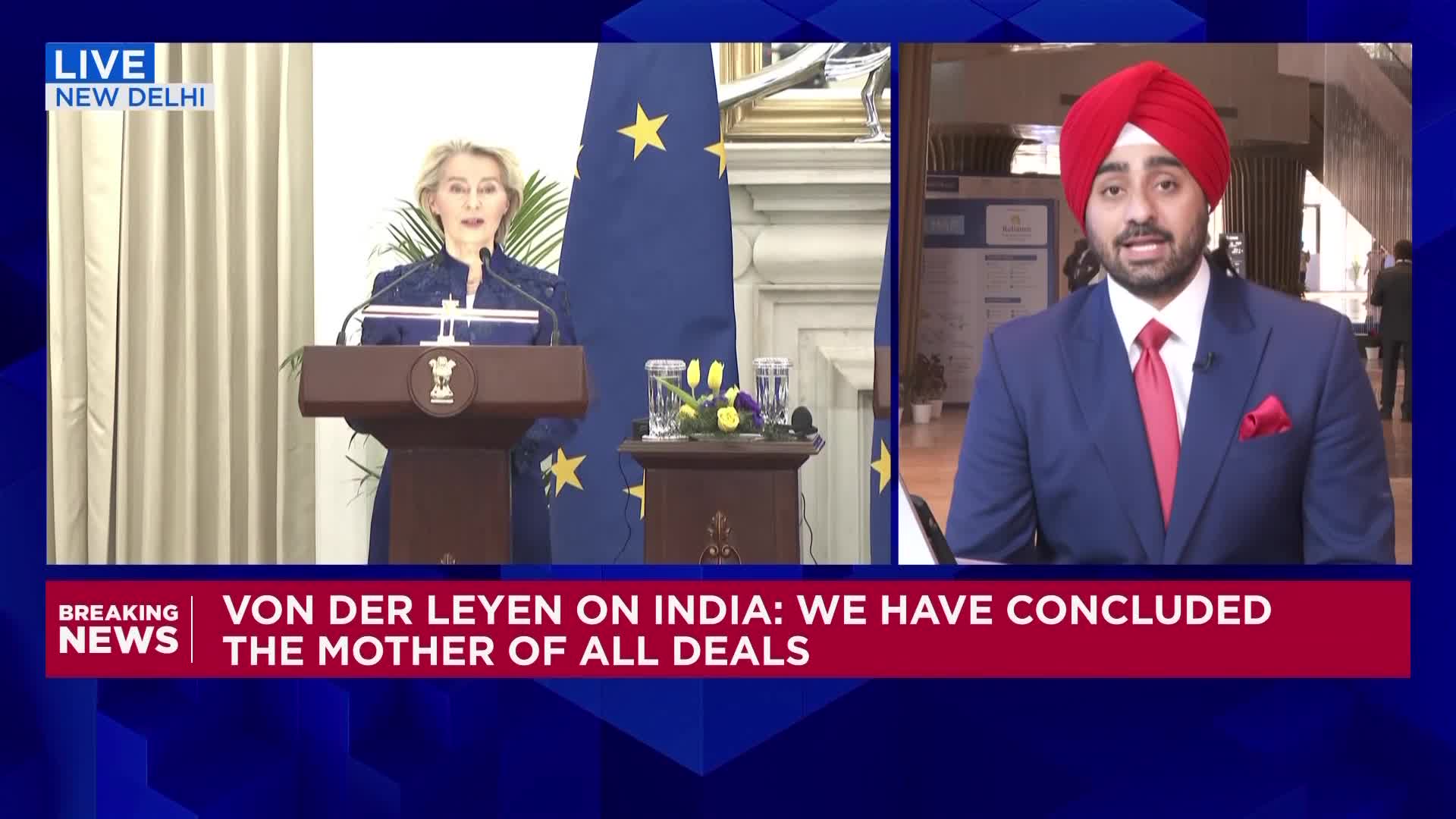
- Indian Prime Minister Narendra Modi praised the “landmark” free trade agreement earlier, calling it the “mother of all deals.”
- The trade agreement is being widely seen as a strategic hedge against volatile U.S. trade policies.
The ink is barely dry on the European Union and India’s historic trade deal but all eyes are now on how President Donald Trump will react to the free trade agreement that’s widely seen as a strategic hedge against the U.S.’ volatile trade policies and tariff threats.
The deal, which was confirmed earlier Tuesday, has taken almost two decades to agree and will see the trading behemoths gradually cut tariffs to zero on the majority of each other’s imports, except on some key products and sectors.
Trump is yet to react publicly to the EU-India deal, which was announced in the early hours of Tuesday morning European time, but he and the White House are unlikely to be happy with the deal. Treasury Secretary Scott Bessent has already criticized the EU for forging ahead with a trade agreement with India.
“The U.S. has made much bigger sacrifices than Europeans have. We have put 25% tariffs on India for buying Russian oil. Guess what happened last week? The Europeans signed a trade deal with India,” Bessent told ABC News Sunday.
India’s Minister of Petroleum and Natural Gas Hardeep Singh Puri told CNBC Tuesday that he expected the U.S.-India relationship to remain positive and for a trade deal to be completed soon.
“The relationship structure [between the U.S. and India] is very strong. I would try and look at the positive side, I’m not a soothsayer, I don’t know when trade deals will get signed, how long it takes … but everybody needs to chill a bit.” Hardeep Singh Puri told CNBC’s Amitoj Singh.
India supported the multilateral trading system, he said, and this was evident in the latest deal with the EU: “If you were to make the statement that the multilateral trading system, the global economy, is undergoing challenges, then I don’t think anyone would want to challenge that assessment. On the Indian side, there are several sectors which are looking to an enhanced European market,” he said.
How will Trump react?
Indian Prime Minister Narendra Modi praised the “landmark” free trade agreement earlier, calling it the “mother of all deals,” while European Commission President Ursula von der Leyen said the agreement will allow the two sides to grow their strategic relationship.

Both leaders are due to speak at an EU-India summit later Tuesday and are likely to praise a deal that sees trade barriers eased and tariffs slashed at a time when their export-oriented industries face punitive duties from the U.S.
The White House imposed a 15% tariff on EU imports last year despite agreeing on a trade deal with the bloc, while goods from India were slapped with a more punitive 50%, in part because of its ongoing oil purchases from Russia.
Hosuk Lee-Makiyama, director of the European Centre for International Political Economy, said the EU-India trade deal is one of the best agreements available to the two sides, which have traditionally been protectionist when it comes to strategic sectors of their economies, like agriculture and autos.
“This is a deal that they can do that will have a positive impact, while the U.S. and China will remain closed as new market openings go. So in that respect, this is probably one of the best deals they can do at the moment,” Lee-Makiyama told CNBC Tuesday.

Both India and the EU had reasons for forging ahead with a deal, despite the inevitable wrath it might unleash in Washington, he added.
“But there is a significant difference [with this landmark deal], though, which is that India actually failed to secure the deal with United States,” while “EU trade ministers are now getting used to the fact that there is a new tariff threat coming from Washington every week, and of course, their skins get a little bit thicker [each time],” he told CNBC’s “Europe Early Edition.”
Needs must
There will undoubtedly be some wariness in Europe about upsetting the U.S. at a time when its commitment to its European allies appears highly vulnerable, particularly when it comes to the collective defense principle that’s a central tenet of the NATO military alliance.
David McAllister, member of the European Parliament and chair of its foreign affairs committee, summed up the balancing act that the region needs to maintain between pursuing its own economic interests while maintaining good relations with Washington.
“Europe needs to become more sovereign. Europe needs to grow up, and that means that we need to become economically more competitive,” he told CNBC’s “Europe Early Edition” on Tuesday.
“We need to do much more for our own security and defense, but we also want to maintain the close transatlantic relationship with the United States … but this relationship needs to be based on mutual respect and trust,” he said.