
This post was originally published on this site.
On November 28, 2025, the International College of Economics and Finance (ICEF) of HSE University hosted the 14th International Moscow Finance Conference. The event brought together many leading researchers in financial economics. The program featured three regular sessions focusing on cutting‑edge topics in contemporary finance research and a keynote address by Allen N. Berger, Professor of Finance at the University of South Carolina (USA).
© ICEF
The conference opened with a welcoming speech by Vladimir Sokolov, Chair of the Conference Organizing Committee and Head of the ICEF Laboratory in Financial Economics at HSE University. He emphasized the international character of the event and the high academic standard of the selected papers.
“We continue to be one of the leading platforms for finance researchers in Russia. This year, we are pleased to welcome both Russian and international scholars to our annual conference,” Vladimir noted.
Regular Sessions
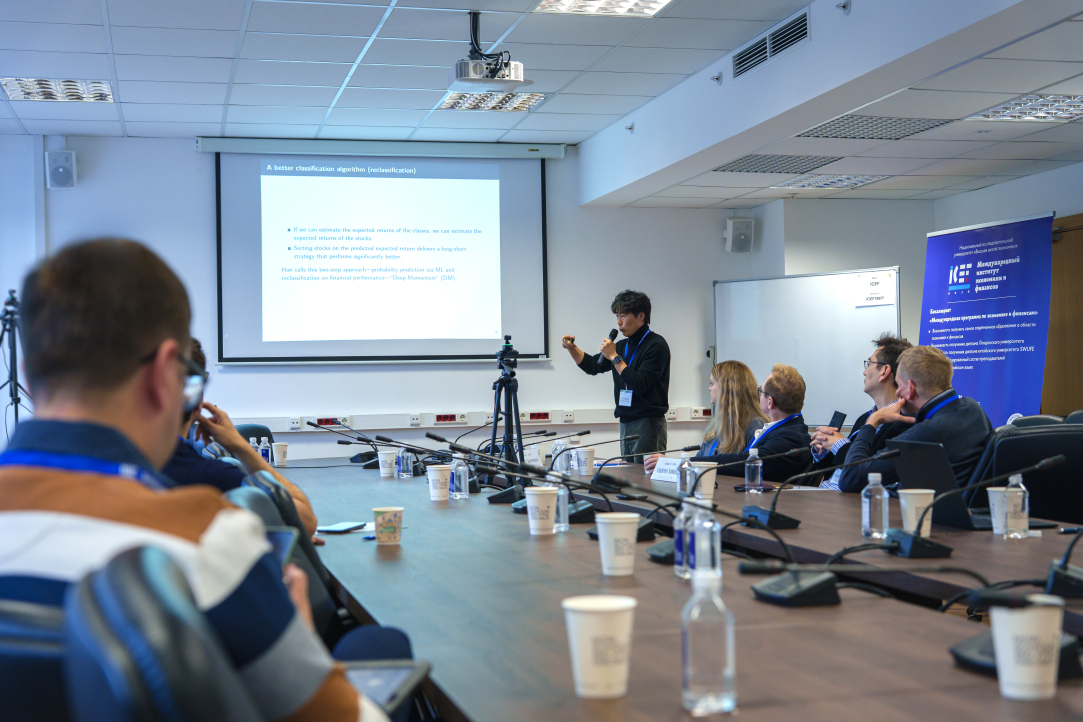
The first session focused on new empirical studies in asset pricing. Professor Chulwoo Han (Sungkyunkwan University, South Korea) presented a paper using machine learning‑based forecasting to demonstrate the superiority of deep momentum strategies over traditional approaches in stock market investing. Alexey Kolokolov (NES, Russia) was as discussant. Lorenzo Schönleber (University of Turin, Italy) presented a paper on the efficiency of Polymarket markets for Bitcoin, comparing it with Bitcoin derivatives markets. Dmitry Makarov (ICEF HSE University, Russia) served as discussant. The presentations sparked lively debate, with audience raising counterarguments regarding methods for measuring efficiency and theoretical underpinnings.
The second session addressed how structural shocks affect international value chains and financial market participants. Yan Dong (Southwestern University of Finance and Economics, China) studied the impact of tariffs on the relocation of Chinese industrial value chains. Her research showed that tariff shocks significantly influence the offshoring of production in affected industries. Tai Lo Yeung (University of Lugano, Switzerland) examined how labor income asymmetry affects risk‑taking in investors’ portfolios. Using both theoretical and empirical tools, he identified how income volatility asymmetrically affects the proportion of stocks in an investor’s portfolio. Discussants were Zhen Wang (SILC Business School, Shanghai University, China) and Olga Kuzmina (NES, Russia), respectively.
The final regular session covered banking, derivatives markets, and debt instruments. Jasper Pan (TCNJ School of Business, USA) found that the proposed measure of bank diversification outperforms existing ones in predictive power. Jitendra Tayal (Ohio University, USA) showed that short‑sale risk negatively impacts monthly returns on put options. Han Xiao’s (The Chinese University of Hong Kong, China) study revealed that mutual funds can adjust market inflation risk by recalibrating market risks in their portfolios, with adjustments aligned with inflation risk forecasts. Discussants were Sergey Tsyplakov (University of South Carolina, USA) for the first paper, Alexey Bulatov (ICEF HSE University, Russia) for the second, and Anna Rozhkova (ICEF HSE University, Russia) for the last.
Keynote Address
The event concluded with a keynote speech by Professor Allen N. Berger (University of South Carolina, USA), one of the world’s leading banking experts, with over 100,000 citations of his work. In his presentation, Professor Berger examined the impact of climate risks on bank stability, asset valuation, and financial institution regulation, as well as the profound effects of climate change on real businesses worldwide.
The main contribution of the work lies in identifying the channels through which climate change affects bank operations and the consequences of mitigating those impacts. The researcher identified two key risks underlying broader climate risk: transition risk (toward a low‑carbon economy) and physical risk (from climate change). Professor Berger then presented a detailed framework for transmission channels, risk management, and economic responses to these risks.
His talk served as the climax of the conference’s scientific program and drew particular interest from both academic and professional attendees.
Looking ahead, the conference organizing committee plans to continue its work and host the 15th International Moscow Conference on Financial Economics at the same high standard next year.
.h4 + .decorator-person-info {
margin-top: 0;
padding-top: 0;
}