

This post was originally published on this site.
Choosing between two top-tier dominant forces in any particular sector can be a difficult task. In the world of crypto, investors looking to put long-term capital to work in tokens they view as long-term stores of value outside the monetary system do have a few choices to choose from.
Of course, there’s the first (and still the largest) cryptocurrency out there which is most often viewed as such a monetary system hedge – Bitcoin (CRYPTO:BTC). Bitcoin’s historical performance, its sheer size at a market capitalization of more than $1.8 trillion, and its ardent investor base makes this top token one investors have to consider up front.
That said, there are other base layer networks such as XRP (CRYPTO:XRP) which are quickly becoming their own unique asset classes investors want to own. Plenty of XRP investors, who have held through Ripple’s long and arduous legal battle with the Securities and Exchange Commission (SEC), may now view this token as truly battle-tested. XRP’s network, at least in terms of transaction activity, is a dominant force in the crypto landscape.
So, which top-tier digital asset is the better long-term bet right now? Let’s dive in.
Bitcoin’s Bull Case
There’s really not much that needs to be said about Bitcoin. It’s the biggest, largely considered to be the most stable, well-known, and liquid cryptocurrency out there. For traders, speculators and long-term investors alike, Bitcoin is often the only choice when it comes to playing momentum-driven moves in this space. And notably, the early introduction of spot ETFs and other exchange traded products which offered traditional investors an avenue to gain exposure to Bitcoin has propelled massive amounts of investor capital into this network.
Now, given Bitcoin’s size at a market capitalization that’s nearing $2 trillion, absolute floods of capital are going to need to continuously pour into this ecosystem in order for investors today to see upside. Indeed, a 10x from here would require Bitcoin to achieve a market capitalization of roughly $18 trillion, which would make this digital asset (which doesn’t generate cash flows and can’t be seen or held) worth more than any other entire stock market index of any country outside the United States (China currently has the second-largest equity market capitalization of around $12 trillion).
That’s an incredible statistic.
Of course, Bitcoin’s dominant position in terms of network value, liquidity, usage and as a perceived store of value will remain. This is among the most integral pieces of infrastructure in this sector, with a n important role for corporate treasuries and the balance sheets of financial institutions. As such, there are now many vested interests in seeing Bitcoin’s price continue to rise.
Over the long-term, most investors would say Bitcoin will be the more stable bet. But will it outperform XRP?
XRP’s Bull Case
XRP visual
XRP is certainly a more compelling opportunity for investors looking more for outright growth right now. As far as a utility-focused network is concerned, XRP’s key XRP Ledger technology, which allows individuals, companies and large financial entities to transfer vast amounts of capital around the world at lightning fast speeds and ultra-low costs (compared to other networks such as SWIFT which can take days to close, and take percentage points off each transaction), is very valuable.
In the world of cross-border finance, XRP is clearly a long-term winner. I’m bullish on this area of the crypto market myself, and I think that this is ultimately what Bitcoin’s founders intended (at least in part) when creating the Bitcoin network to begin with.
To a certain extent, XRP has capitalized on this initial mission, and perhaps done a better job than Bitcoin of creating the sort of integrated rails many coming out of the GFC hoped would exist. Being able to transfer money outsize of the system, while retaining key remittance data that ensures one will reliably receive these funds same-day, can provide immense value to an immeasurable number of counterparties.
Who’s the Winner?
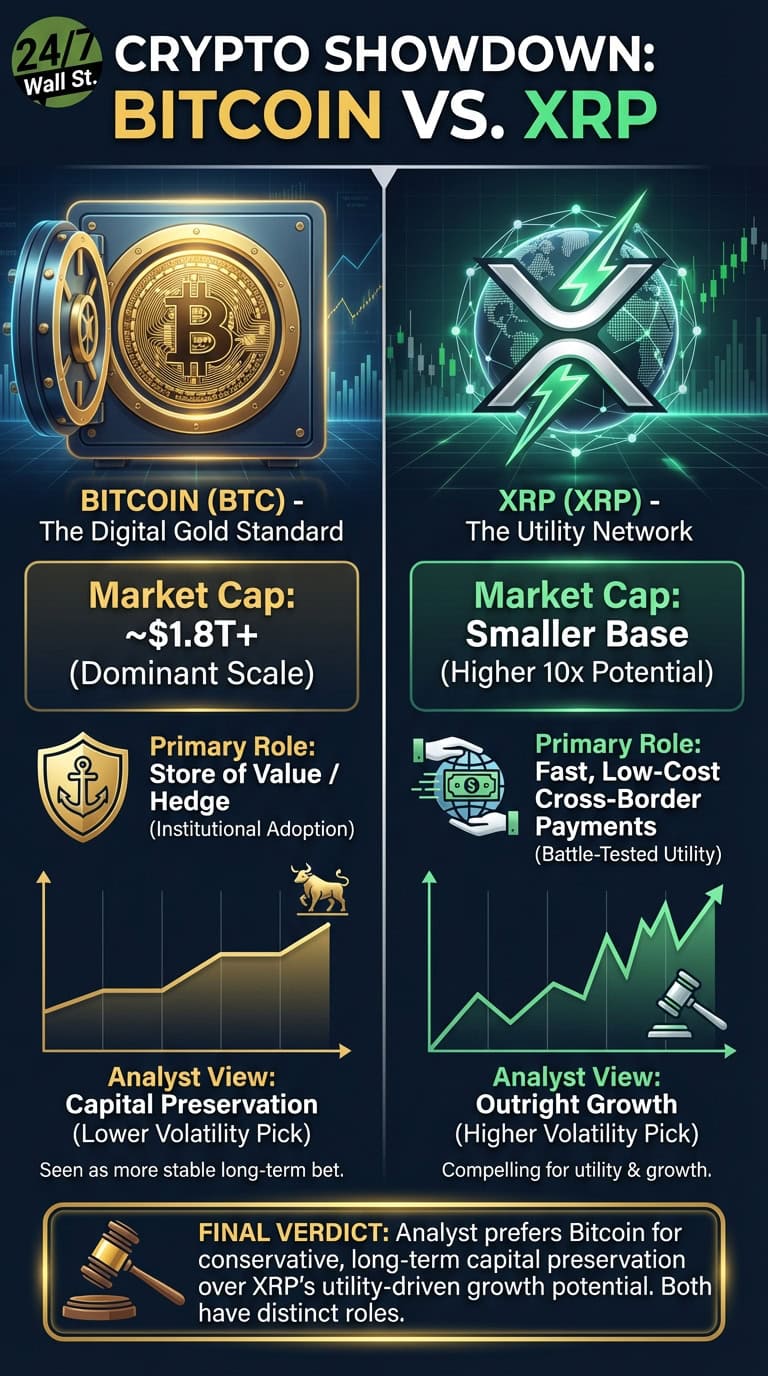
In my view, Bitcoin’s bull case is more conducive to long-term investors who may be more concerned around capital preservation over long periods of time. Indeed, the reality for the digital assets sector is that there are a number of high-profile blowups which have effectively pulled the rug out from underneath some pretty savvy investors. There are simply plenty of investors out there who won’t want to fall prey to such a situation, and given Bitcoin’s aforementioned status as a key treasury holding on many balance sheets within the U.S. economy (and even the U.S. government), there’s a broad vested interest in seeing this token continue to appreciate over time.
Despite XRP’s enhanced utility and status as a key network to “get things done,” that’s the way things stand right now in my view. As such, and being an investor who is inherently more conservative than many out there, I’m going to stick with Bitcoin as my top crypto pick for right now.
Of course, every investor’s risk tolerance preferences and investing style will differ. There are plenty of investors out there would would pick XRP over Bitcoin any day of the week (and by way of each network’s sheer size, it’s mathematically easier for XRP to 10x in value from here).
But for those looking to steer clear of as much unnecessary volatility as possible, while generating market-beating returns over time, Bitcoin still stands as my preferential pick (particularly during selloffs).