
This post was originally published on this site.
PHOENIX (AZFamily) — The U.S. and Taiwan have signed a $250 billion trade deal aimed at bolstering American chipmaking. For Arizona, the agreement could reshape the state’s economic future—and its infrastructure.
The agreement will lower reciprocal tariffs on Taiwanese goods and allow Taiwan-US facilities to import goods faster.
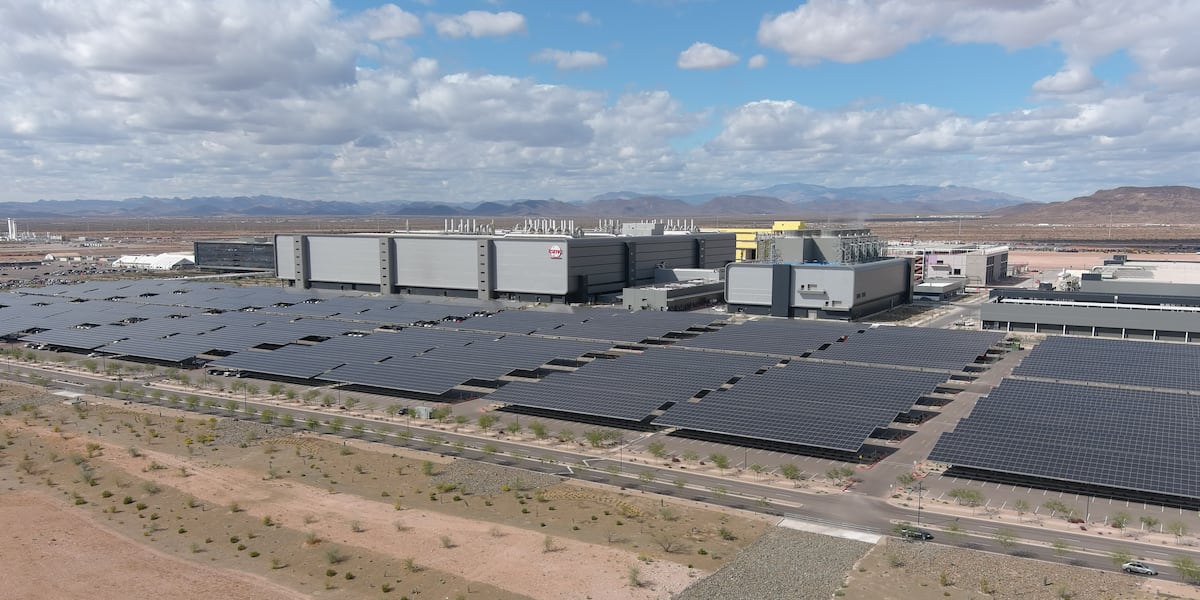
Arizona State University economist Hitendra Chaturvedi said the deal will draw international attention to the state, particularly given that Taiwan Semiconductor Manufacturing Company (TSMC)—the world’s largest chipmaker—is anchored in North Phoenix.
“Taiwan is not predicting war, but moving to the US. A lot of its fab production is its risk mitigation strategy, and Arizona is becoming its insurance strategy, in a way,” Chaturvedi said.
Arizona is already the nation’s semiconductor powerhouse. The state is home to more than 200 semiconductor companies and has invested approximately $205 billion in chipmaking—more than any other state. TSMC alone is investing $165 billion to expand chipmaking in the Valley.
Chaturvedi said the deal will only solidify Arizona’s position as the country’s front-runner in chip production.
Despite the economic boost, ASU economists don’t expect the deal to attract entirely new chipmakers to Arizona in the near term.
“Rather than creating clusters from scratch, it will mainly accelerate and enlarge existing projects,” Chaturvedi explained. “I personally don’t expect new chip companies coming in anytime soon because you already have big players like Samsung, Intel and TSMC, their ecosystem of suppliers, which includes packaging and testing that needs to be strengthened today.”
However, Chaturvedi cautioned that Arizona may not be fully prepared for this scale of growth.
Current semiconductor construction has already strained Arizona’s resources and frustrated residents. Chaturvedi warned that the coming wave of chip production will intensify pressure on the state’s water, power and housing.
“It is going to increase pressure on water, power and housing in Arizona.”
Despite these concerns, economists don’t expect state lawmakers to pause development before infrastructure improvements are in place.
“The most important thing that we need to do as a state, with the help of the central government, is to ensure that we have the water resources, the power and the housing that is needed for such a huge investment,” Chaturvedi noted.
Economists say the trade deal signals long-term growth for Arizona’s chip sector, but results will take time to materialize. For those already frustrated with construction activity in the Northwest Valley, the message is clear: today’s development is only the beginning.
See a spelling or grammatical error in our story? Please click here to report it.
Do you have a photo or video of a breaking news story? Send it to us here with a brief description.
Copyright 2026 KTVK/KPHO. All rights reserved.