
This post was originally published on this site.
President Donald Trump is generating political backlash and industry anxiety after branding the trilateral trade agreement between North American allies “irrelevant.”
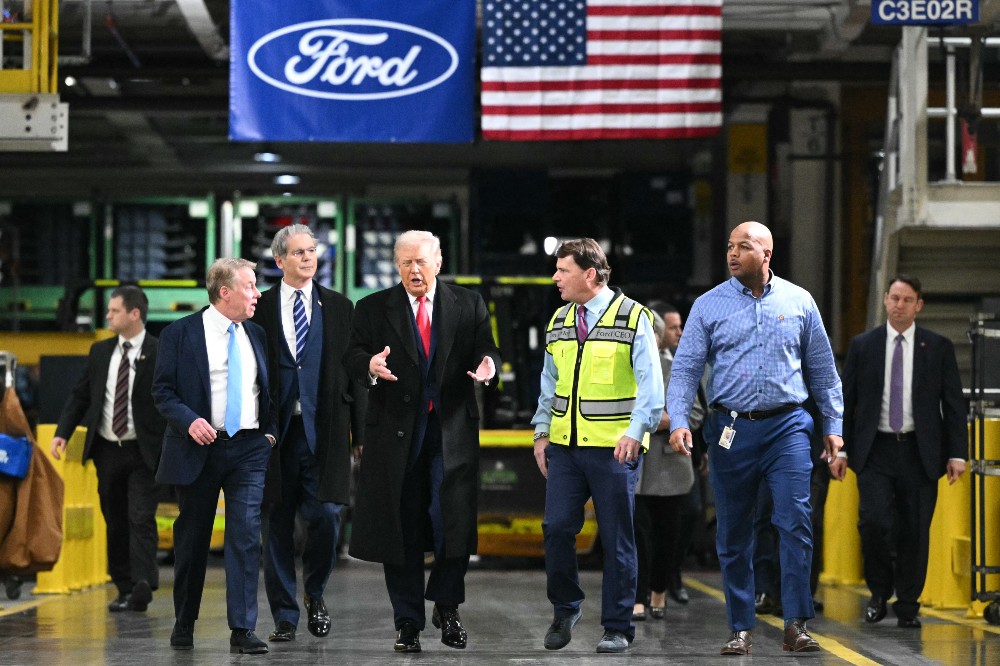
Speaking during a visit to a Ford auto plant in Dearborn, Mich. on Tuesday, Trump indicated to an audience of employees and reporters that the U.S-Mexico-Canada Agreement, which he brokered during his first term, is not a priority within his trade policy agenda.
“There’s no real advantage to it, it’s irrelevant,” he said. “Canada would love it. Canada wants it. They need it.”
“It expires very shortly and we could have it or not,” he added. “It wouldn’t matter to me. I think they want it. I don’t really care about it.”
The comments were mostly made in relation to the automotive supply chain. “The problem is, we don’t need their product. You know, we don’t need cars made in Canada. We don’t need cars made in Mexico. We want to take them here. And that’s what’s happening,” Trump added during his tour of the plant.
The auto makers, by contrast, have characterized the industry as one that has grown deeply collaborative, with partners integrated across the continent. General Motors president Mark Reuss said Tuesday that the company’s supply chain encompasses all three countries. “It’s not simple. It’s very complex. The whole North American piece of that is a big strength,” he added.
Meanwhile, textile, apparel and footwear industry groups have been lobbying in recent months for an extension of the USMCA, echoing similar sentiments.
At a hearing held by the Office of the U.S. Trade Representative last month, American Apparel and Footwear Association vice president of trade and customs policy Beth Hughes said the agreement enables the success of the regional supply chain for fashion products, “setting clear and predictable ground rules and articulating a long-term incentive structure that powers jobs, investments, and regional trade.”
National Council of Textile Organizations (NCTO) vice president of policy Katherine White applauded the Trump administration for exempting USMCA-qualifying products from the International Emergency Economic Powers Act tariffs and urged the government to maintain this exemption.
Some of the president’s political opponents challenged his dismissive statements about the trade agreement and its importance to trade in the Western Hemisphere.
Congresswoman Rosa DeLauro (D-Conn.) criticized the president for not prioritizing the renegotiation of the bill as it comes up for joint “sunset” review in July. If extended, USMCA will remain in place for 16 years, but Trump has repeatedly threatened to pull out of the pact as tensions have flared with Mexican and especially Canadian leadership over the past 12 months.
“I led 104 Democratic members of Congress in urging renegotiation of USMCA because it is failing American workers. President Trump’s claims that it is ‘irrelevant’ show that he remains in the pockets of big business which is happy with the status quo,” she said.
USMCA—which Trump once referred to as “historic” and “the best deal ever”—has exacerbated trade imbalances and undermined American industry,” DeLauro asserted.
“Since enactment of the USMCA, multinational corporations have continued to use the threat of offshoring as leverage wielded against workers standing up for dignity on the job and a share of the profits generated by their hard work—and far too often, enabled by our trade deals, companies have acted on these threats,” she said.
According to data from the Economic Policy Institute, the trade gap between the U.S. and its neighbors has widened significantly, reaching $263 billion in 2025, up from $125 billion in 2020. Despite the president’s stated aim of ushering in an American manufacturing renaissance, producers in the U.S. furloughed over 576,000 jobs since the agreement was signed into law. The nonpartisan think tank asserted that Mexico’s low wages and laxer worker rights laws and environmental standards have facilitated the offshoring of jobs.
“If President Trump does not commit to renegotiating USMCA in a bipartisan fashion to strengthen worker protections, American workers will continue to pay the price,” DeLauro said.
However, Trump has backed away from talks with Mexican and Canadian leaders about the future of the USMCA, and the talks have all but stalled.
The president has doubled down on rhetoric surrounding potential military action against Mexico’s drug cartels recently, especially in the wake of the operation that saw Venezuelan leader Nicolas Maduro abducted and put on trial in the U.S. Mexican President Claudia Sheinbaum reportedly spoke to Trump by phone on Monday and rejected his offer to send troops into Mexico to engage with the cartels, seeking instead to emphasize the success of joint U.S.-Mexico efforts to curb the smuggling of fentanyl across the border.
Trump’s trade policy throughout his second term in office has revolved around invoking sanctions, like tariffs, rather than striking mutually beneficial deals with trade partners, and he appears wholly focused on defending the strategy as it faces scrutiny by the Supreme Court. A decision on the fate of the tariffs could have come Wednesday, but the day came and went without a ruling.
According to Trump, the duties have helped alleviate deep trade imbalances. Last week, he wrote on Truth Social that the U.S. trade deficit has decreased, hitting its lowest level since 2009. The nation’s gross domestic product (GDP) is projected to come in at over 5 percent, he claimed. On Wednesday, however, the Federal Reserve Bank of Atlanta’s GDPNow forecast for Q4 2025 was updated with a 2.1 percent growth estimate.
“These incredible numbers, and the unprecedented SUCCESS of our Country, are a direct result of TARIFFS, which have rescued our Economy and National Security,” Trump wrote.