
This post was originally published on this site.
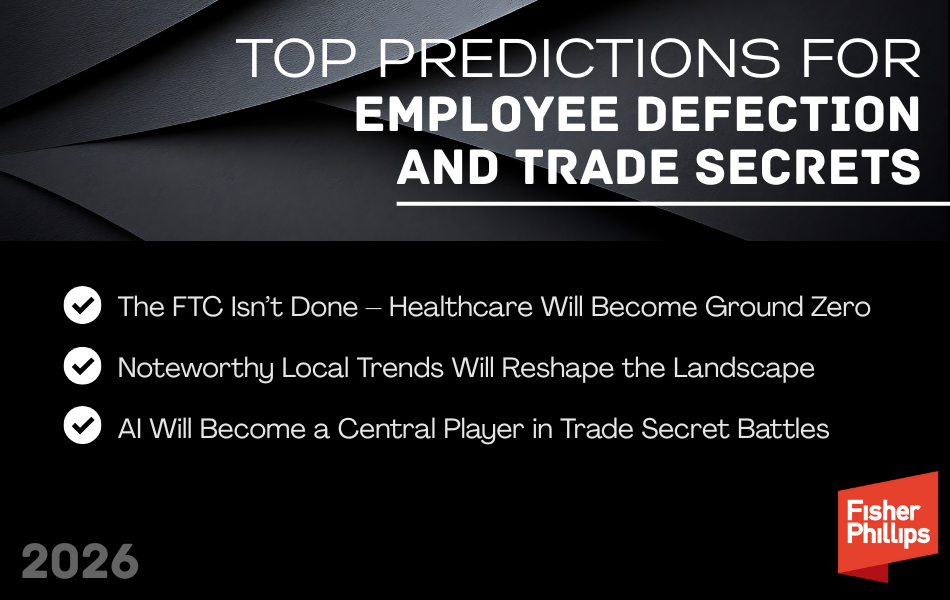
Our Employee Defection and Trade Secrets thought leaders have pulled together their top predictions for the new year so that employers can get a running start to 2026. If you want more, register for our FP Forecast 2026 Webinar here.
The FTC Isn’t Done – Healthcare Will Become Ground Zero
Even with a scaled-back agenda, the FTC will target non-competes and mobility-restricting agreements in healthcare, including B2B no-hire arrangements. Expect more enforcement actions focusing on competition in the labor market even without a federal non-compete ban.
Noteworthy Local Trends Will Reshape the Landscape
2026 will bring major local developments that create real compliance headaches for multi-state employers:
- Florida’s CHOICE Act will produce its first mandatory injunctions, raising fights over how federal courts apply state substantive law versus federal procedure.
- New York City will ban non-competes, setting up a jurisdictional clash with the state legislature.
- California courts will clarify the reach of its non-compete ban and confirm that California employers can still enforce lawful restrictive covenants in other states where they’re permitted.
AI Will Become a Central Player in Trade Secret Battles
Trade secret litigation will increasingly revolve around AI systems. We’ll see AI notetaker transcripts, voice records, and auto-summaries will become critical discovery material. Employees departing with custom AI agents or model-trained assets will give rise to new misappropriation claims. And courts will wrestle with ownership questions involving model weights, training sets, and AI-generated engineering artifacts. This means employers will need stronger controls around AI-enabled workflows, clearer IP assignments, and updated exit protocols.
Conclusion
We will continue to monitor developments related to all aspects of workplace safety law. Make sure you are subscribed to Fisher Phillips’ Insight System to get the most up-to-date information. If you have questions, contact your Fisher Phillips attorney, the authors of this Insight, or any member of our Employee Defection and Trade Secrets Team.