
This post was originally published on this site.
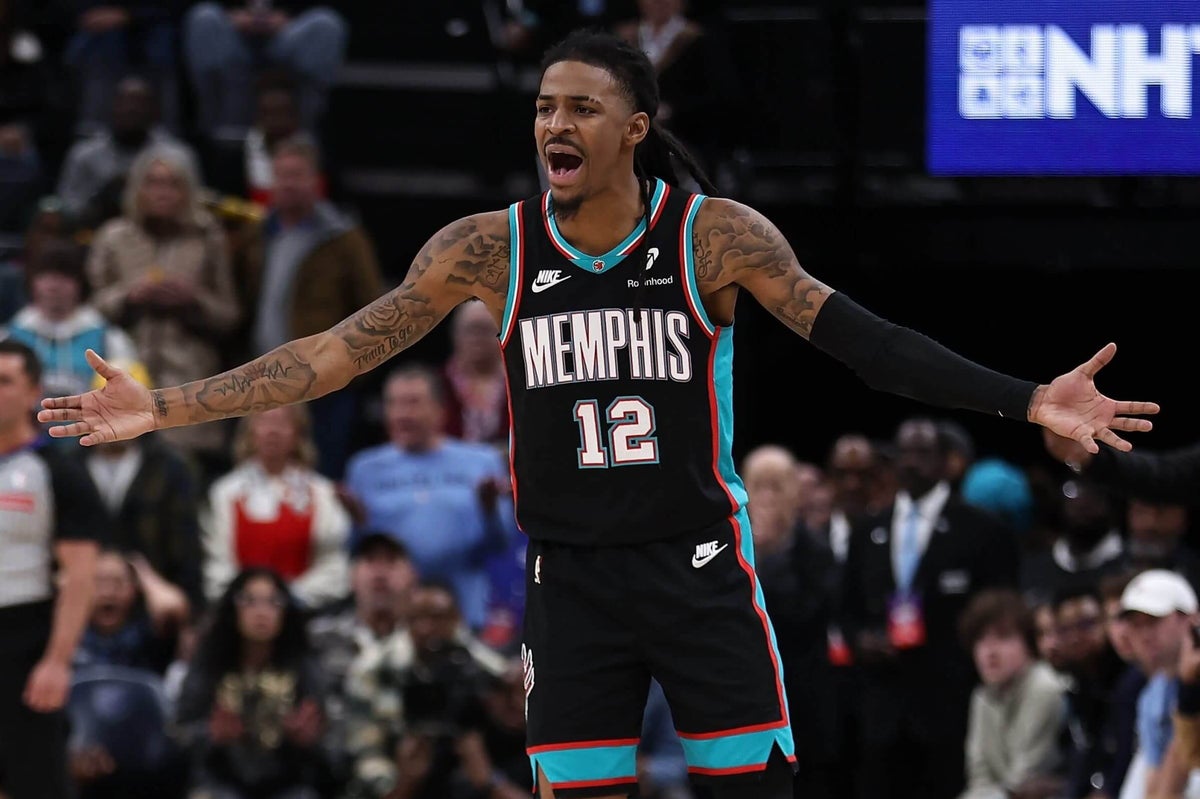
Sooner or later, the Ja Morant era in Memphis feels like it’s hurtling toward a conclusion.
League sources have confirmed to The Athletic that, for the first time, the Grizzlies are open and willing to listen to trade offers for their mercurial star guard, a player who is in the midst of a down three-year stretch after a meteoric start to his career. Morant made second-team All-NBA in 2022 and then was on his way to a similar result in 2023 before being suspended for conduct detrimental to his team after an Instagram video showed him with a firearm in a Denver nightclub.
Advertisement
Because of that suspension, Morant missed making the All-NBA team. He was the top vote-getting guard not to make the teams before All-NBA voting became positionless. In the end, it cost Morant $40 million and locked his extension into five years at $197 million, rather than the Rose rule max of five years at $237 million.
From there, things fell further off the rails. Morant was suspended for 25 games at the start of the 2023-24 season for conduct detrimental to the league. He only played nine games after a shoulder injury ended his season.
Last season, Morant played in only 50 games due to an AC joint sprain in his shoulder and an early-season hip injury. He then injured his hip again in the playoffs against Oklahoma City, missing the second half of Game 3 and all of Game 4.
Then this season, he has dealt with a calf injury and has only played in 18 games. Since 2021-22, the most games Morant has played in a season is 61, meaning he’s likely to miss 20 or so games or more per season.
On top of that, Morant’s jump shot has abandoned him.
Over the last three years, he has made just 28.6 percent of his 3-pointers, including 20.8 percent this season. He’s averaging fewer points per shot attempt on jumpers than any of the 275 players league-wide to have taken at least 70 this season, per Synergy. It’s also worth noting that Morant isn’t precisely a high-end defender as a more undersized, skinny guard, though his presence hasn’t stopped the Grizzlies from putting strong defenses on the court.
However, the thing about Morant that might make people buy into a turnaround is that he hasn’t lost much of the burst or athleticism that made him so special in the first place. He’s still quick with the ball in his hands and can rise to finish, although his finishing at the basket this season has been relatively poor.
Advertisement
His floater game is still on point, and his passing ability is dynamic, with live-dribble looks getting kicked out from myriad angles to open shooters.
The first question about Morant’s value to another team comes down to what they think of his scoring. Does another team believe that they can get his jumper back to the levels it was at before his shoulder injury?
If that’s the case, it could open up the rest of his offensive skills package again and make him one of the league’s most dynamic offensive guards. The second question involves conducting due diligence on Morant off the court, ensuring his head is in the right space, and that he’ll do the right things, given his track record of suspensions.
Indeed, there seems to have been an easy, comparable trade this week.
The Atlanta Hawks traded Trae Young for C.J. McCollum and Corey Kispert. It’s a deal I came close to projecting, getting the player structure right and slightly missing on the pick compensation, while also believing the Hawks would get something like the 30th, 45th and 50th overall picks in return for sending Young to Washington. Not a ton of draft capital, but I thought they would get a small amount.
However, I do think there are two leverage points here that change the calculus on the asset compensation that could be involved in a Morant deal compared to a Young deal. First, the Grizzlies are not under the same level of contractual pressure with Morant as the Hawks were with Young.
Young had a player option this summer to decline and become a free agent, meaning he could have left for nothing. The Grizzlies have two years left after this one on Morant’s deal, where he’s set to make $42.2 million next season and $44.9 million in 2027-28. They can be patient and take this into the offseason if required, which makes me think that an in-season deal would involve them receiving more than what people expect.
Advertisement
The Grizzlies are shifting in a different organizational direction than the Hawks. Atlanta had the potential in a Young deal to open up a lot of cap space this summer by moving him for an expiring salary, and it didn’t want to risk him picking up his $49 million player option.
Again, that meant the Hawks were incentivized to move him for cheaper asset capital. The Hawks are also still trying to make the playoffs. I don’t think the Grizzlies will be as incentivized to do that this season. They will likely be interested in losing games and getting into the top end of the lottery if they can.
Also, I would bet the Grizzlies are more willing to take back bad money themselves in return for draft pick capital. Maximizing assets will be the key, rather than maximizing flexibility.
Because he has a bit more team control, because the Grizzlies aren’t forced to move him, and because I would bet that they’re willing to take on more long-term money than Atlanta was, I would expect Morant to be traded for more asset capital than what Young was. It might involve taking back bad contracts, but I do sense a bit more enthusiasm among league sources about what Morant could return, compared to Young.
So what deals make sense for Memphis to explore? Let’s take a look.
Raptors make a move
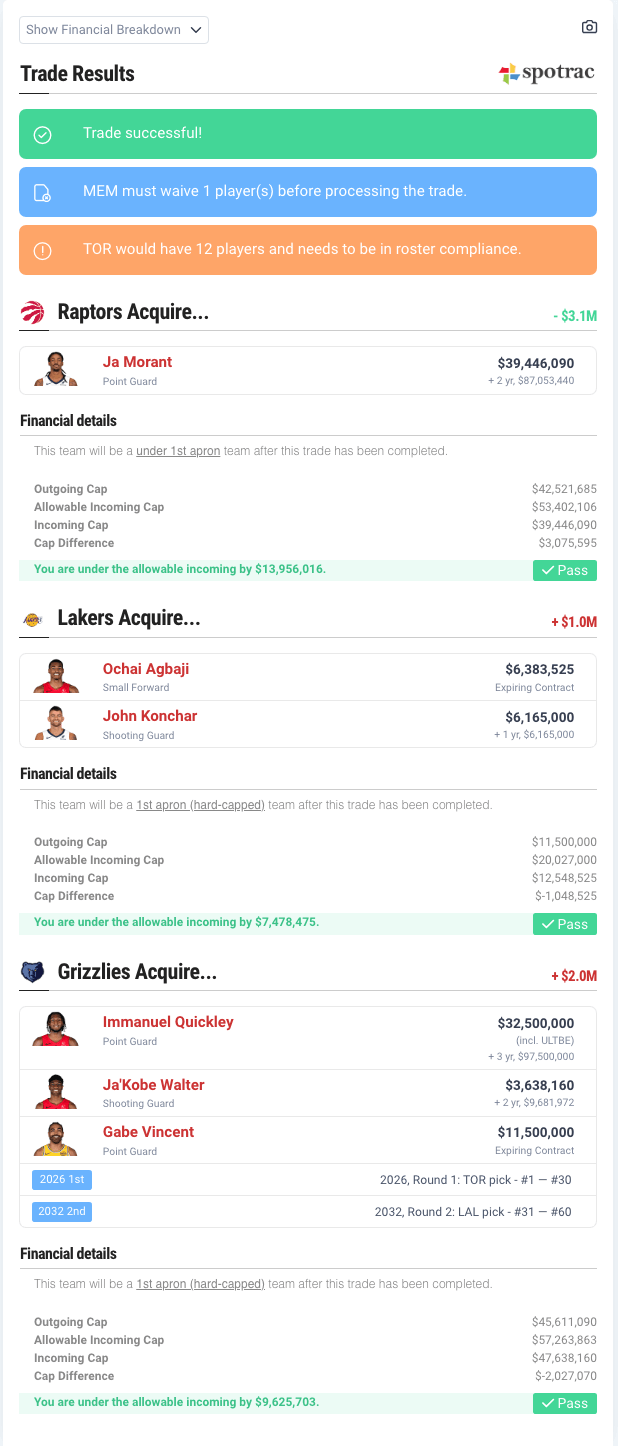
Raptors receive: Morant
Grizzlies receive: Immanuel Quickley, Ja’Kobe Walter, Gabe Vincent, 2026 Toronto first-round pick, 2032 Lakers second-round pick
Lakers receive: Ochai Agbaji and John Konchar
Why the Raptors do this: The Raptors’ biggest recent mistake has been overpaying for Quickley, a solid player and worthy starting point guard who is making too much money for what he brings to the table.
Typically, players who average about 16 points, six assists and shoot at a true-shooting percentage just slightly below league average tend to make about $15 to $20 million, not the $32.5 million that Quickley is slated to make in each of the next three years after this one.
Advertisement
By flipping Quickley for Morant, the Raptors get off of an extra year of high-end point guard money in the worst-case scenario where it doesn’t work out with Morant on the court.
In a year, if the Morant experiment hasn’t worked out, the Raptors will increase their flexibility because Morant’s contract will expire a year sooner than Quickley’s, making him an easier trade chip to move. More importantly, they also get a much higher upside swing at the guard spot if they can get Morant right.
The Raptors need more half-court shot creation around Brandon Ingram and Scottie Barnes, and Morant can provide it. Particularly, the starting lineup hasn’t had a passer at the guard position quite like Morant since Kyle Lowry left Toronto.
This is the kind of consolidation star trade that continues to give the Raptors flexibility moving forward, potentially even allowing them to make another one down the road, regardless of whether Morant works out.
If he works out, they could use R.J. Barrett’s money as salary matching in another deal to get another star. If not, they have his contract expiring in the summer of 2027. They would also have their full complement of first-round picks to trade after the draft in June. To do so, the team gives up its 2026 first-round pick, a selection that will probably end up somewhere in the No. 16 to 22 range, and Walter.
The former Baylor wing has shown flashes as a floor-spacer. He had a solid close to his rookie season, but this season hasn’t shot it well. In his last 17 games, he’s made just 31.1 percent from 3. But during the previous 14, he’d made 46.2 percent from 3. He needs to even out his streakiness for a team to capitalize on his solid defensive play on the wing. However, he’s a worthwhile, cheap project for Memphis.
It’s worth noting that this deal gets the Raptors out of the luxury tax and far enough away that they can fill their roster spots for the rest of the year without going over the tax. This deal increases the team’s flexibility, increases its upside when fully healthy and does so without giving up an immense amount of value.
Advertisement
Why the Grizzlies do this: I bet that the Grizzlies will be willing to take on some money to get value in a Morant deal. While Quickley isn’t worth his contract, he is still a solid enough player who could help the team grow and develop as they enter this new phase.
With several young wings and bigs such as Cedric Coward, Zach Edey, Cam Spencer, Jaylen Wells and others, the team should still want quality point guard play. Quickley, Ty Jerome and Scotty Pippen Jr. should provide that.
To take back the Quickley money, they get the flier on Walter and a third first-round pick this year, as an organization that has drafted well in a class seen as strong. The Lakers also send them a second-rounder in 2032 to add to their asset cache.
From a pure asset perspective, I’m not sure the Grizzlies will do much better than that in a Morant deal, and it’s because they’re willing to take back what’s widely seen as one of the league’s least valuable contracts.
Why the Lakers do this: With the Lakers’ limited assets and a seeming desire to try to hold onto their own first-round picks, their options to shore up the wing position with more athleticism and defense are limited.
In this deal, they pay only a second to Memphis to be able to get Agbaji and Konchar, both of whom are at least end-of-rotation players with athleticism.
For some reason, Agbaji’s shooting has abandoned him this season. Still, after hitting 40 percent from 3 last season, he’s a reasonable reclamation project for a team with limited trade resources that needs to make a deal.
Konchar is a typical 10th man, but would give the Lakers a smart player and a bit more depth with his wing experience, which they need. They’re doing what they can to reshape the roster while not limiting their ability to make another deal using Maxi Kleber’s and Rui Hachimura’s expiring money.
Advertisement
Heat take a shot on Morant
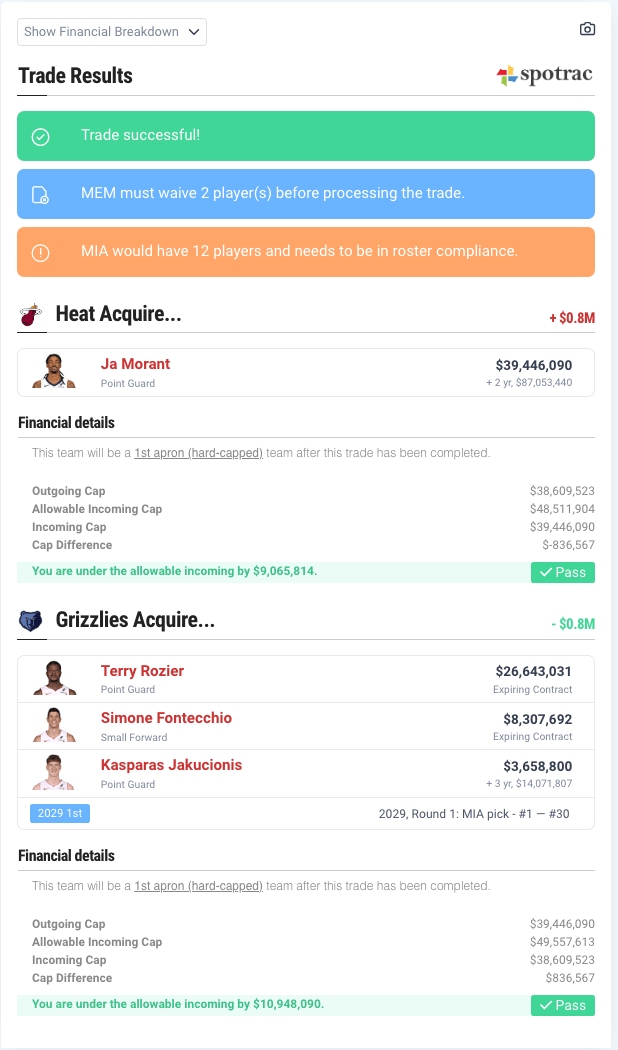
Heat receive: Morant
Grizzlies receive: Terry Rozier, Simone Fontecchio, Kasparas Jakučionis, 2029 Heat lottery-protected first-round pick (becomes two seconds in 2030)
Why the Heat do this: With a top-10 defense in the league, the Heat need more offensive firepower. Morant would bring that if he’s at his best. He’s a dynamic athlete who is terrific at playing in ball-screens and making decisions.
However, would the Heat offense excel with Morant, given that he’s coming from playing within a low-ball-screen, Noah LaRoche-led offensive scheme centered on pace, movement and flowing principles, rather than relying on a high number of screens? While I enjoy watching the LaRoche offense for its pace of play and quick decision-making, I’m not sure it’s proven itself enough at the NBA level to justify continuing rather than acquiring star-level talent.
The key here is the price point, though. This isn’t a large amount of value to give up for the potential swing that is Morant. Rozier, whose time in the NBA feels tenuous, is on an expiring deal, essentially. Fontecchio has shot it well from 3 this season, but that’s it.
Jakučionis and the first rounder are the value adds. The former Illinois guard is a skilled player that I liked a lot entering the draft, who I think would blend well in Memphis. However, his athletic concerns have been exacerbated at the NBA level, as he’s struggled to get any penetration off the bounce.
I would also note that I’m skeptical of his fit in an offense that doesn’t run a high ball-screen rate, meaning that if Miami is going to continue playing the LaRoche scheme, I don’t think he fits the Heat all that well.
Because Jakučionis doesn’t have the juice to beat his man off the bounce in isolation and can sometimes struggle to maintain his advantages off the catch, he needs screens to get loose. The 2029 first-rounder would be frustrating to give up, as the Heat will be opening up this summer to deal three first-rounders in a potential star trade, but maybe the juice is worth the squeeze here for them to take a flier on Morant.
Advertisement
Speaking of that future trade flexibility, I think a deal like this keeps the Heat in the game for a potential Giannis Antetokounmpo deal if the Milwaukee Bucks decide to move him at some point this summer.
With a potentially expiring Tyler Herro deal if the Bucks want to bring the former Wisconsin native home, Miami still has the salary flexibility to make a move.
Then, the Heat maintain their best young assets in Kel’el Ware, Pelle Larsson, Nikola Jović and Jaime Jaquez Jr. to add as potential enticements in a deal for Antetokounmpo. I’m not convinced that the Heat have the best package of assets in a potential Antetokounmpo deal anyway.
However, if Antetokounmpo were to force the Heat’s hand, they have enough assets to put together a package that could be interesting. I’d at least be interested in a Morant, Antetokounmpo, Adebayo core, especially if they could retain Norman Powell in free agency.
Why the Grizzlies do it: This is more of a flexibility-and-assets deal than the Raptors could offer to take Quickley, though I don’t know the assets are quite as good here.
The Rozier and Fontecchio deals would erase about $33 million from the Grizzlies’ books this offseason, and they’d do so while adding an interesting young player in Jakučionis who fits the Grizzlies archetype of high-IQ players who can dribble, pass and shoot, while also getting a future first-round pick.
It’s not a monster deal, but it’s not awful, given there are teams around the league who see Morant as being a negative asset.
Clippers get their long-term point guard
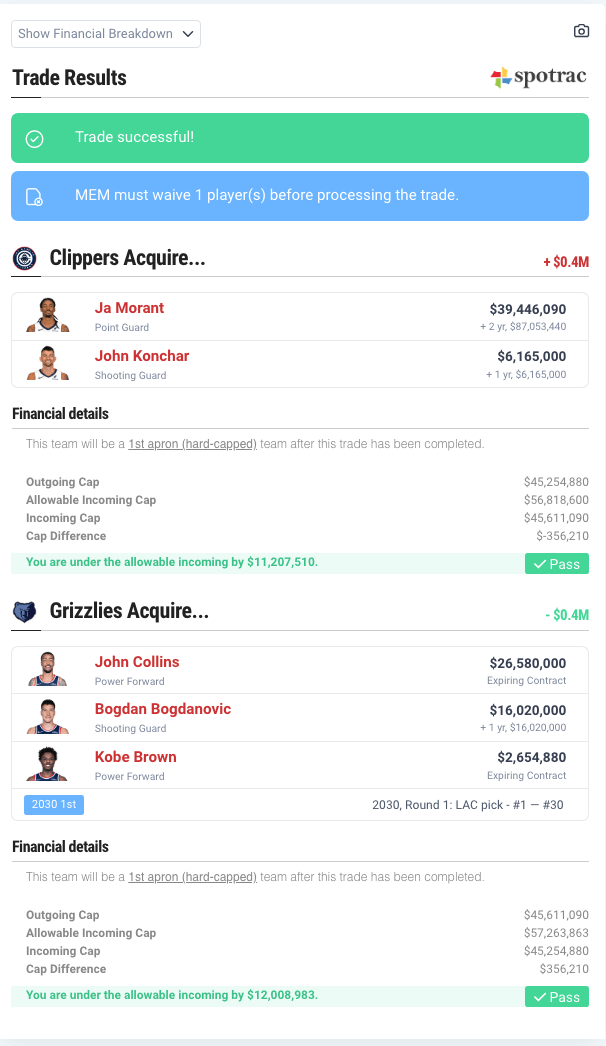
Clippers receive: Morant, Konchar
Grizzlies receive: John Collins, Bogdan Bogdanović, Kobe Brown, 2030 lottery-protected Clippers’ first
Why the Clippers do this: The Clippers can set up their long-term answer at point guard for after James Harden retires. The Clippers will likely have significant cap space in the summer of 2027, with only Ivica Zubac’s $21 million locked in on their books. This would add Morant to the books at $44.9 million, leaving them with only about $66 million on the books entering free agency.
Advertisement
The team could try to sign Kawhi Leonard for around $50 million if he’s still worth that much, while maintaining $45 million-plus in cap space. Or the Clippers could retain only Morant with Zubac and be in the market for stars who become available. Or, if the time is right, they could look to move on from Morant in a trade when his deal becomes an expiring contract.
This season, LA’s offense falls off a cliff when Harden leaves the court. Per Databallr, when Harden is on the court, the Clippers put up an offensive rating of 121.2. That would be equivalent to the fifth-best offense in the NBA this season.
When he’s off the court, they put up an offensive rating of 106.5, a number that would be dead last in the NBA by more than two points per 100 possessions. By acquiring Morant and staggering him with Harden, the team would have a competent point guard on the floor at all times and could make the Play-In Tournament.
Yes, the fit with Harden is not ideal by any stretch when they’re both on the court. However, Harden can hit free agency after this season, and working toward the long term might make more sense for the Clippers while also shoring up a short-term issue.
With Steve Ballmer’s money, what is reputed to be the best medical team in the NBA, a well-respected front office, a new high-end arena and a sunny greater-Los Angeles zip code, the Clippers could easily pivot into a positive situation if they acquire Morant.
Why the Grizzlies do this: This is essentially the same deal that I gave for Young. The idea for the Grizzlies would be increased flexibility through expiring salary plus a draft pick.
I think this figures to be on the lower end of what the Grizzlies would look to get in a Morant trade in terms of assets coming back, as the Clippers don’t have all that much bad money to send back.
Advertisement
One name worth noting that I would look to acquire if I were the Grizzlies is Kobe Sanders, who I think has a case as one of the most valuable two-way contracts in the league right now as a 6-foot-8 guard who is defending well and has some dribble, pass and shooting. But I don’t know that I would be all that excited about trading him if I were the Clippers.
Other teams to note
• Maybe the Bucks could look at Morant as a last-chance type of player for the Giannis era. Still, I’m skeptical that Morant is the kind of player they should invest in, even if the price point is only Kyle Kuzma, Kevin Porter Jr., and Gary Harris with the Bucks’ lone remaining 2031 first-round pick that can be traded.
• The Sacramento Kings should not be investing in players such as Morant right now. They do have some bad money that they could send back to the Grizzlies if they were willing to trade positive assets, but that feels like they’d just be rearranging deck chairs on the Titanic. This should be a deal they pass on.
• Much like with Young, the Minnesota Timberwolves will be mentioned every time a point guard comes up. However, much like with Young, I’m skeptical that moving Julius Randle or a combination of Naz Reid, Mike Conley, Rob Dillingham, and one of the team’s young minimum-salaried players makes sense for them. I’m also skeptical that the Grizzlies would have interest in valuing Dillingham as an asset.