
This post was originally published on this site.
The NBA trade deadline is closing in — it’s at 3 p.m. ET on Thursday — and we finally have some trades.
We’re grading every deal up until the deadline, breaking down the ramifications for all teams and players involved. Let’s get into the latest move:
What this means for Warriors: Porzingis fills Golden State’s longstanding desire for a stretch 5 who can also protect the rim. It was a logical enough fit that I essentially included this exact swap as part of a multiteam Anthony Davis trade proposal in December.
But the Warriors’ needs have changed significantly since then due to Jimmy Butler III‘s season-ending ACL injury. I’m no longer convinced center was the right place to address at the expense of wing depth.
Kuminga was the most natural replacement for Butler on Golden State’s roster. He scored 30 points in as many minutes in extended playing time after Butler’s injury, only to suffer a bone bruise that sidelined him for his final five games before the trade. Without Butler and Kuminga, the Warriors now have only Gui Santos as a wing taller than 6-foot-5.
Beyond that, Kuminga was also one of Golden State’s best options for generating offense with Stephen Curry on the bench. Warriors lineups without both Butler and Curry have ranked in the fifth percentile leaguewide in offensive rating, per Cleaning the Glass.
It’s possible Porzingis could help solve the latter issue. Posting him up against smaller defenders has become a reliable source of offense that requires only adequate spacing to generate. The question is how much Golden State can count on having Porzingis available.
Porzingis hasn’t played since Jan. 7 because of Achilles tendinitis and has also sat out time this season because of a recurrence of symptoms associated with postural orthostatic tachycardia syndrome (POTS), a nervous system disorder he was diagnosed with last summer. In total, Porzingis played only 17 of a total 52 games during his brief stint with Atlanta.
Already down a roster spot because of Butler’s injury and with one of the league’s oldest rosters, the Warriors aren’t ideally positioned to manage the time Porzingis can reasonably be expected to sit out.
Of course, with Butler’s injury making a deep playoff run unlikely, the bigger ramification of this trade is how it affects Golden State’s pursuit of Giannis Antetokounmpo. Team sources told ESPN’s Anthony Slater that it unofficially ends those efforts this season by virtue of removing an important possible matching salary.
If the Antetokounmpo saga continues this summer, the Warriors can certainly get back in the mix. Porzingis could be included via sign-and-trade to help match salary, or Golden State could adjust its offer to include Butler instead. Still, the path to acquiring Antetokounmpo isn’t quite as clean as using Kuminga as an expiring contract either this season or over the summer by exercising his $24.3 million team option.
It appears the Warriors had reached the point where they just couldn’t wait out an unhappy relationship with Kuminga any longer. They also achieved some modest savings by sending out Hield, who had slumped to a career-low 34% from 3-point range this season. Some $3 million of Hield’s 2026-27 salary is guaranteed if he’s waived by the day after the 2026 draft.
What this means for Hawks: I liked Atlanta’s summer deal to add Porzingis given how well he would fit with Trae Young. Seven months later, neither player finished the season with the Hawks. NBA life comes at you fast.
There was certainly still a role for Porzingis to play in Atlanta, but it’s understandable they’d want to move on in favor of Kuminga, who’s seven years younger. Although forward wasn’t a glaring need for the Hawks, Kuminga’s power game is a useful dimension for an Atlanta roster that’s more built on finesse.
In particular, the Hawks can benefit from Kuminga getting to the free throw line. They rank 29th in free throw rate and have only one player (All-Star Jalen Johnson) averaging more than five attempts. Kuminga averaged five in just 24.3 minutes during 2024-25, and his upside has always been as a Corey Maggette-style bruiser who can compensate for his poor 3-point shooting by getting to the line.
The contract Kuminga ended up signing after a protracted restricted free agency standoff with the Golden State was surely attractive to Atlanta, which now gets to decide on the $24.3 million team option. The Hawks can choose between having more cap space than the non-taxpayer midlevel exception or picking up Kuminga’s option, staying over the cap and having the midlevel available to add frontcourt depth.
Hield’s fit is less clear with an Atlanta team that already has two similar shooting specialists in Luke Kennard and Corey Kispert, both of whom have been more accurate from 3-point range this season. It’s possible the Hawks could seek to reroute Hield before Thursday’s deadline.



Toronto Raptors get: Chris Paul
Brooklyn Nets get: Ochai Agbaji, second-round pick, cash
LA Clippers get: draft rights to Vanja Marinkovic
Grade for Toronto: B
What it means for the Raptors: Let’s start with what it doesn’t: Alas, Chris Paul is not wrapping up his career north of the border. ESPN’s Shams Charania reported that Toronto won’t require Paul to report to the team and will look to re-trade his salary prior to the deadline.
Essentially, the Raptors were close enough to the luxury tax line (less than $1 million over, pending incentives for multiple players) that they still had wiggle room after moving Agbaji’s $6.4 million salary and used it to get cash from the Clippers to take on Paul’s minimum contract.
After starting 45 games in 2024-25, Agbaji has been unable to buy a 3-pointer this season. He has shot 18.5% (12-of-65), less than half of last season’s 40% mark. That made Agbaji, who has played just eight minutes total in Toronto’s past three games, more expendable than the team’s younger or more effective players on minimum contracts.
The Raptors could still take on a little more salary before the deadline if they want to add a contributor.
Grade for Brooklyn: B
What it means for the Nets: This is the start of Brooklyn using its position as the only NBA team with appreciable cap space to take on contracts for draft picks. Getting Agbaji leaves the Nets about $9 million below the cap, now less than teams can add using the taxpayer midlevel exception, though they could take on a bigger contract by sending back a smaller one (such as Agbaji’s) or exhaust their space and then use their room midlevel exception to add more salary.
Brooklyn will have to waive a player to create the roster spot for Agbaji.
Grade for LA: A
What it means for the Clippers: A Paul trade was one of the most inevitable outcomes prior to the deadline. He was sent home by the Clippers in December and their tax situation meant waiving Paul made no sense.
From that standpoint, getting out of Paul’s contract without having to give up any precious draft picks was a win for the Clippers. We’ll see if they have any bigger moves coming before the deadline. Barring that, they’ve created a second roster spot and enough room below a hard cap at the lower luxury tax apron to promote both Jordan Miller and Kobe Sanders from two-way contracts — necessary with both playing key rotation roles in the wake of Paul leaving the team.


Magic send Tyus Jones to Hornets
Charlotte Hornets get: G Tyus Jones, 2027 second-round pick (least favorable of BOS or ORL), 2028 second-round pick
Orlando Magic get: Cash considerations
Grade for Charlotte: A
What this means for Hornets: Charlotte offered fans on both sides of Tobacco Road something to like Wednesday, adding Duke legend Jones hours after trading for North Carolina product Coby White. Both players can help the Hornets’ backcourt depth behind LaMelo Ball.
It was a tough run with the Magic for Jones, who shot a career-low 34% and fell to the fringes of Jamahl Mosley’s rotation. Charlotte is wise to bet on a bounce-back given Jones shot 45% overall and 41% from 3 for the Phoenix Suns in 2024-25. He remains one of the league’s most reliable ball handlers, committing only 14 turnovers in 754 minutes in Orlando.
With Ball and White, the Hornets might not need Jones to play a rotation role when at full strength. He’s overqualified as a third point guard, and the price was right for Charlotte, which acquired a pair of second-round picks to offset the two the team lost in the White deal.
Clearing a roster spot was also no issue for the Hornets, who waived Pat Connaughton to facilitate this move. Connaughton, acquired in a salary-related move last summer, made more headlines for his blond hair this week (the result of a fantasy football wager) than during 155 minutes in Charlotte.
Grade for Orlando: C
What this means for Magic: Granting that one of the two picks in this trade (the least favorable of Boston’s and Orlando’s in 2027) is unlikely to hold much value, I’m surprised it cost Orlando two picks to get off of Jones’ modest $7 million salary relative to similar deals this week.
The Toronto Raptors needed only one second-rounder and cash to move Ochai Agbaji, and two second-rounders got the Cleveland Cavaliers out of Lonzo Ball‘s larger salary and created massive tax savings.
That noted, paying the tax was surely a nonstarter for the Magic, who have dropped to 25-24 after losing six of their past seven games. And Jones was probably the right player to move given his poor play and rookie Jase Richardson‘s emergence as a viable option for backup point guard minutes.



Utah Jazz get: Lonzo Ball, cash considerations, two second-round picks
Atlanta Hawks get: Jock Landale
Cleveland Cavaliers get: Cash considerations
Grade for Cleveland: B+
What it means for the Cavaliers: Another $50 million in luxury tax payments saved, taking their total savings since last weekend to approximately $100 million, per ESPN’s Bobby Marks.
I liked Cleveland adding Ball in exchange for Isaac Okoro last summer, but his shooting never made the trip to northeast Ohio. Ball shot a career-low 27% on 3s, down from not only the 39% he made during his three prime seasons but also the 34% he hit coming back from multiple knee surgeries in 2024-25.
Given that Ball almost never gets easy shots around the basket anymore (his average shot distance has been around the 3-point line the past two seasons, according to Basketball Reference), it was difficult for Kenny Atkinson to keep him on the court. And with the Cavaliers adding guards Keon Ellis and Dennis Schroder, Ball’s role was only likely to shrink.
From that standpoint, saving $50 million for two second-round picks is strong business for Cleveland. It’s worth noting, however, that after including a second-rounder in the Darius Garland–James Harden swap, the Cavaliers no longer have any to trade until after the 2026 draft is complete.
Grade for Utah: B
What it means for the Jazz: Despite adding massive salary in Tuesday’s trade to acquire Jaren Jackson Jr. from the Memphis Grizzlies, Utah was substantially below the luxury tax line and had trade exceptions to take on additional contracts. The Jazz leveraged those to add the second-round picks and will likely agree to a buyout with Ball.
It’s worth noting that if Ball is available at the minimum, his savvy at both ends of the court makes him well worth a roster spot despite the shooting woes this season. Ball bringing his career full circle by returning to the Lakers could be a fit, though he’d certainly need to shoot better to crack their rotation.
Grade for Atlanta: A
What it means for the Hawks: Atlanta has been searching for frontcourt size with Kristaps Porzingis sidelined since early January and backup center N’Faly Dante out for the rest of the season due to an ACL tear.
Enter Landale, who started 25 games for the Grizzlies this season before being included in the Jackson trade. Utah had no particular need for Landale during a lottery-bound season.
0:49
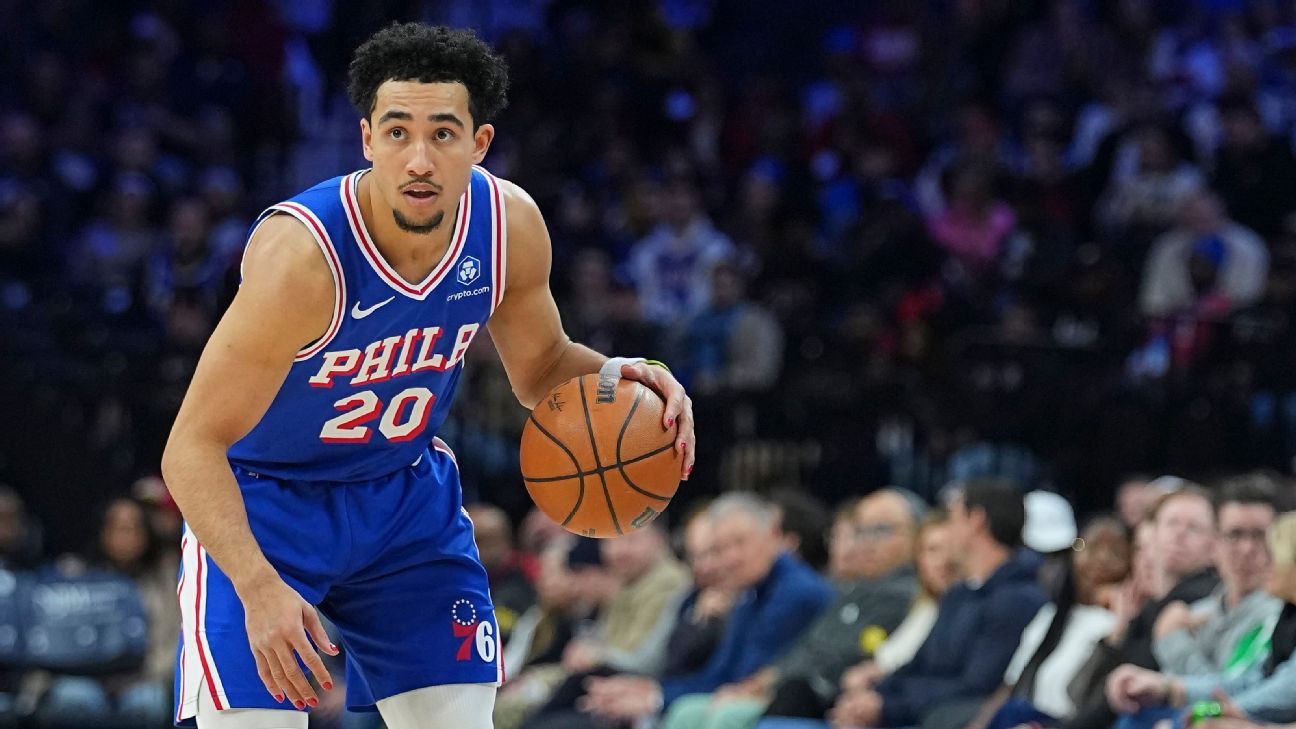
Shams: 76ers create roster room by trading Jared McCain
Shams Charania gives details of the 76ers’ trade of Jared McCain to the Thunder.


Oklahoma City Thunder get: G Jared McCain
Philadelphia 76ers get: 2026 first-round pick (from HOU), 2027 second-round pick (most favorable of picks via OKC/Houston/Indiana/Miami), two 2028 second-round picks (via OKC, Milwaukee)
Grade for Oklahoma City: B+
What this deal means for the Thunder: As usual, Oklahoma City is thinking ahead. Though this move could help the Thunder’s effort to repeat as champions — particularly if Shai Gilgeous-Alexander is sidelined beyond the All-Star break — it’s really about setting up for potential losses this summer when extensions kick in for Chet Holmgren and Jalen Williams.
The massive stockpile of draft picks in Oklahoma City means the Thunder can keep adding cheap contributors as their current stars age out of their rookie contracts. In this case, they’re turning what will likely be a first-rounder in the 20s — Houston would send the No. 26 pick if the season ended today, with wiggle room a few spots in either direction — into the 16th pick in the 2024 draft.
McCain started his NBA career on fire, averaging 15.3 points for the injury-plagued 76ers over the first 23 games of his rookie season before undergoing season-ending meniscus surgery. A thumb injury leading up to training camp set back McCain’s return to game action, and he was shooting just 35% from the field through Jan. 19.
Over the past few weeks, McCain’s shooting has perked up. He’s 15-of-26 on 3s (58%) over the past six games, an encouraging sign that he can get back to the prospect he was coming out of Duke. Back then, my draft projections had McCain in the top 10. Oklahoma City, which took Nikola Topic four picks earlier, surely scouted McCain extensively leading up to the draft.
In particular, McCain’s shooting makes him a good fit in the Thunder’s backcourt. Even with the slump to start this season, he has hit 38% career beyond the arc after shooting 41% in his lone season at Duke. After their own recent slump, Oklahoma City is down to 36% on 3s, right at league average.
For a player who is more comfortable off the ball, McCain’s stature (a listed 6-foot-3) could be an issue. That’s not the case with the Thunder, who start the 6-6 Gilgeous-Alexander at point guard and have the 6-4 Ajay Mitchell as a backup with the 6-6 Topic as a future option when he returns to the court after testicular cancer treatment.
The biggest key for Oklahoma City is likely McCain’s $4.4 million salary for 2026-27, when the Thunder currently project nearly $50 million over the luxury tax line pending team options on starters Lu Dort and Isaiah Hartenstein. If the Thunder have to cut ties with Dort, or one of wing reserves Isaiah Joe and Aaron Wiggins, McCain can step in to the rotation with experience in Oklahoma City’s system as a more readymade replacement than a 2026 first-round pick.
For this season, the Thunder staying under the tax line required them to flip Ousmane Dieng to the Charlotte Hornets with a second-round pick for veteran Mason Plumlee. Oklahoma City will surely complete that move first, then waive Plumlee to create a roster spot for McCain.
Grade for Philadelphia: B+
What it means for the 76ers: After adding VJ Edgecombe and Quentin Grimes to All-Star Tyrese Maxey in the past year, Philadelphia’s roster got crowded, part of the reason McCain hasn’t played many minutes this season. Turning McCain into draft picks not only gets Philadelphia below the luxury tax line but probably makes it easier to make additional deals, whether before Thursday’s trade deadline or this offseason.
The Sixers now have the flexibility to add some salary in deals involving their players with expiring contracts, most notably wing Kelly Oubre Jr. and Andre Drummond, without pushing back into the tax or threatening the first apron.
The other thing Philly needed to do by the deadline was create roster spots to convert the contracts of two-way players Dom Barlow and Jabari Walker. Walker hit his limit of 50 games on the active list Tuesday, per ESPN’s Bobby Marks, while Barlow is starting at power forward and would currently be ineligible for the postseason.
ESPN’s Shams Charania highlighted that down the road this deal helps in Philadelphia re-signing Grimes as an unrestricted free agent in the summer. If the 76ers make the pick, it won’t be dramatically cheaper than McCain’s 2026-27 salary, but Philadelphia could use it to fill needs at the forward spots or backup center to make bringing Grimes back less of a luxury.

Chicago Bulls get: G Collin Sexton, F Ousmane Dieng, 2029 second (least favorable of Denver/Charlotte), 2031 second (Knicks), 2031 second (Nuggets)
Charlotte Hornets get: G Coby White, G Mike Conley, 2029 second (most favorable of Hawks/Heat)
Oklahoma City Thunder get: C Mason Plumlee (waived)
Grade for Charlotte: B
What it means for the Hornets: Swapping one score-first combo guard for another. In fact, both Sexton and White are among each other’s five most similar players in the NBA this season, per my SCHOENE model.
That said, I prefer White independent of his North Carolina homecoming. At a listed 6-foot-4, he is slightly taller than the 6-3 Sexton. He’s also been the more sure-handed ballhandler historically, averaging 2.3 turnovers per 36 minutes to Sexton’s 2.9. And, at 25 for a few weeks, White is about a year younger.
Value metrics like White’s impact on team performance in Chicago. The Bulls have been at least five points per 100 possessions better on offense with White on the court three of the past four seasons according to Cleaning the Glass, with 2024-25 as the outlier. Sexton’s impact has been less consistent.
Charlotte is betting on White playing better than he has so far this season, when Sexton has been the more valuable player to date. After missing the season’s first three weeks with a calf strain, White is shooting a career-low 35% on 3s. He has hit at a 37.5% clip over the previous four, which is likely a better gauge of his true talent. And since Jan. 18, White is over 40% beyond the arc.
With $50 million-plus in float below the 2026-27 luxury tax line, the Hornets can certainly afford to re-sign White as an unrestricted free agent this summer. They won’t want to overextend themselves given White projects as a reserve in Charlotte after starting all but five of his games over the past two-plus seasons in Chicago. As long as White buys into that role, however, he’s a good fit with the Hornets and insurance for LaMelo Ball at point guard.
Grade for Chicago: B
What it means for the Bulls: Chicago continues to reshape its roster at the deadline, having agreed to four trades already since Saturday. This one barely nudges the Bulls toward a more coherent balance of guards and frontcourt options.
It’s possible Dieng is more than just matching salary from Chicago’s perspective. A lottery pick in 2022, Dieng, 22, has shown some promise in the final season of his rookie contract, making 37% of 3-point attempts. At 6-9, he could fit into a guard-heavy Bulls roster the rest of the season.
Still, this deal is mostly about getting second-round picks for White, whose role on the roster has already been replaced by newly acquired Jaden Ivey.
As is often the case, it feels like Chicago waited too long to move on from White, whose combination of shooting and a team-friendly contract once might have drawn first-round compensation in return. Now that he is slumping and nearing free agency, that was evidently nowhere to be found. Getting less value for him remains preferable to getting nothing at all.
One interesting sidebar to this trade: Because the Bulls officially acquired Conley in a three-team trade with the Minnesota Timberwolves on Tuesday and are now dealing him again, he becomes eligible to re-sign with the Timberwolves if waived by the Hornets. Typically, that’s not permitted after a trade, but as ESPN’s Bobby Marks explained earlier Tuesday, the rule applies only to the most recent team to trade the player.
1:54
Shams: Mavs essentially cutting their losses by trading AD to Wizards
Shams Charania breaks down the eight-player trade that sees Mavericks star Anthony Davis join the Washington Wizards.


Dallas Mavericks get: F Khris Middleton, G AJ Johnson, G Malaki Branham, F Marvin Bagley III, 2026 first-round pick (from OKC), 2030 first-round pick (from GS, top-20 protected), 2026 second-round pick (from PHX), 2027 second-round pick (from CHI), 2029 second-round pick (from HOU)
Washington Wizards get: F Anthony Davis, G Jaden Hardy, G D’Angelo Russell, G Dante Exum
Grade for Dallas: B
This is a grade strictly for the Mavericks trading away Davis based on his current market, not one that encompasses the decision to acquire him in the first place. (I already graded that trade an F at the time.)
It’s unlikely any team would have valued Davis as much as Dallas evidently did a year ago, and the series of injuries he has dealt with since — including a hand sprain that has sidelined him for the last month — has only decreased his appeal. Instead of viewing him as the two-way force he was at his best, teams surely now see Davis as an unreliable contributor with one of the NBA’s seven largest salaries.
Grade for Washington: C
Acquiring Davis with an existing injury fits more readily into the Wizards’ need to finish with a bottom-four record, ensuring they’ll keep a first-round pick that goes to the New York Knicks if it lands outside the top eight. Washington is currently tied for fourth in the lottery standings but will likely trade spots with the New Orleans Pelicans, who have an identical 13 wins and no incentive to lose games for draft positioning.
With Davis likely to sit out the rest of this season, the Wizards will show up for training camp with a different style to integrate. They’ve spent nearly all of this season playing four-out basketball around center Alex Sarr, who has played just 7.4 minutes as a power forward according to my analysis of lineup data from NBA Advanced Stats.
Cleveland Cavaliers get: G James Harden
LA Clippers get: G Darius Garland, 2026 second-round pick
Grade for Cleveland: B
What this deal means for the Cavaliers: The more I think about it, the more I like Cleveland adding Harden to jolt an offense that ranks just eighth in offensive rating this season after leading the league in 2024-25 with 64 wins.
Garland’s toe injuries have been a key factor in that decline. He has been dealing with toe issues since last April, and offseason surgery hasn’t solved them. Garland suffered a bruise to his troublesome left toe shortly after returning in November and is now sidelined by a big toe sprain on the right foot.
When he has been available, Garland is shooting just 36% on 3s, down from 40% a season ago. His usage rate also has declined as Garland’s steal rate would be the lowest since his rookie season. Those struggles are reflected in team performance. The Cavaliers have been outscored by 3.0 points per 100 possessions with Garland on the court, according to NBA Advanced Stats, worst of any player on the team who has logged more than 500 minutes.
Grade for LA: B-
What this deal means for the Clippers: A drastic change of course from their current path, which was built around contending now while keeping cap space available for the star-studded crop of potential 2027 free agents — a group that includes Donovan Mitchell.
From that standpoint, trading Harden would have made more sense in December, when the Clippers were as many as 15 games below .500. They subsequently ripped off 16 wins in a 19-game stretch to get back in the play-in spot conversation in the Western Conference and suggest they might be capable of a playoff upset.
Nonetheless, I can get the Clippers pulling the plug on their win-now strategy. Projections using ESPN’s Basketball Power Index gave them just a 5% chance of reaching the top six and ducking not only the play-in tournament but also any chance of a first-round matchup against the defending champion Oklahoma City Thunder. The Clippers would have to climb to at least eighth in the standings to have a chance at avoiding the Thunder in the first round, and the BPI has that happening less than 40% of the time.

Boston Celtics get: C Nikola Vucevic, second-round pick
Chicago Bulls get: G Anfernee Simons, second-round pick
Grade for Chicago: C+
Grade for Boston: C
What this deal means for the Bulls: An upgrade in the second round and doing Vucevic a solid after he was part of three consecutive years of play-in tournament exits.
As confirmed by ESPN’s Bobby Marks, Chicago will get the best of a large group of second-round picks, most likely coming from the New Orleans Pelicans. If the season ended today, that would be the No. 32 pick, though the Pelicans have a good chance of passing a few teams in the standings as they don’t control their 2026 first-round pick. Realistically, I’d bet on the Bulls getting the 36th pick while sending back one in the 50s in 2027.
That’s still a relatively low price for Boston to both save money and upgrade on the court, and it leaves Chicago’s roster a mess. After previously adding guards Mike Conley Jr. and Jaden Ivey in a trade with the Detroit Pistons and Minnesota Timberwolves, the Bulls are perilously guard heavy. They still have starters Josh Giddey and Coby White, plus reserves Ayo Dosunmu and Tre Jones.
We’ll see whether the Bulls have more moves in store before the deadline that could even things out. In particular, Chicago has created its own hole in the frontcourt. Zach Collins has been out since December because of a big toe sprain, leaving Jalen Smith as the only rotation-caliber center option for coach Billy Donovan.
In the bigger picture, concerns about the Bulls holding off the Charlotte Hornets for a play-in spot are unimportant. Like Vucevic, Simons has a contract that expires this summer, and Chicago can use its trove of cap space to reorient its roster with a younger focus. Moving Vucevic ends a disappointing era that saw the Bulls give up two lottery picks to the Orlando Magic (one of which was used to draft Franz Wagner) to add him at the deadline five years ago.
What this deal means for the Celtics: A trade involving Simons was one of the most logical outcomes of this season’s deadline given his large salary ($27.7 million) and Boston’s frontcourt needs.
By making this deal, the Celtics not only save nearly $21 million in the luxury tax but they also get all the way under the first apron. As Marks explains, that means Boston is no longer subject to limitations on taxpaying teams signing high-salaried players who are bought out of their contracts after the deadline.
That rule could help the Celtics fill Simons’ spot in the rotation. While Jayson Tatum might eventually play that role if he returns this season from an Achilles rupture, Tatum’s recent comments questioning whether he’ll play this season suggest that even in the best-case scenario, Boston still needs to get through an extended stretch without him.
Although Simons’ numbers are down across the board in a reserve role after spending the previous three seasons as a starter for the Portland Trail Blazers, Boston has played well with Simons on the court. The Celtics have a better offensive rating with Simons alongside either of starting guards Payton Pritchard and Derrick White than Pritchard and White have playing together, per Cleaning the Glass.
The concern from Boston’s standpoint was whether Simons might be difficult to play in the postseason because of his defensive shortcomings. Simons has played just 15 career playoff games, all off the bench early in his Portland career.
It’s far more likely Vucevic will play a key role for the Celtics in the postseason. After losing three rotation centers last offseason (Al Horford, Luke Kornet and Kristaps Porzingis), Boston replaced them with two players making the veterans minimum. Starter Neemias Queta has been strong in that role, averaging 10.1 points and 8.1 rebounds while shooting nearly 65% on 2s.
Off the bench, Luka Garza has been highly productive, averaging 16.6 points and 9.3 rebounds per 36 minutes while shooting 44% on 3s and 65% on 2s. However, Garza is one of the league’s weaker rim protectors at center and an immobile defender, suggesting he too might be played out of a postseason series.
Vucevic won’t be an upgrade in rim protection (opponents are shooting 68% when he’s the primary defender on attempts inside five feet, according to GeniusIQ tracking on NBA Advanced Stats, slightly worse than the 67% against Garza), but he at least brings more veteran savvy on defense.
Opposing teams are also more likely to respect Vucevic as a floor spacer than Garza, who had shot just 31% beyond the arc in his NBA career before this season. Vucevic has shot 39% over the past two campaigns and attempted at least four 3s per game every season since 2019-20. That’s a different element from what Queta brings that could make playing Vucevic a useful adjustment in a playoff series.
I’m not convinced Vucevic is enough of an improvement in the frontcourt to be worth downgrading in the backcourt, but if the Celtics can find a replacement for Simons on the buyout market, that plus the savings probably made this a trade worth doing.
One last benefit: Because Vucevic fits into Boston’s existing trade exception from the Kristaps Porzingis trade, the Celtics can generate a new exception for the full value of Simons’ salary, good through next year’s deadline.
2:00
What does Jaren Jackson Jr. trade mean for Jazz, Ja Morant and Grizzlies?
Shams Charania breaks down Jaren Jackson Jr.’s trade to the Jazz and what it means for Ja Morant and the Grizzlies.

Memphis Grizzlies get: G Walter Clayton Jr.; F Kyle Anderson; F Taylor Hendricks; F Georges Niang; three future first-round picks
Utah Jazz get: F Jaren Jackson Jr.; G John Konchar; C Jock Landale; G Vince Williams Jr.
Grade for Memphis: A-
Grade for Utah: B-
What this deals means for Grizzlies: This is Part 2 of a Memphis teardown that began last summer when the Grizzlies sent Desmond Bane to the Orlando Magic, and this deal is very much in the same vein. Memphis has struck to maximize value at the expense of a roster that fit together but had topped out shy of competing in the playoffs.
I do think it’s worth asking just how good Jackson really is. Although Defensive Player of the Year will always remain a top-line item on his résumé, Jackson hasn’t really performed at that level since. He’s now a good rim protector (opponents are making 54% of their attempts within 5 feet when Jackson is a primary defender, per GeniusIQ tracking on NBA Advanced Stats, putting him in the NBA’s top 10 among players who defend at least four shots per game) but no longer the elite one he was in 2022-23 (when that same mark was a league-low 47%).
To some extent, that drop-off was probably inevitable because of Jackson’s increased offensive load. He played just 28.4 minutes per game in his Defensive Player of the Year season and sported a 25% usage rate. That ballooned to 30% the following year, when Ja Morant missed all but nine games, and remained at 28% last season.
The issue is this season Jackson hasn’t really been elite at either end. His usage rate is back down in the mid-20s, his efficiency as a scorer is down from last season, and he has been only average (36%) as a 3-point shooter. Having Jackson be more good than great at both ends is fine when he’s making $35 million. On his extension, which averages more than $51 million, that will be a bigger issue.
From that standpoint, I think now was the best time to trade Jackson. We’ve also gotten ample evidence that the post-Bane lineup the Grizzlies hoped would keep them in contention is unlikely to become reality. Center Zach Edey, an ideal fit next to Jackson, has been limited to 11 games by ankle injuries, while Morant can neither stay on the court nor produce at an All-Star level on it.
Making this deal cleans up Memphis’ books — which include a record $29 million trade exception to take on unwanted salaries through the 2027 trade deadline — while continuing to add to a cache of 12 first-round picks, which now trails just two teams (the Thunder and Brooklyn Nets) leaguewide, according to ESPN’s Bobby Marks. Perhaps most importantly, the Grizzlies’ extra picks are coming from a variety of different teams, giving them a number of ways to luck into a franchise-changing lottery pick.
As great a story as the Phoenix Suns have been this season — much to the dismay of Memphis, which holds swap rights with Phoenix via the Bane trade — the Suns’ unprotected 2031 first-rounder remains one of the most valuable future picks to change hands. Phoenix’s combination of owing Bradley Beal‘s stretched salary through 2029-30 and a lavish extension that will pay Devin Booker $60-plus million in 2027-28 and 2028-29 makes betting against the Suns a strong play.
Even if the Grizzlies are too good for their own pick to jump up in the lottery and don’t get lucky with incoming first-rounders, the Memphis front office has shown the ability to find rotation-caliber players later in the draft. Rookie Cedric Coward looks like a long-term starter, while Edey was massively productive before his injuries and 2024 second-round picks Cam Spencer and Jaylen Wells were both hits.
We’ll see whether the Grizzlies can pull off something similar by developing the young players they got in this trade. Hendricks was the No. 9 pick in 2023, and Clayton is months removed from being taken 18th in June. Hendricks hasn’t yet shown the 3-point shooting he needs to be a contributor since suffering a leg fracture in October 2024, and Clayton is going through predictable issues with his efficiency as a rookie point guard. Both can still become rotation players in Memphis.
The obvious question for the Grizzlies is what’s next for Ja Morant, the last remaining of the three young stars who led Memphis to 50-plus wins in 2021-22 and 2022-23. The reality is no offer like this is forthcoming for Morant, which might mean the Grizzlies are better off just letting his contract play out and hoping he can rebuild his value.
Making the Bane and Jackson trades has given Memphis one of the NBA’s most valuable commodities: patience.
What this deal means for Jazz: An end to Utah’s patient rebuild.
Nearing four years since the “Why would they do that?” summer when the Jazz dealt away Rudy Gobert and Donovan Mitchell, they’re finally cashing in some of their bounty of first-round picks in order to add a prime-age star to Lauri Markkanen (acquired in the Mitchell trade) and budding homegrown guard Keyonte George.
From a cap standpoint, Utah is using its 2026-27 space a few months early to take on Jackson’s extension signed last summer, which will boost his salary from $35 million this season to $49 million as part of a deal that has him under contract through 2030. By sending out Niang’s expiring contract and Anderson’s nonguaranteed $9.6 million salary, the Jazz go from having somewhere in the ballpark of $55 million to spend this summer to likely staying over the cap.
Of course, Utah stood no realistic chance of signing a free agent as accomplished as Jackson. A two-time All-Star pick and the 2022-23 Defensive Player of the Year, Jackson is a fascinating fit in what now looks like a complete Jazz starting five of the future.
In the frontcourt, I love Jackson’s fit alongside injured Utah center Walker Kessler, who is out for the season following surgery to repair a shoulder labrum tear but now seems like a lock to return as a restricted free agent.
Jackson and Kessler are two of the NBA’s top rim protectors, meaning the paint should be a “no-fly zone” for Jazz opponents with one of them on the court at all times. That’s a dramatic difference from the Utah defense we’ve seen this season, which ranks last in defensive rating and 29th in opponent FG% inside the restricted area, per GeniusIQ tracking.
As powerful a shot-blocking force as Jackson is, the Grizzlies preferred to keep him at power forward because of his penchant for foul trouble when defending centers. Playing him with Kessler makes sense from that standpoint, while Jackson’s ability to space the floor (35% career 3-point shooting on six-plus attempts per 36 minutes) will work well when Kessler is screening in the pick-and-roll for George.
The fascinating ripple effect is on the perimeter. Starting Jackson at power forward means sliding Markkanen to small forward, a spot at which he started the first eight games of this season but rarely since. Overall, my analysis of lineup data from NBA Advanced Stats has Markkanen playing about two-thirds of his minutes this season at power forward.
Markkanen thrived on the wing early in the campaign, averaging 30.4 points over the season’s first eight games. However, defending wings could be an increasing challenge as Markkanen — who turns 29 in May — heads into his 30s.
The Jazz’s starting lineup of the future will likely be rounded out by rookie lottery pick Ace Bailey at shooting guard, giving them only one starter (George) listed at shorter than 6-foot-9. If you think of basketball on a fundamental level as being about maximizing shooting relative to size, Utah’s lineup is close to ideal.
The downside is that description doesn’t include dribbling or passing as skills, and the Jazz will inevitably be relatively light on both of those. As ESPN’s Zach Kram noted on social media, Jackson (2.1 assists per game) and Markkanen (1.9) are the lone two players who have averaged at least 20 points and fewer than three assists over the past three seasons.
Historically, Utah coach Will Hardy has emphasized creating via the pass, and the Jazz lead the NBA this season by recording assists on 72% of their baskets. (A little of that might be attributable to favorable scoring as Utah’s assist rate drops to 70% in road games, still fourth highest in the NBA.)
Much of the Jazz’s playmaking this season has come via veteran center Jusuf Nurkic, who has operated as a hub in the high post and out of short rolls since replacing Kessler in the starting five. His 4.9 assists per game aren’t far behind George (6.6) among Utah’s starters, with backup point guard Isaiah Collier averaging a team-high 6.7 assists off the bench. It will be interesting to see whether Hardy can generate that same ball movement without a single starter who would be rated an above-average passer for their position.
At the same time, the leaderboard for team assist rate doesn’t exactly align with offensive rating. The best offenses are typically those that create one-on-one advantages, and the Jazz now have multiple options there and should surround them with credible spacing if Bailey can continue to hone his 3-point shot.
Despite giving up three valuable first-round picks in this deal, including the most favorable of three in 2027 (among Utah’s own and those coming from the Cleveland Cavaliers and Minnesota Timberwolves from the Gobert and Mitchell deals), the Jazz still have at least one pick in every draft going forward after 2026. They still have upside from Cavaliers and Timberwolves picks and swaps down the line, and surely still hope to ensure their pick this year lands in the top eight and isn’t conveyed to the Oklahoma City Thunder.
From that standpoint, Utah might not yet be a finished product. The Jazz’s rebuild hasn’t yielded a star to compete with the likes of Shai Gilgeous-Alexander, Nikola Jokic and Victor Wembanyama in the West, but with this deal Utah has built a deep starting lineup that could follow the Houston Rockets‘ more balanced model. It’s time for the Jazz to get serious about winning games again in 2026-27, and adding Jackson should help do just that.


Chicago Bulls get: G Jaden Ivey; G Mike Conley
Detroit Pistons get: G Kevin Huerter; F Dario Saric; 2026 first-round protected swap from Minnesota
Grade for Detroit: B
Grade for Minnesota: B
Grade for Chicago: B+
What this deal means for the Pistons: For the second consecutive year, Detroit was in a unique spot at the deadline as a contending team with the ability to add salary via nearly $19 million in room below the luxury tax line.
Instead of looking to turn veteran Tobias Harris into a difference-making player at power forward, the Pistons aimed more modestly to add to their rotation. Huerter could end up playing the role off the bench on the wing that Detroit hoped Caris LeVert would fill. LeVert hasn’t played in two weeks due to illness, though he was upgraded to available for Tuesday’s game at Denver, and had shot 1-of-14 from 3-point range in January before being sidelined.
Huerter, too, has slumped beyond the arc this season, hitting just 31% of his 3s, down from 37% career. When Huerter was a key starter on the Sacramento Kings‘ 2022-23 playoff team, he shot 40% and attempted nearly seven 3s per game, a memory that now seems distant. Huerter had remained an important part of Chicago’s rotation by virtue of his active cutting (his 63% accuracy on 2s is a career high) and secondary playmaking.
If Huerter’s shooting comes back around, I could see him finishing playoff games at times in place of Duncan Robinson as a more capable defensive option, or at least serving as the offense half of a late-game platoon with Ausar Thompson if Thompson’s non-shooting becomes an issue in crunch time.
As for Ivey, the No. 5 pick of the 2022 draft, he was clearly not in the Pistons’ plans beyond the final season of his rookie contract. After a breakthrough 2024-25 campaign was ended early by a fibula fracture on New Year’s Day, Ivey had struggled to find his spot off the bench this season.
In theory, Detroit surely hoped Ivey would move into more of a playmaking role when Cade Cunningham rested. Instead, he’s averaging a career-low 3.4 assists per 36 minutes, and the Pistons’ offensive rating ranks in the 8th percentile leaguewide with Ivey at point guard, per Cleaning the Glass lineup data.
Clearly, Detroit was better off with two-way standout Daniss Jenkins leading the second unit. Lineups with Jenkins but not Cunningham have outscored opponents by 9.1 points per 100 possessions, according to Cleaning the Glass. The next order of business after the trade deadline is converting Jenkins’ two-way contract into something long-term, presumably to take Saric’s roster spot, barring another move.
I’m not sure the Pistons maximized what they could do by adding $13 million in salary, but they’re a better playoff team after this deal. They also upgraded their 2026 draft pick, potentially significantly. We haven’t yet seen details on the swap protections, but if the season ended today, Detroit would jump up from No. 29 to No. 23. Given ESPN’s Basketball Power Index rates the Timberwolves’ remaining schedule as fourth-hardest in the NBA, there’s some upside for the Pistons to move higher than that.
What this deal means for the Timberwolves: With 48 hours left until the deadline, that remains to be seen.
For now, moving Conley was a necessary sacrifice for what has been an expensive team. At 38, Conley is nearing the finish line of a terrific career highlighted by an All-Star appearance at age 33. An important starter as recently as last season, Conley is shooting a career-low 32% from the field and is averaging a career-low 18.5 minutes per game.
As valuable as Conley’s veteran leadership remains, it was hard for Minnesota to justify paying him $10.8 million in the final season of his contract for limited contributions. If the Timberwolves sit tight, they’ve saved more than $20 million in luxury tax payments for a draft swap that amounts to something like a second-round pick of value.
Given Minnesota’s hopes of getting back to the Western Conference finals for a third consecutive year, and maybe going further, I’d be surprised if that’s the end result when the dust clears Thursday afternoon.
Between now and then, the Timberwolves would create a $10.8 million trade exception to use or could fold this deal into a larger one that uses Conley’s salary in conjunction with other players’. The obvious marquee target is Giannis Antetokounmpo, given that Minnesota is among four “serious suitors” in pursuit of Antetokounmpo per ESPN’s Shams Charania. Moving Conley now would allow the Timberwolves to offer the Bucks more savings this season.
Alternatively, a smaller deal might see Minnesota deal away one or both of 2024 first-round picks Rob Dillingham and Terrence Shannon Jr. and take back more money while remaining below the lower luxury tax apron. Until we see how things play out, this grade is officially a B but really is an incomplete.
What this deal means for the Bulls: A swing on a talented guard who turns 24 later this month.
Despite the concerns about Ivey’s fit in Detroit, there are encouraging signs in his individual numbers. Ivey is shooting 37% from 3-point range, carrying over his hot start to 2024-25 after shooting just 34% in his first two NBA campaigns. Combining Ivey’s quickness with defenses having to respect the threat of him pulling up beyond the arc makes him far more difficult to guard, while spot-up shooting makes Ivey viable off the ball.
The latter skill is particularly important in Chicago, where Josh Giddey is likely to have the ball in his hands much of the game. Ivey fits alongside Giddey in a similar manner to incumbent Bulls starter Coby White, and Chicago stockpiling guards Tuesday surely raises the question of whether White — an unrestricted free agent this summer — might be moved before Thursday.
The Bulls will be in a tricky spot handling Ivey’s restricted free agency. Last year, they waited out the market for Giddey, who didn’t re-sign with the team until September. Because Chicago aspires to use cap space, that likely won’t be an option with Ivey, who will carry a massive $30.3 million cap hold as long as his rights are maintained.
Rather than carrying that cap hold for an extended period, the Bulls would be better off re-signing Ivey quickly to replace it with what will surely be a smaller starting salary on a new contract. Chicago just has to be careful not to let that become a reason to bid against itself.
Overall, turning the older Huerter into the younger Ivey is exactly the kind of move a team in the Bulls’ position should be making.

Atlanta Hawks get: C Duop Reath, two second-round picks
Portland Trail Blazers get: G Vit Krejci
Grade for Atlanta: B
Grade for Portland: A-
What this deal means for the Trail Blazers: Portland has been one of the season’s best stories, carrying over a strong finish to 2024-25 into what will likely be its first postseason appearance since 2021 despite a crushing set of backcourt injuries.
Lately, however, a back strain for Deni Avdija forced him to miss five games in late January and play at less than 100 percent when he was on the court. The Blazers went 0-3 during a disappointing East Coast road trip, losing to the lowly Washington Wizards and getting blown out at Madison Square Garden on Friday.
Although Portland is hoping to get perimeter players back soon, shooting was also a need at full strength. The Blazers are third in 3-point attempts per game but dead last in accuracy beyond the arc. Krejci, who has hit 42% beyond the arc this season and throughout his time in Atlanta, should help there while fitting into Portland’s aggressive defense.
Better yet, Krejci is on a team-friendly contract that pays him the minimum through 2027-28 with no guaranteed money beyond this season. That could be particularly important if the Blazers shed some salary before the deadline with an eye toward using cap space to renegotiate Avdija’s contract in conjunction with a long-term extension.
Even before Reath was diagnosed with a stress fracture in his right foot earlier this week that required season-ending surgery, he looked like an odd man out for Portland, having played just 258 minutes this season after the Blazers drafted center Yang Hansen in the first round last June.
From that standpoint, the most interesting part of this deal is it leaves Portland in need of finding two roster spots to convert the contracts of two-way standouts Sidy Cissoko and Caleb Love. Veteran wing Matisse Thybulle, who has been sidelined since October and is in the final season of his contract, could be moved before the deadline.
What this deal means for the Hawks: Adding sharpshooter Corey Kispert in the trade sending Trae Young to the Washington Wizards last month helped cut Krejci’s playing time in recent games. Before starting and getting 27 minutes with Atlanta short-handed on Thursday, he’d totaled 17 minutes over the previous three games.
Unlike Portland, which was $1.5 million from the luxury tax prior to what is largely a salary-neutral trade, the Hawks have a bit more room to operate. So Atlanta will surely waive Reath, who’s in the final season of his contract, and could utilize the roster spot to convert two-way contributor Christian Koloko.
The real prize of this deal for the Hawks is getting back their own 2027 second-round pick, which had been sent to the Boston Celtics in a 2023 draft-night trade and rerouted multiple times before ending up in Portland.

Cleveland Cavaliers get: G Dennis Schroder, G Keon Ellis
Sacramento Kings get: F De’Andre Hunter
Chicago Bulls get: F Dario Saric, two future second-round picks
Grade for Cleveland: B+
Grade for Sacramento: C
Grade for Chicago: A
What this deal means for the Cavaliers: Ellis improbably became one of the most in-demand players at the deadline while playing a smaller role than last season because of his minimum salary and combined with a 3-and-D skill set that fits better on a contending team than it did in Sacramento.
In part, Ellis’ role has shrunk because he hasn’t shot the ball as well as last season, when he hit an effective 64% of his shots when accounting for the added value of 3-point attempts. This season, he has slumped to 37% on 3s and just 46% inside the arc, both his lowest marks in a full season. (He played just 71 minutes in 2022-23 as an undrafted rookie on a two-way contract.)
Over the full sample of his career, Ellis is at 42% on 3s and 56.5% for 2s for 61% effective shooting that makes him one of the league’s most efficient perimeter role players. At 6-foot-4, he also has the size to defend either backcourt spot and particularly excels on the ball with his quickness. He has defended the opposing player who brings the ball up on 24% of his defensive possessions this season, according to GeniusIQ tracking.
I particularly like how Ellis will fit alongside Donovan Mitchell, who has played nearly as much point guard this season as he has off the ball as Darius Garland has experienced toe injuries. Ellis can free Mitchell from having to defend ball handlers in those lineups while also spacing the floor at the other end.
It’s less clear how Schroder fits in, particularly if Garland is able to get healthy. The Cavaliers are adding Ellis and Schroder to a backcourt that includes All-Stars in Garland and Mitchell, an ace outside shooter in Sam Merrill, a capable backup point guard in Craig Porter Jr. and a veteran in Lonzo Ball. It’s unlikely Schroder will play anywhere near as much as with the Kings, for whom he averaged 26.4 minutes per game despite losing his starting job to Russell Westbrook.
From a financial standpoint, Cleveland has significantly cut its luxury tax bill, saving nearly $40 million in tax payments alone by rerouting Saric to Chicago. Perhaps more importantly, the Cavaliers have moved within striking distance of going under the second-apron threshold, a necessity if they want to aggregate salaries before the deadline.
Before, accomplishing that might have required shedding Hunter’s full $23.3 million salary, which was too big for any team to take into cap space or a trade exception. By cutting nearly $7 million in salary, Cleveland could now duck the second apron by dealing either Schroder ($14.1 million) or Max Strus ($15.9 million) without taking back contracts, giving the franchise more options to pursue a star.
Down the road, Cleveland’s roster could get more expensive if the team re-signs Ellis. Schroder will make $10 million less than Hunter for 2026-27, which might not cover Ellis’ starting salary on an extension or a new contract as an unrestricted free agent. Schroder also has $4.35 million of his 2027-28 salary guaranteed, per ESPN’s Bobby Marks, while Hunter’s contract will be up after next season.
Those are concerns for another day.
The most realistic way for the Cavaliers to save money remains Mitchell leaving as an unrestricted free agent in 2027, when he holds a $53.8 million player option. That’s the scenario they hope to avoid. Strengthening a team that is tied for fourth in the Eastern Conference after finishing atop the standings a season ago is the best way to keep Mitchell. This trade is a step forward in that regard — and, perhaps, a step toward a bigger one by Thursday’s deadline.
What this deal means for the Kings: This deal is a tough reminder of the Kings’ missteps last summer, when they were still hoping to compete for the postseason before new general manager Scott Perry shifted his focus to building something more sustainable, as he described last month to Andscape’s Marc J. Spears.
In order to add Schroder as an unrestricted free agent via sign-and-trade without pushing into the luxury tax, Sacramento had to cut salary. That meant dealing Jonas Valanciunas to the Denver Nuggets for Saric, a move that backfired when Valanciunas subsequently signaled a desire to walk away from his contract for an offer from Greek power Panathinaikos. (The Nuggets, who wanted Valanciunas, ended up denying that request.)
Saric ultimately played just five games with the Kings, while Schroder has started only twice since Nov. 12. (Those ended up being Schroder’s final two games with Sacramento, ironically, with Westbrook sidelined by a foot contusion.)
Adding those two newcomers into a deal for Hunter ended up costing the Kings the two second-round picks in this trade, which are instead headed to the Bulls despite Ellis being the single most valuable player who changed teams.
On the plus side, Sacramento is getting Hunter at a low point in his value. A year ago, the Cavaliers gave up three second-round picks and a pair of first-round swaps in order to add him for the stretch run. At the time, he was shooting a career-high 39% from 3-point range, and he improved after joining Cleveland to shot 46% in the playoffs. This season, Hunter is hitting a career-low 31% of 3s and has seen his playing time decline to 22.4 minutes per game in January.
A 37% career 3-point shooter, Hunter should be more accurate with the Kings, and his ability to play both forward spots is a good fit for a team short on frontcourt size. Adding his $24.9 million salary for 2026-27 will push Sacramento into the luxury tax for now, but the franchise will have plenty of opportunity to cut its payroll between now and then. In the worst-case scenario, the partial guarantee on DeMar DeRozan‘s salary ($10 million) should get the Kings safely under the tax line.
If Hunter plays well enough, he could go back to being a deadline pickup for a contending team next year.
What this deal means for the Bulls: Credit the Bulls for being in position to take advantage of the need for a third team to take back Saric’s salary in this deal. When Chicago and Sacramento were part of a three-team trade in 2024 sending DeMar DeRozan to the Kings and Harrison Barnes to the Spurs, the Bulls’ precarious tax position prevented them from getting the best draft pick in the deal — a first-round swap in 2031 that San Antonio got for taking on Barnes’ salary.
Sitting more than $13 million below the tax line this season, Chicago could use the remaining portion of a trade exception created in yet another Bulls-Kings-Spurs three-team deal (the one sending Zach LaVine to Sacramento almost exactly a year ago) in order to take on Saric’s $5.4 million salary.
The only cost for Chicago is a roster spot. The Bulls will have to waive a player to add Saric, with little-used guard Jevon Carter a likely candidate in the last season of his contract. If they don’t include Saric in a subsequent trade, a buyout seems likely after the deadline, leaving them with a couple of extra second-round picks for their trouble.

Atlanta Hawks get: G CJ McCollum; F Corey Kispert
Washington Wizards get: G Trae Young
Grade for Atlanta: B
Grade for Washington: B
What this deal means for the Hawks: Less than five years ago, the Hawks reached the 2021 conference finals behind a star-making performance from Young, who averaged 28.8 PPG and 9.5 APG in the playoffs at age 22. It seemed like the start of a run for Atlanta, which had just one key player older than 27. Instead, the Young-era Hawks had already peaked.
Quickly eliminated from the playoffs in 2022 and 2023, Atlanta has yet to get back. The Hawks opened this season with high expectations after adding Nickeil Alexander-Walker and Kristaps Porzingis, but Atlanta went 2-8 in the 10 games Young played this season, leading to this franchise-altering deal.
The Hawks defending better with Young on the bench is certainly nothing new. That’s been the case throughout his career. According to Cleaning the Glass data, which filters out garbage time, 2022-23 is the only season the Hawks haven’t allowed at least two points per 100 possessions more with Young on the court than on the bench.
Historically, that’s been counterbalanced by the enormous boost Young provides the Atlanta offense. Flipping that stat, 2023-24 is the only season Atlanta hasn’t scored at least five more points per 100 possessions offensively with Young on the court. That actually hasn’t changed at all this season, despite the emergence of Jalen Johnson as an All-Star. The Hawks are scoring 9.2 more points per 100 possessions with Young, which ranks in the 95th percentile leaguewide.
The issue is twofold: Atlanta is defending better with Young on the bench, and much worse with him on the court.
The latter factor is probably random noise. Based on GeniusIQ’s quantified shot probability measure (qSP), which measures the expected effective field goal percentage (eFG%) given the location and type of shot, distance of nearby defenders and player ability, Hawks opponents get slightly better shots when Young plays. Atlanta’s qSP on defense goes from 54% without Young, which would rank 12th in the league, to 56.6% with him. That would rank 29th, ahead of only the New Orleans Pelicans.
Still, the actual shooting difference without Young is more than three times larger. Hawks opponents shoot a 63% eFG% with Young on the court and just 54% with him on the bench. The shot quality differential is more in line with Young’s typical defensive impact, and the shotmaking is likely a fluke.
The bigger factor going forward is that Atlanta has found a way to survive without Young. The Hawks’ minus-0.4 net rating this season is their best when Young sits at any point in his career. And although that kind of break-even play is not good enough to escape the play-in, remember that it comes with zero contributions from Young’s roster spot. Replacing him with McCollum should help the Hawks be more competitive the rest of the season.
The Atlanta offense has still ranked around league average so long as Johnson has been on the court. It’s when the Hawks play with neither Johnson nor Young that their offense craters to 107.8 points per 100 possessions according to Cleaning the Glass, which ranks in the 7th percentile leaguewide.
Starting guards Alexander-Walker and Dyson Daniels supply enough playmaking in concert with Johnson as a point forward to keep the Atlanta offense flowing. But without a third capable ballhandler in the backcourt, the Hawks’ second units have struggled badly. McCollum should lift those groups.
In particular, Atlanta will benefit from McCollum’s ability to create his own shot. According to GeniusIQ, he has shot an effective 51.5% on half-court shots that are neither an assist opportunity nor a putback. Onyeka Okongwu (50.5%) is the only player on the Hawks above 46% eFG% on at least 50 such attempts, and his shot volume is nearly as high as McCollum’s.
There might be a role for Kispert, too, although his skill set overlaps with that of Atlanta reserve Luke Kennard. Kispert is a more capable defender and younger at 26. He’s under contract through 2028-29, whereas Kennard is on a one-year deal.
Looking forward, this trade gives Atlanta the ability to reshape its roster. The Hawks no longer have any player making more than $31 million at any point during his contract. They can re-sign or extend McCollum (and potentially Porzingis, depending on his health) and have ample flexibility to add to the roster this summer without threatening the luxury tax.
In the longer term, Atlanta is betting on the development of Johnson — a good bet to make his All-Star debut — and the draft picks the team has coming to supply needed shot creation. The Hawks have the better of first-round picks this year from the Milwaukee Bucks and Pelicans thanks to their trade on 2025 draft night.
Only the Indiana Pacers have a worse record than the Pelicans, and the Bucks would also be in the lottery if the season ended today. Projections using ESPN’s Basketball Power Index give Atlanta the No. 1 pick via that trade in 15% of simulations.
If the Hawks can find another star through the draft, they’ve collected enough quality role players with an emphasis on defense to build around them better than they could Young. That offers hope for a new era in Atlanta.
Surely, the Hawks hoped they could get some pick value in return for Young. That Atlanta was willing to make this deal without any reflects how difficult the trade market is for max-level players who aren’t inner-circle stars. Given that reality, the Hawks not having to include picks to incentivize taking on Young’s 2026-27 player option isn’t such a bad thing.
What this deal means for the Wizards: Since hiring Michael Winger and Will Dawkins to lead their front office in 2023, the Wizards have been one of the NBA’s most patient teams, accumulating young talent without a clear path toward competing for a playoff spot. Trading for Young is a course correction that signals Washington is heading into a new phase of its rebuild.
It would be interesting to know how much the Wizards’ recent success played into that decision. Since starting the season 1-15, Washington has gone 9-10, including five wins in the past seven games. That might have suggested to Wizards management that simply playing out the season and collecting another lottery pick was no longer a certainty because they owe their pick to the New York Knicks if it falls outside the top eight.
More broadly, Washington might be at the point where supporting the development of its young talent — most notably starters Bilal Coulibaly, Kyshawn George and Alex Sarr, all of them 22 or younger — with capable veterans is appropriate. We’ve seen how that accelerated the progress of the Houston Rockets and Detroit Pistons in recent seasons.
I’m not sure Young is a natural fit in that role. He’s an outstanding passer who led the NBA with 11.6 APG last season, but that came in the context of Young dominating the ball in a way the veterans Houston and Detroit added did not.
Young’s 5.7 minutes time of possession this season, per GeniusIQ tracking on NBA Advanced Stats, is more than McCollum (4.5) in fewer minutes per game. He has held the ball approximately 41% of the time the Hawks have been on offense, as compared with approximately 29% for McCollum with the Wizards. Fred VanVleet, the point guard Houston added at a similar stage, had approximately 35% time of possession during his first season with the Rockets.
Given Coulibaly, George and Sarr will likely end up primarily in off-ball roles, that might work out if they’re OK handling the ball less. Young will be a more dangerous pick-and-roll playmaker than Washington has had since prime John Wall. The Wizards are 25th in points per chance off pick-and-rolls this season. Young ranked 12th in 2024-25 in points per chance among ballhandlers who received at least 1,000 screens.
The trickier fit is Young with second-year guard Bub Carrington, who has played both on and off the ball in his NBA career. Adding Young might push Carrington more toward shooting guard, where Washington already has rookie lottery pick Tre Johnson.
More than anything else, this is probably a value play for the Wizards. Despite his defensive limitations, Young is still a four-time All-Star because of the way he lifted Atlanta offensively. Young picking up his $49 million player option for 2026-27 — perhaps in the context of an extension beyond next season — won’t be an issue for a Washington team that was looking at $90-plus million in cap space, pending the Wizards retaining their draft pick. They’ll still have max-level room to either add supporting veterans or take on contracts for draft compensation.
Acquiring Young now gives Washington three months to evaluate how he and the team’s young players fit together before building around them this offseason. If dealing for Young was the centerpiece of Washington’s efforts to move toward competitiveness, I’d be concerned. As a starting point in that process, it makes more sense.