
This post was originally published on this site.
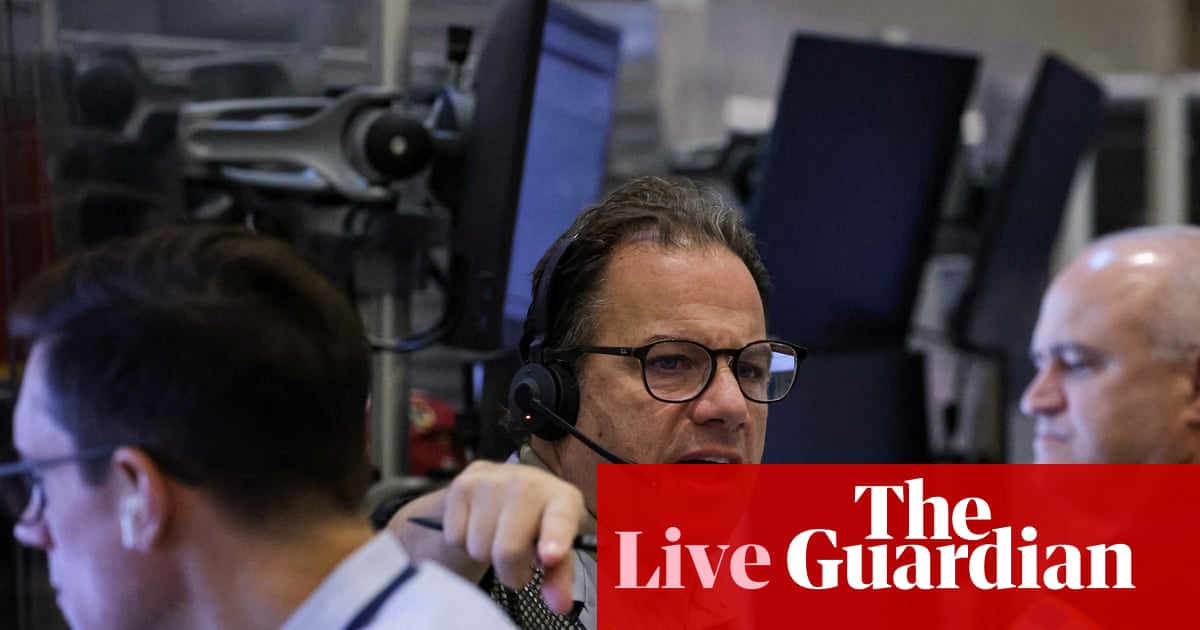
And finally, Britain’s stock market has recorded its biggest one-day fall since the early days of Donald Trump’s trade war.
The blue-chip FTSE 100 share index has closed down 123 points, or 1.27%, at 9552 points, its lowest closing point since 22 October.
That is the index’s biggest one-day drop since 7 April, shortly after Donald Trump announced his swathe of ‘Liberation Day’ tariffs.
Engineering company Melrose (-3.9%), copper producer Antofagasta (-3.7%) and private equity firm 3i (-3.6%) led the fallers, on a day in which markets were hit by worries about AI valuations.
Asia-Pacific stocks had earlier dipped to a one-month low today, amid signs that the enthusiasm that has driven stocks higher in recent months is fading, with shares, risky currencies and crypto assets all sliding.
Fading hopes of a US interest rate cut in December, and anxiety over Nvidia’s results due on Wednesday, were also cited as factors.
Here’s our news story about today’s market sell-off:
Goodnight! GW
“Even before investors get a chance to sample the week’s big news, markets are showing signs of strain,” says Danni Hewson, head of financial analysis at AJ Bell.
Hewson adds:
“It almost feels like whiplash to have been discussing the potential for the FTSE 100 to hit the 10,000 mark last week when this week it seems to be doing its best to slump back towards its previous milestone.
“Nerves are palpable and by the end of the week we might have a good sense of whether the year will end with a bang or a pop.”
That ‘big news’ is Nvidia’s results, due after the Wall Street close tomorrow, and the delayed US non-farm payroll set for Thursday.
Paschal Donohoe’s departure from Irish politics to become managing director of the World Bank will trigger another race for his second job as head of the Eurogroup ,an influential alliance of countries that use the euro.
According to the Business Post’s Brussels correspondent Sarah Collins, Spanish economy minister Carlos Cuerpo almost got the numbers the last time around and could lead the field of contenders.
Donohoe, was reappointed for a third term in July. His other challenger last summer, Lithuania’s Rimantas Šadžius, is no longer a minister.
And finally, Britain’s stock market has recorded its biggest one-day fall since the early days of Donald Trump’s trade war.
The blue-chip FTSE 100 share index has closed down 123 points, or 1.27%, at 9552 points, its lowest closing point since 22 October.
That is the index’s biggest one-day drop since 7 April, shortly after Donald Trump announced his swathe of ‘Liberation Day’ tariffs.
Engineering company Melrose (-3.9%), copper producer Antofagasta (-3.7%) and private equity firm 3i (-3.6%) led the fallers, on a day in which markets were hit by worries about AI valuations.
Asia-Pacific stocks had earlier dipped to a one-month low today, amid signs that the enthusiasm that has driven stocks higher in recent months is fading, with shares, risky currencies and crypto assets all sliding.
Fading hopes of a US interest rate cut in December, and anxiety over Nvidia’s results due on Wednesday, were also cited as factors.
Here’s our news story about today’s market sell-off:
Goodnight! GW
Companies at the heart of this year’s AI boom are among the biggest fallers on Wall Street today.
Chipmaker Nvidia are down 2.3%, Microsoft has lost 3.3%, and Google’s parent company Alphabet has lost 2.6%.
Google has just launched the latest version of Gemini, its AI model.
It claims that Gemini 3 will bring in “a new era of intelligence”, saying:
It’s state-of-the-art in reasoning, built to grasp depth and nuance — whether it’s perceiving the subtle clues in a creative idea, or peeling apart the overlapping layers of a difficult problem.
Gemini 3 is also much better at figuring out the context and intent behind your request, so you get what you need with less prompting. It’s amazing to think that in just two years, AI has evolved from simply reading text and images to reading the room.
On a day in which anxiety over AI valuations has been starkly apparent, Google is emphasizing that Gemini’s new capabilities will be immediately available in several profit-generating products like its search engine.
CEO Sundar Pichai has described it as “our most intelligent model,” in a company blog post.
The US S&P 500 share index is on track for its longest slide since August, points out Bloomberg, with today’s losses setting it up four its fourth daily drop in a row.
The S&P 500 index is now down around 1%.
There’s been no let-up in the selling across Europe today.
As the session draws towards a close, the UK’s FTSE 100 share index is now down 153 points, or 1.6%, at 9,521 points.
France’s CAC 40 index is down 2.2%, and Germany’s DAX has lost almost 2%.
Simon Harris, Ireland’s ebullient deputy prime minister, will be the country’s new finance minister in a major reshuffle that sees him drop his foreign affairs portfolio.
Helen McEntee, the current education minister, will be the new foreign affairs minister, attending council meetings in Europe and dealing with US foreign and tariff policy.
She is best known internationally as part of the team who helped negotiate Brexit under former taoiseach Leo Varadkar.
The reshuffle was triggered by the surprise news on Tuesday that the long standing cabinet minister Paschal Donohoe was quitting to go to the World Bank in Washington as managing director (see earlier post).
Finance is considered one of the top portfolios in any country along with foreign affairs and home affairs.
But it has taken on huge importance this year in Dublin as the country came under relentless attack from Donald Trump which accused Ireland of “stealing” US pharma companies.
There’s little more than a week to go until Rachel Reeves delivers her long-awaited budget.
But if the fiscal update goes badly, could the chancellor be bounced into a second budget?!
David Zahn, the head of European fixed income at Franklin Templeton, said the biggest risk from the budget on 26 November was that Reeves “disappoints”, leading to a sharp rise in bond yields – the interest rate on UK government debt.
In that scenario “it forces her hand to do a secondary budget”, Zahn told reporters in London this morning, adding:
“It depends how the bond market reacts. If the bond market reacts very badly … the government will have to react if bond yields start to go up too much.”
More by, err, me here:
Shares in Ocado have dived 14% – to the lowest level since 2013 – after Kroger, its major partner in the US, announced the closure of three warehouses using the UK company’s high tech equipment.
Ocado signed a deal to build 20 automated warehouses for Kroger in 2018, eight of which are currently live with two more planned for next year. The deal was seen as a major part of Ocado’s plan to sell its online grocery delivery technology internationally.
However, on Tuesday, Kroger said sites in Frederick in Maryland, Pleasant Prairie in
Wisconsin, and Groveland in Florida would close in January. Ocado said it expected to receive more than $250m in compensation for fees related to the early closure of the sites but its fee revenue this financial year would take a $50m hit.
Kroger said on Tuesday that “a comprehensive review” of its set up had “identified opportunities to optimise its fulfillment network”.
It said it would now mover towards a “hybrid fulfillment network” testing out “capital-light, store-based automation in high-volume geographies” while continuing to use automated warehouse processing of online orders where it sees “higher density of demand.” It noted that it had recently expanded its relationship with quick delivery service providers DoorDash and Instacart.
The British company said in a statement:
“Ocado continues to engage with Kroger on these and other matters, and expects significant growth in the US market, both with [warehousing] and store based automation.”
The opening bell on the New York stock market has rung, and another wave of selling has begun.
The Dow Jones Industrial Average has dropped by 379 points, or 0.8%, in early trading to 46,211 points, and has hit a one-month low.
Home Depot are the top faller, down 3.3%, followed by Amazon (-2.1%).
Stocks continue to be hit by concerns that technology company valuations have surged too high, and pessimism that the US Federal Reserve might cut interest rates as soon as next month.
Bank of England chief economist Huw Pill has indicated that he isn’t close to changing his position and voting for a cut in interest rates.
Speaking in London this morning, Pill argued that policymakers should not place too much weight on often-noisy short-run economic data, saying:
“I think policymakers should be cautious about over-interpreting the latest news in data, because there is a lot of noise in the data flow, and partly because of some of the challenges our colleagues in the Office for National Statistics have faced.”
Earlier this month, Pill was one of five policymakers who voted to leave interest rates on hold, outvoting four who wanted a cut.
Today’s comments suggests he may not be persuaded to change his view by the recent increase in unemployment, and slowdown in wage growth.
Wall Street’s fear index has hit a one-month high today, Reuters reports, as investors have grown more jittery.
The CBOE volatility index, known as the VIX, is currently up 1.2 points at 23.58 points.
We also have fresh evidence that US companies cut jobs last month.
With official economic statistics slowly roaring back into life after the US government shutdown, economists are indebted to other sources, such as payroll operator ADP.
According to ADP’s latest weekly data, US companies shed 2,500 jobs per week on average in the four weeks to 1 November.
That suggests the pace of job cuts slowed at the end of the month – a week ago, ADP reported that US companies shed 11,250 jobs per week on average in the four weeks ending on 25 October.