
This post was originally published on this site.
NEW YORK — Fans shared plenty of angst in our recent mailbag. Many questions echoed the sentiment of Joshua R., who said simply, “Does the franchise have a plan?”
The state of the New York Rangers isn’t great right now, though they got a nice win Friday at the Winter Classic. Heading into NHL play Sunday, they were last in the Eastern Conference in point percentage (.523), and they have spent stretches of the year without Vincent Trocheck, Adam Fox and J.T. Miller, who is currently recovering from an upper-body injury. The difficult start, as well as the lingering disappointment from the 2024-25 season, colored many of your questions for this mailbag.
Advertisement
My colleague Vincent Z. Mercogliano handled part one of the mailbag. Now let’s dig into part two.
Note: Some questions have been edited for clarity and length.
The Rangers top players are aging and declining, there are no young players ready to take over and they don’t have assets to acquire elite talent. How are the Rangers not a rebuilding team? — Robert P.
The Rangers aren’t a rebuilding team because they are making moves that are clearly focused on keeping a competitive window open. President and general manager Chris Drury traded for Miller, who is 32, and signed Vladislav Gavrikov, who is 30. The team used its financial might to woo coach Mike Sullivan, who won two Stanley Cups with Pittsburgh. Those aren’t moves rebuilding teams make.
As the deadline nears, the Rangers will have to decide whether it makes sense to continue with the current approach. As your question hinted at, this isn’t a team in position to trade its limited assets for rentals. If anything, Drury will likely have to consider moving players on expiring contracts (think Carson Soucy, or maybe even Artemi Panarin, who we’ll discuss later) as he did last deadline. Perhaps the front office should take an even more drastic approach and think about trading players with term in an effort to get younger. That would be more in line with rebuilding.
In my eyes, the worst-case scenario for the Rangers is accidentally becoming a rebuilding team without fully committing to it. We’ve seen that with other clubs: They try to elongate an aging or incomplete core’s window, and it results in teams operating in win-now mode that are neither good enough to make noise or bad enough to maximize draft lottery odds. It’s how you stay bad for a long time.
What would you think of a trade of Igor Shesterkin as a means of rebuilding? It seems like massive goalie contracts are at least part of the problem in building a championship team. What do you think a deal would bring back in terms of players and roster flexibility? — Maki D.
I’d push back on big goalie contracts being a problem for building a championship team, at least on well-built clubs. Look at Sergei Bobrovsky, who has won back-to-back Cups on a $10 million average annual value deal. His contract took up 11.97 percent of the salary cap in Florida’s first Cup year. This year, Shesterkin’s contract (eight years at $11.5 million AAV) is at 12.04 percent of the Rangers’ cap. Next year, it will be barely over 11 percent. Neither the goalie — whom we named team MVP at the midway point — nor his contract is an issue.
Advertisement
As for the possibility of a trade, I can’t see it. Shesterkin has a full no-movement clause, and it’s hard to envision him wanting to uproot his family after signing a massive extension last year. Owner James Dolan presumably wouldn’t stomach it either. Even if he could be convinced to embark on a roster reset, Shesterkin is someone the franchise would likely want on its next competitive team.
To entertain your hypothetical: Shesterkin would fetch a massive haul. Jacob Markström and Linus Ullmark both recently fetched packages that included a first-round pick, and Shesterkin is a better goalie and multiple years younger than both of them. I’d expect he’d get the equivalent of multiple firsts, whether in the form of actual picks or young prospects. As for roster flexibility, the Rangers would gain $11.5 million of space a year. The impact of that could be marginal, though. New York already has flexibility and might not have many free agents to spend it on.
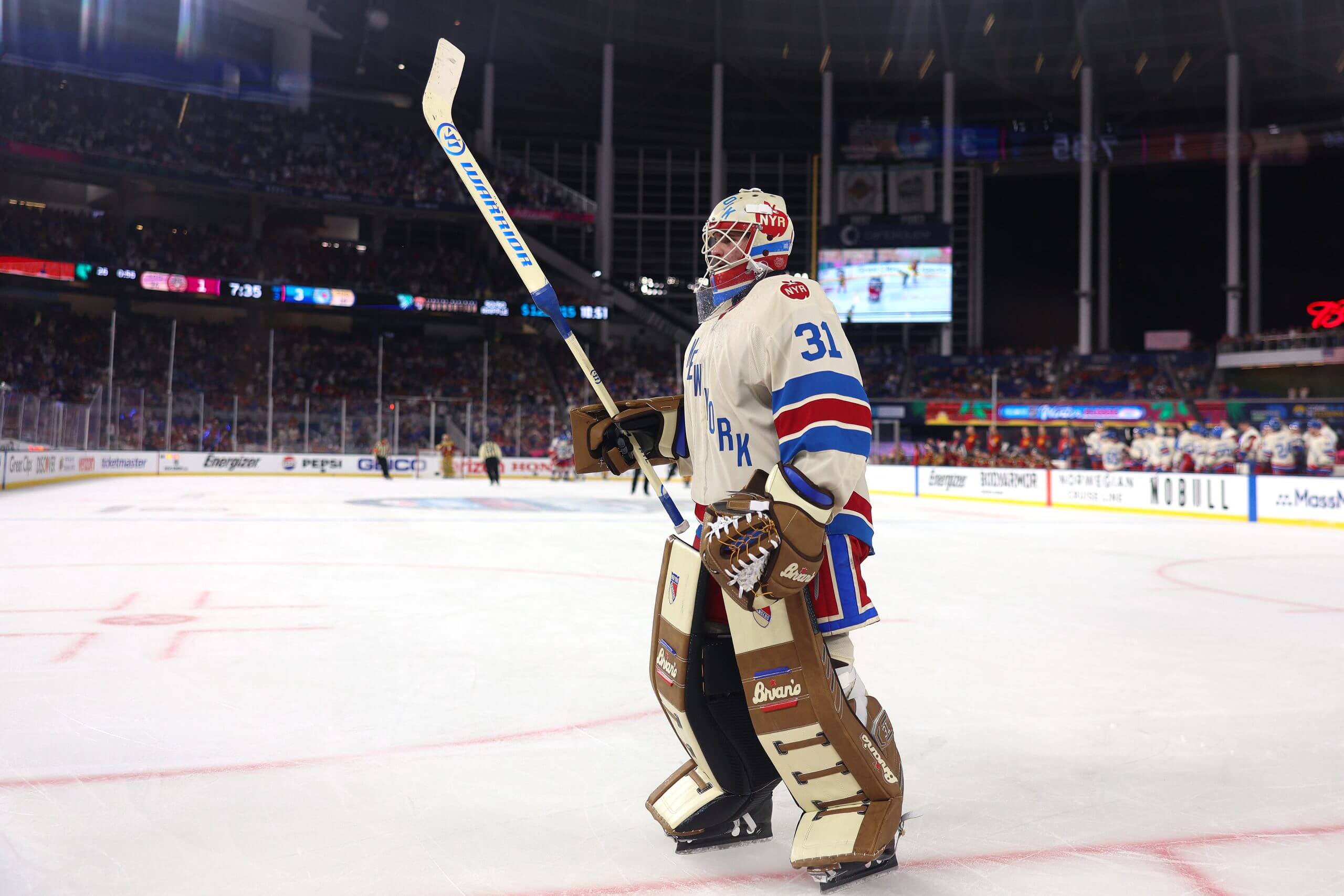
Neither Igor Shesterkin nor his eight-year contract is an issue for the Rangers. (Tomas Diniz Santos / Getty Images)
Is it time to cut bait on Alexis Lafrenière and his absurd contract? — Michael W.
In my eyes, this is not the right time to make any moves involving Lafrenière unless, of course, a big-name player becomes available. As frustrating as the post-2023-24 Lafrenière has been, he’s still one of the only young forwards on the roster with offensive upside, as he showed in a strong Winter Classic performance. New York needs more youth, not less of it. I could perhaps be convinced if a similar-aged player becomes available — think the Josh Norris-Dylan Cozens swap last year — but trading Lafrenière now would be selling low and feels rash. Perhaps I’d feel differently if the Rangers were one piece away from winning the Stanley Cup, but that’s not their reality.
Lafrenière’s contract — $7.45 million AAV through 2031-32 — is not an insignificant amount of money, but I don’t view it as absurd. Remember, the salary cap is going up. Paying that amount for a decent but not game-breaking top-six winger isn’t catastrophic like it perhaps would have been a few years ago. Colleague Dom Luszczyszyn’s model still projects a greater than 50 percent chance that the contract will end up having positive value for the Rangers.
Would it be realistic to package Lafrenière for another young player? Would Matty Beniers be a potential one-for-one trade? Could we snag Byfield for Lafrenière and a pick? — Jrblinbaum
Unfortunately for the Rangers, Lafrenière’s trade value isn’t as high as it was after the 2023-24 season. Beniers hasn’t become a star like it looked like he might after his Calder Trophy-winning rookie season, but he still has had similar production levels to Lafrenière, all while playing a more valuable position (center) and without a linemate as offensively gifted as Panarin, whom Lafrenière has frequently skated with in recent years. Beniers also makes slightly less money, and Seattle presumably views him as one of its core pieces going forward. I doubt New York would be able to land him in a one-for-one deal.
Advertisement
Quinton Byfield’s ability to play center would also make Los Angeles hesitant to move him for Lafrenière, even if there’s some extra draft compensation going to the Kings. Luszczyszyn’s model gives both Byfield’s and Beniers’ contracts better percentage chances of bringing positive value to their teams. They’re also both around a year younger than Lafrenière.
People talk a lot about trading Panarin, but I don’t see any potential free agent or realistic trade target who can match his production. For a team that has trouble scoring goals, don’t we want to hold onto the best we have and add to it instead of subtracting? — Mike K.
That’s certainly the concern with saying goodbye to Panarin. There aren’t players in this upcoming free-agent class who bring as much to the table offensively. The big question is whether it’s worth it for the Rangers to pay as much as it would cost to retain the winger, especially since he’ll turn 35 shortly after his new contract goes into effect. His production has taken a slight downturn this year; with 44 points in 42 games, he’s producing at the lowest rate of his Rangers career. Is that merely a blip or a sign of him starting to age?
Panarin also has agency in this. He could decide it’s time to move on, especially if he doesn’t view the Rangers as a true contender in the coming years. If that’s the case or the Rangers don’t want to commit a high-money deal to him, trading him at the deadline makes sense if he’s willing to waive his no-movement clause. That would be better than losing him for nothing.
There’s the off-ice element of Panarin’s situation, too: The Athletic’s Katie Strang reported in April 2025 that both “Panarin and Madison Square Garden Sports, the company that owns the team, paid financial settlements to a Rangers employee last year after she alleged that Panarin sexually assaulted her.” It’s unclear if that would factor into the Rangers’ decision-making regarding Panarin’s free agency, though.
With the upcoming cap space and nobody to spend it on in the unrestricted free agent group, what are the odds the Rangers throw a big amount at a restricted free agent? Not like we will do anything with the four first-round picks (required for a deal above $11.7 million average annual value). Say seven years, $16 million AAV to Connor Bedard. — Richard T.
There’s a reason offer sheets are rare: They are hard to pull off. If the Rangers were to sign Bedard to a seven-year, $16 million AAV deal in restricted free agency, the Blackhawks would simply match it and retain their young star. There’s no chance it would result in New York actually getting the player. It would do nothing but signal desperation.
Offer sheets aren’t a feasible strategy for going for a superstar. When they work, it’s usually from a team wooing younger, often unproven players who could thrive with more opportunity. Look at the most recent successful ones: St. Louis nabbing Philip Broberg and Dylan Holloway from Edmonton. The Blues took advantage of the Oilers being up against the cap to go after players they thought could level up in a new situation. St. Louis risked a slight overpayment — especially with Broberg, who had played only 81 games at the time of the signing — and Edmonton decided letting the players go and not having to untangle a salary-cap web was worth the return of draft compensation. The bet paid off for the Blues, but it took a unique set of circumstances that wouldn’t be present for an elite-level player like Bedard.

Could Jason Robertson become available? If so, the Rangers would be wise to pounce. (Robert Edwards / Imagn Images)
The Rangers need obviously one more elite player. The Wild filled a similar need with the Hughes trade. Who would be available now to fill that need for the Rangers? — Tim R.
Franchise-altering players don’t become available often, and many clubs could use one. It’s easy to point out the need, but finding a fit is much harder. The only trades for younger superstars in the 2020s have been for Jack Eichel (Buffalo to Vegas in 2021), Matthew Tkachuk (Calgary to Florida in 2022) and Quinn Hughes (Vancouver to Minnesota this year). Mikko Rantanen also might fall into this category, but he was a bit older (28) at the time of his two trades (Colorado to Carolina, then Carolina to Dallas).
Advertisement
There isn’t another clearly available star now. That could change quickly, and history suggests an elite player will shake free at some point.
Perhaps Jason Robertson, a pending restricted free agent, can’t come to terms with Dallas. Assuming that happens would be unwise for New York — Dallas general manager Jim Nill should have the cap space to make a deal work — but the Rangers could try to pounce if the Stars explore trading him. Like many GMs, Drury would surely love to make a pitch for Ottawa captain Brady Tkachuk. He’s not set to hit unrestricted free agency until 2028, though, so the Senators’ situation would likely have to take a downturn for anything to happen in the near future. If the Red Wings had gotten off to another poor start, maybe Dylan Larkin would have been open to a change. Instead, Detroit is one of the top teams in the Atlantic, so cross that name off the wish list for now.
In short, there aren’t any obvious candidates currently. However, if one emerges, it will be incumbent upon the Rangers to be proactive. The problem for them, as Mercogliano wrote recently, is that they haven’t positioned themselves to have enough in their prospect or draft pick pool to make an offer like the one Minnesota put forth for Hughes.
Is there a path this offseason where they re-sign Panarin and use their cap space to overpay for good middle sixers like Nick Schmaltz and Oliver Bjorkstrand to create a more balanced attack that’s defensively responsible? Hard to rebuild with current contracts, no young assets to develop into or trade for a superstar. Seems like using cap space to create forward depth might be a viable option to be a little more competitive in the next two-three years. — Bill C.
Before digging in, let’s do some quick cap evaluation: The Rangers are projected to have a little under $30 million in space entering the summer, per PuckPedia. Some of that will have to go to restricted free agents (Braden Schneider is the most notable one) and some will fill needs, such as No. 2 goalie. By the time those deals are taken care of, the team should still have more than $20 million.
The path you suggest could be possible, but it would depend on what Panarin’s cap hit would come in at. If it’s $10 million, the Rangers could perhaps sign another top-six forward and a defenseman to round out the roster. There’s no guarantee, though, that other teams won’t also try to woo players with cap space. Many clubs will have room to make big offers with the cap going up.
In the short term, your strategy could potentially lead to a competitive team. The Rangers would have to be careful, though, of adding even more age to an already older roster. Schmaltz, Bjorkstrand and Alex Tuch will all be at least 30 when free agency opens next summer.
What could the Rangers get for Urho Vaakanainen from a desperate contender around the trade deadline? — Jay B.
Probably not much. Vaakanainen comes with term ($1.55 million AAV through 2026-27), and opposing teams would likely be hesitant to trade for someone with another year on his deal who isn’t a lineup regular.
Advertisement
Do you see a realistic path to becoming a real contender again with this aging core? — Rachel F.
I find it hard to view this team as a true contender as currently constructed. To me, its ceiling is sneaking into the playoffs, then praying elite goaltending from Shesterkin can propel them on a bit of a run. The Rangers are more than one trade or signing away from being more than that.
Your question is the same one Drury and Dolan need to be asking themselves. If the answer is no, both will have to consider whether it’s necessary to pivot from what appears to be the current strategy.