
This post was originally published on this site.
” data-image-caption=”
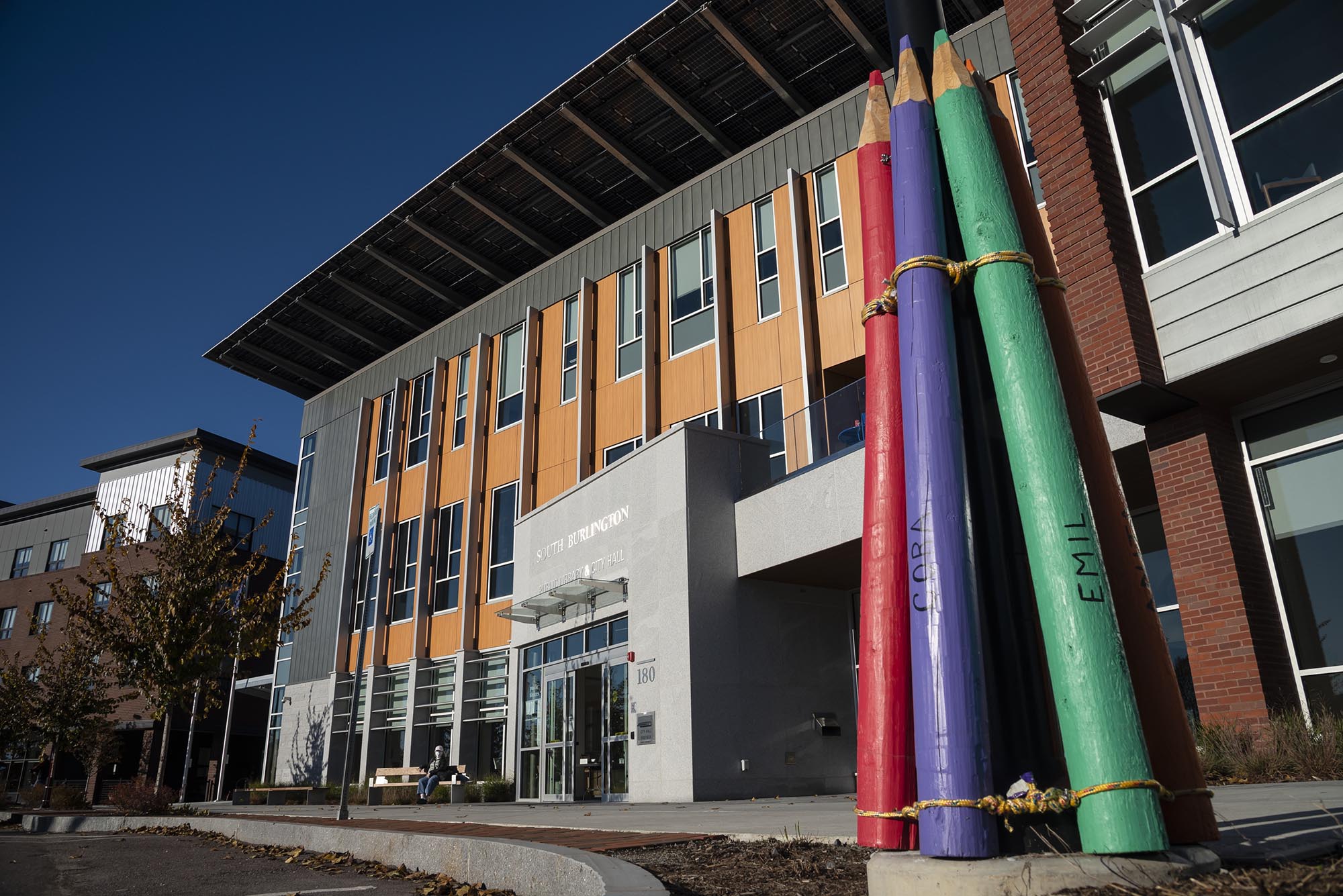
South Burlington Public Library and City Hall on Wednesday, November 10, 2021. Photo by Glenn Russell/VTDigger
” data-medium-file=”https://vtdigger.org/wp-content/uploads/2021/11/south-burlington-1-20211110-300×200.jpg” data-large-file=”https://vtdigger.org/wp-content/uploads/2021/11/south-burlington-1-20211110-1200×801.jpg” src=”https://vtdigger.org/wp-content/uploads/2021/11/south-burlington-1-20211110-1200×801.jpg” alt=”A modern building with large windows and a sculpture of oversized colored pencils standing upright near the entrance.” class=”wp-image-530677″ srcset=”https://vtdigger.org/wp-content/uploads/2021/11/south-burlington-1-20211110-1200×801.jpg 1200w, https://vtdigger.org/wp-content/uploads/2021/11/south-burlington-1-20211110-300×200.jpg 300w, https://vtdigger.org/wp-content/uploads/2021/11/south-burlington-1-20211110-125×83.jpg 125w, https://vtdigger.org/wp-content/uploads/2021/11/south-burlington-1-20211110-768×513.jpg 768w, https://vtdigger.org/wp-content/uploads/2021/11/south-burlington-1-20211110-1536×1025.jpg 1536w, https://insidernarrative.com/wp-content/uploads/2025/12/south-burlington-1-20211110.jpg 2000w” sizes=”(max-width: 1200px) 100vw, 1200px”>
This story by Liberty Darr was first published in the Other Paper on Dec. 24, 2025.
The South Burlington Tax Increment Financing district is in good financial standing, but according to a recent report, for the city to realize the full benefits of its success, development and growth must continue.
The city will hold a “substantial change” hearing next month to update anticipated growing costs in the TIF district and financing plan, particularly for outstanding projects, with costs that have exceeded former projections.
TIF is one of the most powerful economic tools available to municipalities for financing public and private development. It is essentially a way a town or city pays for improvements in a specific area without raising taxes.
Once the area is designated — in South Burlington’s case, it’s a small subset of the 300-acre City Center — the current level of property taxes from that area continues to go to schools and government as usual. The municipality is then able to borrow money to build roads, sidewalks or other public infrastructure. As development happens, property values rise and generate extra tax revenue. That extra tax money is used to pay back the borrowed money.
The idea is that, as the infrastructure is built and improved, it attracts private sector investment in new and renovated buildings and increases the value of the grand list.
South Burlington’s TIF district was instituted in 2012, but the city didn’t incur its first debt until 2017, setting the 20-year increment retention period in motion. Since then, the city has made several advances in its own projects and in incentivizing the private sector to build up City Center. Over 650 new homes have been built in the area, along with approximately 80,000 square feet of first-floor commercial space. Ninety-six homes are currently under construction in the district.
And this year, the TIF district expenditures and revenues are in balance. As part of the city’s overall 2025 grand list, the TIF district grand list was $107.8 million higher than that area was in 2012 — almost three times the 2012 original taxable value. The city expects to add $1.77 million to the fund by the end of the current fiscal year, more than $600,000 than the prior year.
South Burlington’s community development director and unofficial TIF district guru, Ilona Blanchard, told the city council last month that, while the TIF district is performing well, projection models show lower revenues and a deeper need to cushion the TIF district fund if no future development occurs.
“Sustained and consistent mixed-use or compact housing development will bring the TIF district into balance over the long run and result in higher overall annual revenues,” Blanchard wrote in a memo. “Ongoing efforts to encourage additional development are promising, including recent actions to update zoning regulations, but permits have yet to be filed.”
Blanchard’s “break even forecast” estimates that 56 rental apartment homes need to be added each year to result in a positive balance at the end of the TIF district’s life — fiscal year 2038 — with no surplus revenue.
Growing project costs
The city has four remaining TIF district projects to complete, with four — including Market Street and the city’s municipal buildings —already complete.
But the costs for those projects are increasing. Most notable is a proposed bike and pedestrian bridge over Interstate 89, where the estimated cost has increased by nearly $13 million since 2021. The project is 30% eligible for TIF.
The city has received two major federal grants for the project, totaling $17.7 million, in addition to the roughly $70,000 in federal funds expended during the scoping period of the project.
The project was initially put out to bid in May, but when bids came back, both came in significantly higher than previously anticipated.
As this project is shovel-ready, the city is “value engineering” the project to rebid for construction, perhaps this winter, while also working to obtain an estimated $3.5 million of gap funding.
“We’re squeezing down that initial cost as much as we can, and we’ll be looking for more grant money,” Blanchard said, noting the project will likely be broken into phases. “We’re keeping the overall designs but there are a few things that will change.”
Other outstanding projects include the second and third phases of Garden Street, the City Center Park Phase 2 recreation path — connecting Market and Garden streets to the City Center Park — and the Williston Road Streetscape, which improves bicycle and pedestrian access on one of the city’s busiest corridors.