
This post was originally published on this site.
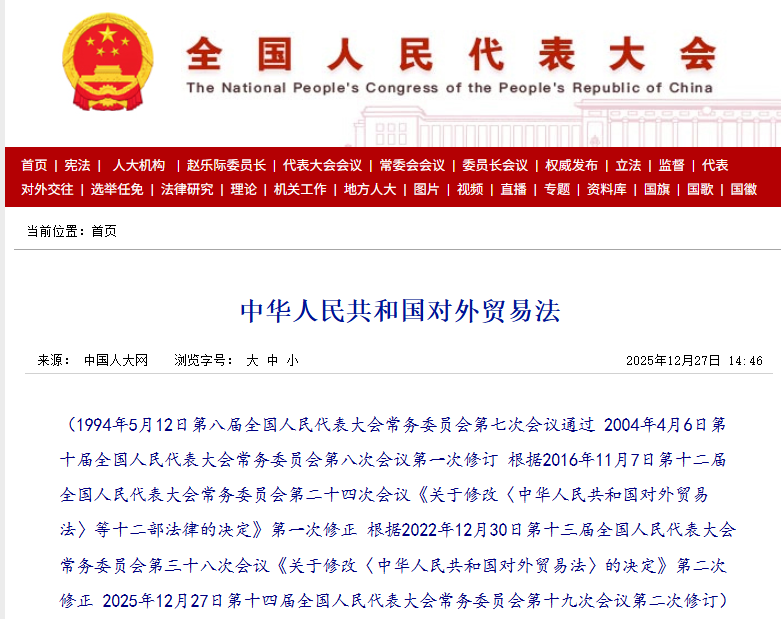
On December 27, 2025, China’s National People’s Congress (NPC) released the Foreign Trade Law of the People’s Republic of China (中华人民共和国对外贸易法) effective March 1, 2026. The Foreign Trade Law includes a chapter on intellectual property (IP) introducing trade sanctions for IP infringement based when it endangers the order of foreign trade and also targets specific IP licensing practices such as standard validity challenge clauses and portfolio license bundling. Further, the Law allows retaliation if China’s IP is not protected adequately overseas. China’s Ministry of Commerce (MOFCOM), and not China’s National IP Administration (CNIPA), Supreme People’s Court (SPC) or State Administration for Market Regulation (SMAR), will presumably enforce this new law implying the potential formation of something analogous to the US International Trade Commission and 337 investigations.
A translation follows. The original text is available here (Chinese only).
Chapter 1 General Provisions
Article 1 This Law is formulated in accordance with the Constitution in order to promote high-level opening up, drive high-quality development of foreign trade, maintain foreign trade order, protect the legitimate rights and interests of foreign trade operators, promote the healthy development of the socialist market economy, and safeguard national sovereignty, security, and development interests.
Article 2 This Law applies to foreign trade and the protection of intellectual property rights related to foreign trade.
Foreign trade as referred to in this Law means the import and export of goods, the import and export of technology, and international trade in services.
Article 3 Foreign trade work shall adhere to serving the country’s economic and social development and promoting the building of a strong trading nation.
Article 4 The competent department of foreign trade under the State Council shall, in accordance with this Law, be in charge of the national foreign trade work.
Article 5 The State implements a unified foreign trade system, encourages the development of foreign trade, and safeguards a fair and free foreign trade order.
Article 6 The State shall proactively align itself with high-standard international economic and trade rules, actively participate in the formulation of international economic and trade rules, safeguard the multilateral trading system and a fair and just international economic and trade order, expand the network of high-standard free trade zones, optimize the environment for open cooperation, and promote the building of an open world economy.
Article 7 The State shall establish a trade policy compliance mechanism that is aligned with international rules.
When formulating policies and measures concerning foreign trade and intellectual property rights related to foreign trade, departments of the State Council and local people’s governments at or above the county level shall conduct trade policy compliance assessments in accordance with relevant national regulations.
Article 8 The People’s Republic of China promotes and develops trade relations with other countries and regions on the basis of equality and mutual benefit, concludes or accedes to regional economic and trade agreements such as customs union agreements and free trade zone agreements, and participates in regional economic organizations.
Article 9 In foreign trade, the People’s Republic of China shall, in accordance with the international treaties and agreements it has concluded or acceded to, grant other contracting parties or participating parties most-favored-nation treatment, national treatment, or other treatment, or, based on the principles of reciprocity and equality, grant other parties most-favored-nation treatment, national treatment, or other treatment.
Article 10 If any country or region adopts discriminatory prohibitions, restrictions or other similar measures against the People’s Republic of China in trade matters, the People’s Republic of China may take corresponding measures against that country or region based on the actual circumstances.
Chapter Two: Foreign Trade Operators
Article 11 For the purposes of this Law, “foreign trade operators” refers to individuals or organizations that have completed business entity registration or other professional procedures in accordance with the law and engage in foreign trade activities in accordance with this Law and other relevant laws and administrative regulations.
Article 12 Anyone engaging in overseas labor cooperation shall obtain the qualification to operate overseas labor cooperation in accordance with the law. Specific measures shall be stipulated by the State Council.
Those undertaking overseas contracted projects shall register in accordance with relevant national regulations; where approval is required by laws and administrative regulations, such approval shall be obtained in accordance with those regulations.
Article 13 The State may exercise state-controlled trade management over the import and export of certain goods. The import and export of goods subject to state-controlled trade management may only be conducted by authorized enterprises; however, this does not apply to situations where the State permits a certain quantity of state-controlled trade management goods to be conducted by unauthorized enterprises.
The catalogue of goods subject to state-run trade management and authorized operating enterprises shall be formulated, adjusted and published by the State Council’s foreign trade authority in conjunction with other relevant departments of the State Council.
If anyone violates the provisions of paragraph 1 of this article by importing or exporting goods subject to state-controlled trade without authorization, the customs shall not release them.
Article 14 Foreign trade operators may accept entrustment from others to handle foreign trade business on their behalf within the scope of their business.
Article 15 Foreign trade operators shall, in accordance with the provisions lawfully made by the State Council’s foreign trade authority or other relevant departments, submit documents and materials related to their foreign trade operations to the relevant departments. The relevant departments shall protect the trade secrets of the providers.
Chapter Three Import and Export of Goods and Technology
Article 16 The State permits the free import and export of goods and technologies. However, this does not apply if otherwise stipulated by laws or administrative regulations.
Article 17 The competent department of foreign trade under the State Council may, based on the need to monitor import and export, implement automatic import and export licensing for certain goods that are freely importable and exportable and publish their catalogues.
For import and export goods subject to automatic licensing, if the consignee or consignor submits an application for automatic licensing before completing customs declaration procedures, the competent department of foreign trade under the State Council or its entrusted agency shall grant the license; the customs shall process the release procedures based on the submitted automatic license certificate.
For technologies that are subject to free import and export, the contracts should be registered with the State Council’s foreign trade authority or its authorized agency.
Article 18 The State may prohibit or restrict the import or export of relevant goods or technologies, or take other necessary measures, for the following reasons:
(i) For the purpose of safeguarding national security, public interests, or public morality;
(ii) For the purpose of protecting human health or safety, protecting the life or health of animals or plants, and protecting the environment;
(iii) Measures related to the import and export of gold or silver;
(iv) Where there is a domestic shortage of supply or in order to effectively protect potentially depleted natural resources;
(v) The market capacity of the country or region to which the goods are exported is limited;
(vi) Where export order is seriously disrupted;
(vii) For the purpose of establishing or accelerating the establishment of specific domestic industries;
(viii) Where it is necessary to restrict the import of any form of agricultural, livestock, or fishery products;
(ix) To safeguard the country’s international financial status and balance of payments;
(x) Other situations where it is necessary to prohibit or restrict the import or export of relevant goods or technologies, or to take other necessary measures, in accordance with the provisions of laws and administrative regulations;
(xi) Where, in accordance with the provisions of international treaties or agreements concluded or acceded to by the People’s Republic of China, it is necessary to prohibit or restrict the import or export of relevant goods or technologies, or to take other necessary measures;
(xii) Other circumstances where it is necessary to prohibit or restrict the import or export of relevant goods or technologies, or to take other necessary measures.
Article 19 The State may take any necessary measures to safeguard national security regarding the import and export of goods and technologies related to fissile or fusion materials or substances derived from such materials, as well as the import and export of weapons, ammunition or other military supplies.
In times of war or other emergencies in international relations, or in order to maintain international peace and security, a state may take any necessary measures regarding the import and export of goods and technology.
Article 20 The competent department of foreign trade under the State Council, in conjunction with other relevant departments under the State Council, shall, in accordance with the provisions of Articles 18 and 19 of this Law, formulate, adjust and publish the catalogues of goods and technologies that are prohibited or restricted from import and export.
With the approval of the State Council, the competent department of foreign trade under the State Council, or in conjunction with other relevant departments under the State Council, may temporarily decide to prohibit or restrict the import and export of specific goods or technologies not included in the catalogues stipulated in the preceding paragraph, within the scope stipulated in Articles 18 and 19 of this Law.
Article 21 The State shall manage restricted import and export goods through quotas, licenses, or other means; and shall manage restricted import and export technologies through licenses.
Goods and technologies subject to quota or license management shall be imported or exported only after obtaining permission from the State Council’s foreign trade authority or, in conjunction with other relevant State Council departments, in accordance with the regulations of the State Council.
The state may implement tariff quota management for certain import and export goods.
Article 22 Import and export quotas and tariff quotas shall be allocated by the State Council’s foreign trade department or other relevant departments within their respective responsibilities, in accordance with the principles of openness, fairness, impartiality, and efficiency. Specific measures shall be stipulated by the State Council.
Article 23 Foreign trade operators may, in accordance with the law, engage in processing trade, import all or part of the raw materials, and re-export the finished products after processing, assembly or repair.
Where the State has regulations prohibiting or restricting goods for processing trade, foreign trade operators shall comply. The State Council’s competent department for foreign trade, in conjunction with other relevant departments of the State Council, shall formulate, adjust, and publish the catalogue of prohibited and restricted goods for processing trade.
If imported materials or finished products under processing trade cannot be re-exported, they may be converted to domestic sales in accordance with the law. If the imported materials or finished products under processing trade converted to domestic sales are subject to quota, license, or tariff quota management, quota certificates, licenses, or tariff quota certificates must be obtained.
Article 24 The State implements a unified commodity conformity assessment system. The certification, inspection and quarantine of import and export commodities shall be carried out in accordance with the provisions of relevant laws and administrative regulations.
Article 25 The State implements rules of origin management for imported and exported goods. The specific determination of the origin of imported and exported goods shall be carried out in accordance with relevant laws and regulations of the State Council and its relevant departments.
Article 26 Where other laws and administrative regulations prohibit or restrict the import and export of cultural relics, wild animals, plants and their products, the provisions of the relevant laws and administrative regulations shall apply.
Chapter Four International Trade in Services
Article 27 The State encourages international trade in services through various modes such as cross-border delivery, overseas consumption, commercial presence, and movement of natural persons.
Article 28 The competent department of foreign trade under the State Council and other relevant departments under the State Council shall, in accordance with the provisions of this Law and other relevant laws and administrative regulations, manage international trade in services.
Article 29 The State may prohibit or restrict relevant international trade in services, or take other necessary measures, for the following reasons:
(i) For the purpose of safeguarding national security, public interests, or public morality;
(ii) For the purpose of protecting human health or safety, protecting the life or health of animals or plants, and protecting the environment;
(iii) For the purpose of establishing or accelerating the establishment of specific domestic service industries;
(iv) For the purpose of ensuring the balance of the country’s foreign exchange receipts and payments;
(v) Other situations where it is necessary to prohibit or restrict relevant international trade in services, or to take other necessary measures, in accordance with the provisions of laws and administrative regulations;
(vi) Where, in accordance with the provisions of international treaties or agreements concluded or acceded to by the People’s Republic of China, it is necessary to prohibit or restrict relevant international trade in services, or to take other necessary measures;
(vii) Other situations where it is necessary to prohibit or restrict relevant international trade in services, or to take other necessary measures.
Article 30 The State may take any necessary measures to safeguard national security regarding international trade in services related to military affairs, and international trade in services related to fissile, fusion or derivative substances.
In times of war or other emergencies in international relations, or in order to maintain international peace and security, a state may take any necessary measures in relation to international trade in services.
Article 31 The State implements a negative list management system for international service trade (hereinafter referred to as cross-border service trade) conducted by overseas service providers in the form of cross-border delivery, overseas consumption, and movement of natural persons.
The State Council’s foreign trade authority, together with other relevant departments of the State Council, shall formulate, adjust and issue a negative list for cross-border trade in services.
Foreign service providers conducting international service trade in a commercial presence manner shall comply with the provisions of the Foreign Investment Law of the People’s Republic of China and other laws and administrative regulations.
Where international treaties or agreements concluded or acceded to by the People’s Republic of China contain more favorable provisions for international trade in services, those provisions shall apply.
Chapter 5 Intellectual Property Protection Related to Foreign Trade
Article 32 The State strengthens the protection of intellectual property rights related to foreign trade and protects intellectual property rights related to foreign trade in accordance with relevant intellectual property laws and administrative regulations.
If imported goods infringe upon intellectual property rights and endanger the order of foreign trade, the State Council’s foreign trade authority may take measures such as prohibiting the import of relevant goods produced or sold by the infringer for a certain period of time.
Article 33 The State shall carry out international exchanges and cooperation on intellectual property rights related to foreign trade, actively promote foreign negotiations on intellectual property rights related to foreign trade, establish and improve overseas intellectual property rights early warning and rights protection assistance information platforms, and enhance the intellectual property rights compliance level and risk response capabilities of foreign trade operators.
Article 34 If an intellectual property rights holder engages in acts such as preventing a licensee from questioning the validity of the intellectual property rights in a licensing agreement, imposing mandatory bundling licenses, or stipulating exclusive re-licensing conditions in a licensing agreement, and thereby endangers the fair competition order of foreign trade, the competent department of foreign trade under the State Council may take necessary measures to eliminate the harm.
Article 35 If other countries or regions fail to grant national treatment to individuals or organizations of the People’s Republic of China in terms of intellectual property protection, or are unable to provide sufficient and effective intellectual property protection for goods, technologies or services derived from the People’s Republic of China, the competent department of foreign trade under the State Council may, in accordance with the provisions of this Law and other relevant laws and administrative regulations, and based on international treaties and agreements concluded or acceded to by the People’s Republic of China, take necessary measures regarding foreign trade with that country or region.
Chapter Six: Foreign Trade Order
Article 36 In foreign trade activities, no monopolistic or unfair competition practices shall be engaged in in violation of the provisions of relevant laws and administrative regulations on anti-monopoly and anti-unfair competition.
Those who engage in monopolistic or unfair competition practices in foreign trade activities, thereby endangering fair market competition, shall be dealt with in accordance with the relevant anti-monopoly and anti-unfair competition laws and administrative regulations.
Article 37 The following acts shall not be committed in foreign trade activities:
(i) Forging or altering the origin markings of imported and exported goods, forging, altering or trading in certificates of origin, import and export quota certificates, import and export licenses, tariff quota certificates or other import and export certificates;
(ii) Evading the payment of domestic export taxes and fraudulently obtaining export tax refunds;
(iii) Smuggling;
(iv) Evading certification, inspection, and quarantine as required by laws and administrative regulations;
(v) Other acts that violate laws and administrative regulations.
Article 38 Foreign trade operators shall comply with relevant regulations on customs supervision and management, foreign exchange management, and data security protection in their foreign trade activities.
Article 39 If any violation of this Law endangers the order of foreign trade, the competent department of foreign trade under the State Council may issue a public announcement and take necessary measures to eliminate the harm.
Article 40 The competent department of foreign trade under the State Council may take measures against foreign individuals or organizations that fall under any of the following circumstances, such as prohibiting or restricting their import and export of goods and technologies related to the People’s Republic of China, as well as their international trade in services:
(i) Endangering the sovereignty, security, and development interests of the People’s Republic of China;
(ii) Violating normal market transaction principles, interrupting normal transactions with individuals and organizations of the People’s Republic of China, and seriously damaging the legitimate rights and interests of individuals and organizations of the People’s Republic of China;
(iii) Taking discriminatory measures against individuals or organizations of the People’s Republic of China, seriously damaging the legitimate rights and interests of individuals or organizations of the People’s Republic of China.
No individual or organization may provide support, assistance, or convenience, such as agency, freight, delivery, customs declaration, warehousing, or third-party trading platform services, for acts that circumvent the measures stipulated in the preceding paragraph.
Chapter Seven Foreign Trade Investigation
Article 41 In order to maintain order in foreign trade, the competent department of foreign trade under the State Council may, on its own or in conjunction with other relevant departments under the State Council, conduct investigations into the following matters in accordance with the provisions of laws and administrative regulations:
(a) The impact of import and export of goods, import and export of technology, and international trade in services on domestic industries and their competitiveness;
(ii) Trade-related barriers imposed by the relevant countries or regions;
(iii) Matters requiring investigation in order to determine whether anti-dumping, countervailing, or safeguard measures or other foreign trade remedy measures should be taken in accordance with the law;
(iv) Acts of circumventing foreign trade remedy measures;
(v) Matters concerning national security interests in foreign trade;
(vi) Matters that need to be investigated in order to implement the provisions of Articles 10, 32, paragraph 2, 34 , and 35 of this Law;
(vii) Other matters that affect the order of foreign trade and require investigation.
Article 42 The State Council’s competent department for foreign trade shall issue a public announcement when initiating a foreign trade investigation.
The investigation can be conducted through methods such as written questionnaires, hearings, on-site investigations, and commissioned investigations.
Based on the investigation results, the State Council’s foreign trade authority shall submit an investigation report or make a ruling and issue a public announcement.
Article 43. Relevant individuals and organizations shall cooperate with and assist in foreign trade investigations.
The State Council’s foreign trade authorities and other relevant departments, as well as their staff, shall not disclose or illegally provide to others state secrets, work secrets, trade secrets, personal privacy, and personal information learned during foreign trade investigations.
Chapter 8 Foreign Trade Remedies
Article 44 The State may take appropriate foreign trade remedy measures based on the results of foreign trade investigations.
Article 45 If products from other countries or regions enter the Chinese market by means of dumping at below normal value, causing material injury or threat of material injury to an established domestic industry, or materially hindering the establishment of a domestic industry, the State may take anti-dumping measures to eliminate or mitigate such injury, threat of injury, or hindrance.
Article 46 If products from other countries or regions are exported to third countries at a price lower than their normal value, causing or threatening material damage to China’s established domestic industries, or materially hindering the establishment of China’s domestic industries, the State Council’s foreign trade authority may, upon application by the domestic industries, consult with the government of the third country and request it to take appropriate measures.
Article 47 Where an imported product receives, directly or indirectly, any form of specific subsidy from the exporting country or region, causing material injury or threat of material injury to an established domestic industry, or materially hindering the establishment of a domestic industry, the State may take countervailing measures to eliminate or mitigate such injury or threat of injury or hindrance.
Article 48 Where a substantial increase in the quantity of imported products causes serious damage or threat of serious damage to a domestic industry that produces similar or directly competing products, the State may take necessary safeguard measures to eliminate or mitigate such damage or threat of damage, and may provide necessary support to the industry.
Article 49 Where an increase in services provided to China by service providers from other countries or regions causes damage or a threat of damage to domestic industries that provide similar services or services that directly compete with them, the State may take necessary remedial measures to eliminate or mitigate such damage or threat of damage.
Article 50 If a product enters the Chinese market in large quantities due to import restrictions imposed by a third country, causing damage to or threatening damage to established domestic industries, or hindering the establishment of domestic industries, the State may take necessary remedial measures to restrict the import of that product.
Article 51 If a country or region that has concluded or jointly participated in an economic or trade treaty or agreement with the People’s Republic of China violates the provisions of the treaty or agreement, causing the loss or damage of the interests enjoyed by the People’s Republic of China under the treaty or agreement, or hindering the achievement of the objectives of the treaty or agreement, the Government of the People’s Republic of China shall have the right to demand that the government of the relevant country or region terminate the aforementioned conduct and take appropriate remedial measures, and may suspend or terminate the performance of relevant obligations in accordance with the relevant treaty or agreement.
If the dispute settlement mechanism stipulated in the relevant treaty or agreement fails to function properly, resulting in the loss or damage of the interests enjoyed by the People’s Republic of China under the treaty or agreement, or the achievement of the objectives of the treaty or agreement, the Government of the People’s Republic of China may take corresponding measures based on the actual circumstances.
Article 52 The competent department of foreign trade under the State Council shall, in accordance with the provisions of this Law and other relevant laws, conduct bilateral or multilateral consultations, negotiations and dispute resolution in foreign trade.
Article 53 The State Council’s foreign trade authority and other relevant departments shall establish and improve early warning and emergency response mechanisms for import and export of goods, import and export of technology and international trade in services, in order to respond to emergencies and abnormal situations in foreign trade and safeguard national economic security.
The State Council’s foreign trade authority may conduct trade policy assessments of relevant countries or regions as needed.
Article 54 The State may take necessary anti-circumvention measures, such as adjusting the foreign trade remedy measures stipulated in Articles 45 to 51 of this Law, against acts that circumvent the foreign trade remedy measures stipulated in this Law.
Article 55 In order to address the impact of trade risks and changes in the trade environment, the relevant people’s governments may, as needed, establish a trade adjustment assistance system that conforms to the rules of the World Trade Organization, etc., and actively carry out trade adjustment assistance work to stabilize industrial and supply chains.
Chapter Nine Foreign Trade Promotion
Article 56 The State shall formulate a foreign trade development strategy, promote the balanced development of foreign trade, establish and improve a foreign trade promotion mechanism, and strengthen the coordination between trade policies and fiscal, taxation, financial, and industrial policies.
Article 57 The State shall, in accordance with the needs of foreign trade development, establish and improve financial institutions to serve foreign trade, improve insurance protection measures, and promote the construction of a cross-border financial service system.
Article 58 The State develops foreign trade through import and export credit, export credit insurance, export tax rebates and other means of promoting foreign trade.
Article 59 The State supports and promotes the innovative development of foreign trade formats and models, such as cross-border e-commerce and comprehensive foreign trade services. The competent department of foreign trade under the State Council shall, in conjunction with other relevant departments of the State Council, establish and improve policies, measures, and management systems that meet the needs of the development of new foreign trade formats and models.
Article 60 The State supports the digital development of foreign trade, promotes and strengthens the application of information technology in foreign trade activities, supports the use of electronic bills of lading, electronic invoices, etc., promotes international mutual recognition of digital certificates, electronic signatures, etc., and improves the level of digitalization and facilitation of foreign trade.
The state supports and encourages the development of digital trade, establishes and improves the digital trade governance system, refines digital trade regulatory measures, and promotes the innovative development of digital trade.
Article 61 The State shall accelerate the establishment of a green trade system, encourage the import and export of green and low-carbon products, promote the development of product standards, certification and labeling systems related to green trade, and strengthen international cooperation in green trade.
Article 62 The State shall establish a public information service system for foreign trade to provide information services to foreign trade operators and other members of the public.
Article 63 The State encourages foreign trade operators to explore international markets, guides and assists them in preventing and responding to risks, and promotes foreign trade through various means such as foreign investment, foreign labor cooperation, and foreign contracting projects.
The state encourages professional service institutions in finance, law, accounting, intellectual property protection and other fields to improve their service networks and provide high-quality professional services for foreign trade operators to explore international markets, conduct business, deal with risks and safeguard their rights and interests.
Article 64 The State supports trade promotion platforms in enhancing their functions and service levels, and assists foreign trade operators in conducting foreign trade through domestic and international exhibitions, online trade platforms and other means.
The state supports and promotes the construction of a diversified and resilient international transport corridor system and improves foreign trade logistics services.
Article 65 Foreign trade operators may establish and participate in relevant associations and chambers of commerce in accordance with the law.
Relevant associations and chambers of commerce shall abide by laws and administrative regulations, provide their members with services related to foreign trade, such as production, marketing, information, and training, in accordance with their articles of association, play a coordinating and self-regulatory role, submit applications for foreign trade remedy measures in accordance with the law, safeguard the interests of members and the industry, reflect members’ suggestions on foreign trade to relevant government departments, and carry out foreign trade promotion activities.
Article 66 The State shall establish and improve a diversified dispute resolution mechanism for foreign trade, providing fair, efficient and convenient channels for foreign trade operators to resolve disputes through mediation, arbitration and litigation.
Article 67 The China Council for the Promotion of International Trade (CCPIT) shall conduct external contacts, hold exhibitions, provide information, consulting services and other foreign trade promotion activities in accordance with its charter.
Article 68 The State supports and promotes small and medium-sized enterprises to carry out foreign trade and provides convenience in terms of supervision, financing and foreign exchange settlement.
Article 69 The State supports and promotes the development of foreign trade in ethnic autonomous regions and economically underdeveloped areas.
Article 70 The State supports and promotes the development of a talent pool for foreign trade, cultivates various types of talent to meet the needs of foreign trade development, and provides talent support for the high-quality development of foreign trade.
Chapter Ten Legal Liability
Article 71 Anyone who violates Article 13 of this Law by importing or exporting goods subject to state-controlled trade without authorization shall be fined up to 500,000 yuan by the foreign trade authority under the State Council or other relevant departments under the State Council; if the circumstances are serious, the application of the violator to engage in the import or export of goods subject to state-controlled trade may be rejected for three years from the date the administrative penalty decision takes effect, or the authorization already granted to the violator to engage in the import or export of other goods subject to state-controlled trade may be revoked.
Article 72 If any entity violates the provisions of Article 17, Paragraph 3 of this Law by failing to register the contract for the import or export of technology that is subject to free import and export, the competent department of foreign trade under the State Council shall order it to make corrections and issue a warning; if it refuses to make corrections, it shall be fined up to 50,000 yuan.
Article 73 If any goods are prohibited from import or export, or if any goods are restricted from import or export without permission, the Customs shall handle and punish such cases in accordance with the provisions of relevant laws and administrative regulations; if a crime is constituted, criminal liability shall be pursued in accordance with the law.
If the import or export of technology is prohibited, or if the import or export of technology is restricted without permission, or if the necessary measures stipulated in Articles 18 and 19 of this Law are not implemented , the matter shall be handled and punished in accordance with the provisions of relevant laws and administrative regulations; if there are no provisions in laws and administrative regulations, the competent department of foreign trade under the State Council shall order rectification, confiscate illegal gains, and if the illegal gains exceed 500,000 yuan, a fine of one to five times the illegal gains shall be imposed; if there are no illegal gains or the illegal gains are less than 500,000 yuan, a fine of up to 500,000 yuan shall be imposed; if a crime is constituted, criminal liability shall be pursued in accordance with the law.
From the date on which the administrative penalty decision or criminal penalty judgment stipulated in the preceding two paragraphs takes effect, the competent department of foreign trade under the State Council or other relevant departments under the State Council may refuse to accept the application for import and export quotas or licenses submitted by the violator within three years, or prohibit the violator from engaging in import and export activities related to goods or technologies for a period of not less than one year but not more than three years.
Article 74 Anyone who engages in prohibited international trade in services, or engages in restricted international trade in services without permission, or fails to implement the necessary measures stipulated in Articles 29 and 30 of this Law , shall be dealt with and punished in accordance with the provisions of relevant laws and administrative regulations; where no such provisions exist in laws and administrative regulations, the competent department of foreign trade under the State Council shall order rectification, confiscate illegal gains, and if the illegal gains exceed 500,000 yuan, impose a fine of not less than one time and not more than five times the illegal gains; if there are no illegal gains or the illegal gains are less than 500,000 yuan, impose a fine of not more than 500,000 yuan; if a crime is constituted, criminal liability shall be pursued in accordance with the law.
The State Council’s foreign trade authority may prohibit violators from engaging in relevant international service trade activities for a period of not less than one year and not more than three years from the date the administrative penalty decision or criminal judgment stipulated in the preceding paragraph takes effect.
Article 75 Anyone who violates Article 37 of this Law shall be punished in accordance with the provisions of relevant laws and administrative regulations; if the violation constitutes a crime, criminal liability shall be pursued in accordance with the law.
The State Council’s foreign trade authority may prohibit violators from engaging in relevant foreign trade activities for a period of not less than one year and not more than three years from the date the administrative penalty decision or criminal judgment stipulated in the preceding paragraph takes effect.
Article 76 Anyone who violates Article 40 of this Law by engaging in foreign trade activities with relevant overseas individuals or organizations or by providing support, assistance, or facilitation such as agency, freight, postal, customs declaration, warehousing, or third-party trading platform services shall be dealt with and punished in accordance with the provisions of relevant laws, administrative regulations, and departmental rules. Where no provisions exist in laws, administrative regulations, or departmental rules, the competent department of foreign trade under the State Council shall order rectification, confiscate illegal gains, and impose a fine of not less than one time and not more than five times the illegal gains if the illegal gains exceed 500,000 yuan; if there are no illegal gains or the illegal gains are less than 500,000 yuan, a fine of not more than 500,000 yuan shall be imposed. If a crime is constituted, criminal liability shall be pursued in accordance with the law.
The State Council’s foreign trade authority may prohibit violators from engaging in relevant foreign trade activities for a period of not less than one year and not more than five years from the date the administrative penalty decision or criminal judgment stipulated in the preceding paragraph takes effect.
Article 77 Where a person is prohibited from engaging in relevant foreign trade activities in accordance with the provisions of Article 40 , Paragraph 1 , and Articles 73 to 76 of this Law , during the period of prohibition, the Customs shall, in accordance with the relevant prohibition decision, refuse to process customs declaration and release procedures for relevant import and export goods, and the People’s Bank of China, the foreign exchange administration department, and financial institutions shall, in accordance with the relevant prohibition decision, refuse to process relevant foreign exchange settlement and sales procedures, as well as procedures for receiving and paying foreign exchange, cross-border RMB settlement, and other fund receipt and payment procedures.
Article 78 Any staff member of the department responsible for foreign trade administration under this Law who abuses his or her power, neglects his or her duties, engages in favoritism or malpractice, or discloses or illegally provides to others state secrets, work secrets, trade secrets, personal privacy, or personal information that he or she has learned, shall be subject to disciplinary action in accordance with the law; if the act constitutes a crime, he or she shall be held criminally liable in accordance with the law.
Any staff member of the department responsible for foreign trade administration under this law who, by taking advantage of his or her position, solicits or illegally accepts property from others in exchange for providing benefits to them, shall be subject to disciplinary action in accordance with the law; if the act constitutes a crime, he or she shall be held criminally liable in accordance with the law.
Article 79 If a party to a foreign trade activity is dissatisfied with an administrative act made by the department responsible for foreign trade administration in accordance with this Law, they may apply for administrative reconsideration or file an administrative lawsuit with the people’s court in accordance with the law.
Chapter Eleven Supplementary Provisions
Article 80 Where laws and administrative regulations provide otherwise for the administration of foreign trade in relation to dual-use items, military products, fissile and fusion materials or substances derived from such materials, and other goods, technologies, services, etc., related to safeguarding national security and interests and fulfilling international obligations such as non-proliferation, as well as the administration of the import and export of cultural products, those provisions shall prevail.
Article 81 The State shall adopt flexible measures and provide preferential treatment and facilitation for trade between border areas and border areas of neighboring countries, as well as for border residents’ mutual trade. Specific measures shall be stipulated by the State Council or relevant departments authorized by the State Council.
Article 82 This Law does not apply to separate customs territories of the People’s Republic of China.
Article 83 This Law shall come into force on March 1 , 2026.