
This post was originally published on this site.
Cryptocurrency Market Outlook (2025–2033)
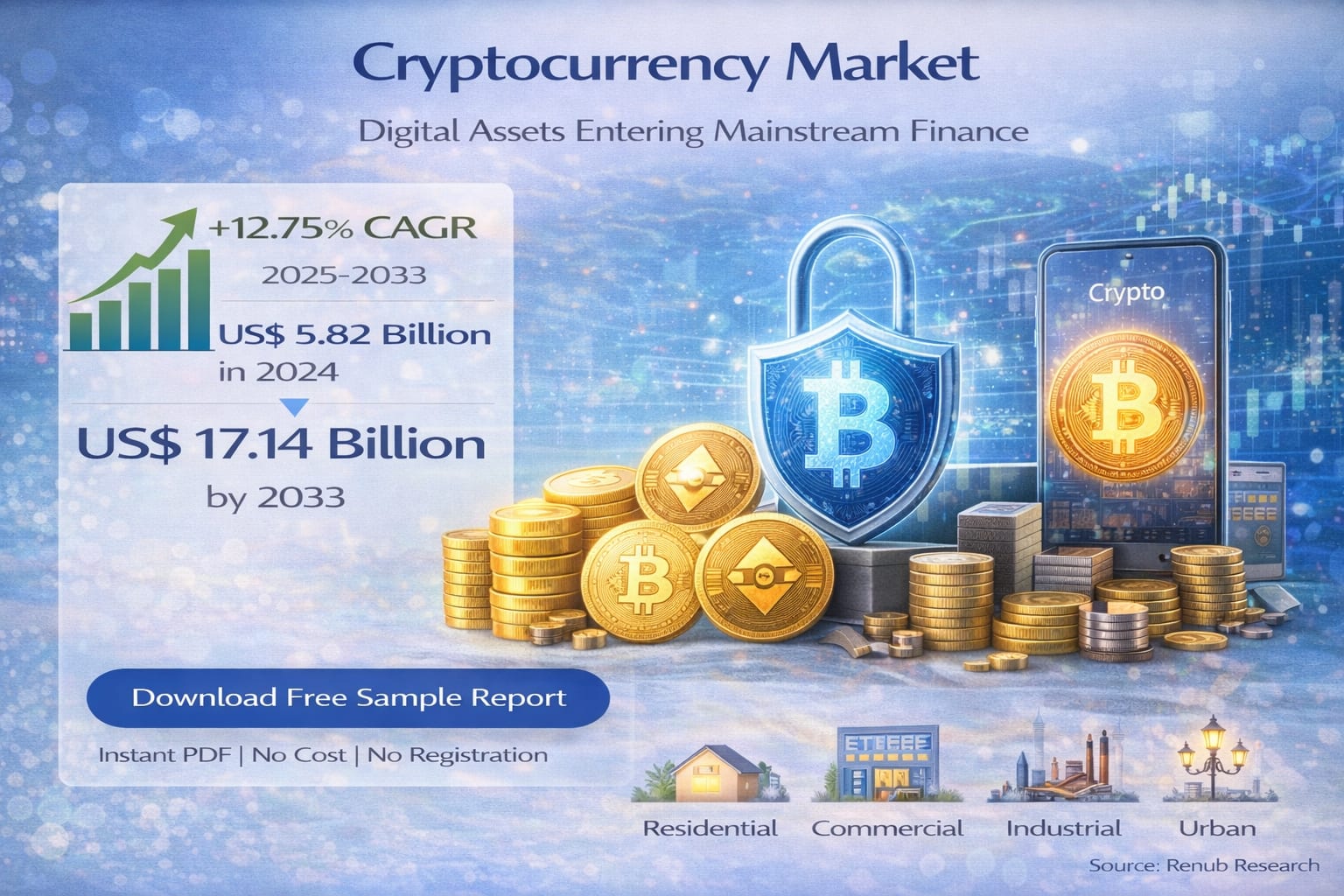
The Cryptocurrency Market is undergoing a powerful transformation as digital assets move steadily from the fringes of finance into mainstream economic systems. According to Renub Research estimates, the global cryptocurrency market is expected to expand from US$ 5.82 billion in 2024 to US$ 17.14 billion by 2033, registering a compound annual growth rate (CAGR) of 12.75% during 2025–2033.
This growth is driven by a convergence of factors: heightened interest in cryptocurrencies as inflation hedges, rising institutional investments, rapid adoption of decentralized finance (DeFi), expanding blockchain use cases, and gradually evolving regulatory frameworks. Beyond speculation, cryptocurrencies are now powering payments, smart contracts, tokenization of real-world assets, cross-border remittances, and next-generation financial infrastructure.
Global Cryptocurrency Market Overview
The global cryptocurrency market has evolved from a niche innovation into a foundational component of the modern digital economy. Initially developed as decentralized alternatives to fiat currencies, cryptocurrencies such as Bitcoin and Ethereum have matured into multifaceted financial instruments with applications far beyond peer-to-peer transactions.
At the core of this ecosystem lies blockchain technology, which offers transparency, immutability, and decentralized security. These attributes have unlocked new business models across finance, supply chains, digital identity, and governance. The emergence of decentralized finance (DeFi) platforms, non-fungible tokens (NFTs), and programmable smart contracts has significantly expanded the functional scope of cryptocurrencies.
Institutional participation has further legitimized the market. Regulated exchanges, professional custody services, and crypto-linked financial products have improved liquidity and investor confidence. Meanwhile, governments and central banks are actively exploring central bank digital currencies (CBDCs), reinforcing blockchain’s long-term role in reshaping monetary systems.
Positive regulatory signals in regions such as North America, Europe, and the Middle East continue to support market expansion. In November 2024, a consortium of crypto and fintech firms—including Robinhood, Kraken, and Galaxy Digital—launched a collaborative US dollar–backed stablecoin initiative under the Global Dollar Network, aimed at accelerating stablecoin adoption worldwide.
Key Factors Driving Cryptocurrency Market Growth
Growing Use of Digital Assets
Adoption of digital assets continues to rise across both retail and institutional segments. Global digital asset valuation nearly doubled in 2023, reflecting growing confidence in cryptocurrencies as efficient, secure, and inflation-resistant financial tools. As banks and payment providers integrate crypto services, trust in the ecosystem strengthens.
Beyond Bitcoin and Ethereum, a diverse universe of altcoins and utility tokens is enabling innovation across sectors. Cryptocurrencies also play a critical role in expanding financial inclusion, especially in underbanked regions, by offering low-cost, borderless access to financial services.
Increasing Public Awareness and Acceptance
Public awareness has become one of the most powerful catalysts for cryptocurrency adoption. As educational initiatives, media coverage, and user-friendly platforms expand, more individuals are becoming comfortable with digital currencies.
Businesses and retailers are also embracing crypto payments due to faster settlement, lower transaction fees, and access to global customers. Industry data indicates that around 40% of American adults owned cryptocurrency in 2024, highlighting the rapid normalization of digital assets in everyday finance.
Rising Institutional Participation
Institutional investors have transformed the credibility and stability of the cryptocurrency market. Hedge funds, asset managers, corporations, and pension funds are increasingly allocating capital to digital assets for portfolio diversification and inflation hedging.
This institutional influx has boosted liquidity, reduced extreme volatility over time, and driven the development of advanced infrastructure such as regulated derivatives, compliant exchanges, and secure custody solutions. Traditional financial institutions’ involvement also signals long-term confidence in blockchain-based financial systems.
Challenges Facing the Cryptocurrency Market
Regulatory Uncertainty
Despite progress, inconsistent regulatory frameworks remain a major hurdle. Governments worldwide adopt varying approaches—ranging from supportive regulation to outright bans—creating legal complexity for businesses and investors.
Unclear regulations can slow innovation, discourage institutional participation, and increase compliance costs. A harmonized global regulatory framework is essential for the cryptocurrency market to mature sustainably while ensuring investor protection, transparency, and responsible innovation.
Market Volatility and Security Risks
Cryptocurrency markets are inherently volatile, influenced by speculative trading, macroeconomic trends, and regulatory announcements. Such price fluctuations deter risk-averse investors and limit widespread adoption for everyday transactions.
Security remains another concern. Cyberattacks on exchanges, wallet breaches, phishing scams, and smart contract vulnerabilities continue to pose risks. While decentralization reduces single points of failure, it also complicates dispute resolution. Strengthening cybersecurity practices, conducting transparent audits, and enhancing user education are vital to building long-term trust.
Cryptocurrency Market Overview by Region
United States Cryptocurrency Market
The United States remains one of the most influential cryptocurrency markets globally. It hosts major exchanges, blockchain startups, and institutional investors. Regulatory oversight from bodies such as the SEC and CFTC continues to evolve, shaping market confidence and innovation.
Cryptocurrencies are increasingly integrated into mainstream finance, with payment companies and banks offering crypto-related services. States like Wyoming and Texas have emerged as crypto-friendly hubs, attracting miners and blockchain entrepreneurs. The potential launch of a U.S. CBDC and continued DeFi growth further strengthen the market outlook.
United Kingdom Cryptocurrency Market
The UK is positioning itself as a regulated yet innovation-friendly cryptocurrency hub. Oversight by the Financial Conduct Authority (FCA) emphasizes investor protection and AML compliance while still supporting fintech growth.
London remains a key center for blockchain and fintech companies, supported by strong financial infrastructure and growing public interest—especially among younger demographics. The UK’s balanced regulatory approach enhances its competitiveness in the global crypto economy.
China Cryptocurrency Market
China maintains strict controls over cryptocurrency trading and mining while aggressively promoting blockchain innovation and its state-backed digital yuan. Although private crypto activities are restricted, blockchain adoption in logistics, finance, and public services continues to advance.
Recent legal interpretations acknowledging cryptocurrencies as personal property suggest nuanced policy shifts. Overall, China’s approach focuses on sovereign digital currency development and state-led blockchain integration.
United Arab Emirates Cryptocurrency Market
The UAE has emerged as a leading crypto and blockchain hub in the Middle East. Proactive regulations in Dubai and Abu Dhabi, supported by authorities such as VARA and ADGM, provide clarity and confidence for investors and startups.
High internet penetration, government backing, and strong capital inflows have accelerated crypto adoption. Many global exchanges and fintech firms have established regional headquarters in the UAE, reinforcing its role as a global crypto innovation center.
Recent Developments in the Cryptocurrency Industry
In November 2024, Ingenico partnered with Crypto.com to enable seamless cryptocurrency payments for merchants worldwide, with automatic settlement in local fiat currencies.
Coinbase collaborated with the Singapore Economic Development Board to establish an engineering hub aimed at strengthening blockchain innovation and developer talent in Asia.
These developments highlight the growing convergence of traditional payment systems and digital assets.
Cryptocurrency Market Segmentation
By Component
Hardware
Software
Others
By Process
Mining
Transaction Processing
By Type
Bitcoin
Bitcoin Cash
Ethereum
Litecoin
Ripple
Others
By End Use
Banking
Gaming
Government
Healthcare
Retail & E-commerce
Trading
Others
Regional Outlook
North America: United States, Canada
Europe: France, Germany, Italy, Spain, United Kingdom, Belgium, Netherlands, Turkey
Asia-Pacific: China, Japan, India, South Korea, Thailand, Malaysia, Indonesia, Australia, New Zealand
Latin America: Brazil, Mexico, Argentina
Middle East & Africa: Saudi Arabia, United Arab Emirates, South Africa
Key Companies Covered
The report includes comprehensive analysis of leading players, covering company overviews, key personnel, recent developments, SWOT analysis, and revenue insights. Major companies include:
Advanced Micro Devices, Inc.
Binance
Bitfury Group Limited
BitGo, Inc.
Bitmain Technologies Holding Company
Intel Corporation
NVIDIA Corporation
Ripple
Xapo Holdings Limited
Xilinx, Inc.
Final Thoughts
The global cryptocurrency market is entering a defining phase. With a projected valuation of US$ 17.14 billion by 2033, cryptocurrencies are no longer experimental assets—they are becoming integral to the future of finance. While challenges such as regulatory uncertainty and volatility remain, continuous technological advancements, institutional adoption, and expanding real-world use cases are reshaping the market’s trajectory.
As blockchain technology continues to mature and integrate with traditional financial systems, cryptocurrencies are poised to play a central role in enabling transparent, inclusive, and efficient global economies. For investors, businesses, and policymakers alike, the coming decade represents a pivotal opportunity to shape and benefit from the next evolution of digital finance.