

This post was originally published on this site.
Retailers are no longer treating embedded finance as a checkout enhancement. The data show it is becoming a tool for control over customer relationships, compliance exposure and operational tempo across the retail stack.
That is the central takeaway from “Retailers Expand Embedded Finance to Unlock Control and Customization,” a November 2025 PYMNTS Intelligence report produced in collaboration with Marqeta.
Based on a survey of heads of payments at 37 U.S. retailers and commerce platforms, the report finds that embedded finance adoption is nearly universal among large retailers and that its value has shifted from experimentation to execution at scale.
While payments, wallets and lending options remain core use cases, retailers increasingly view embedded finance as infrastructure that shapes how shoppers pay, how firms manage risk and how quickly new offerings can reach market.
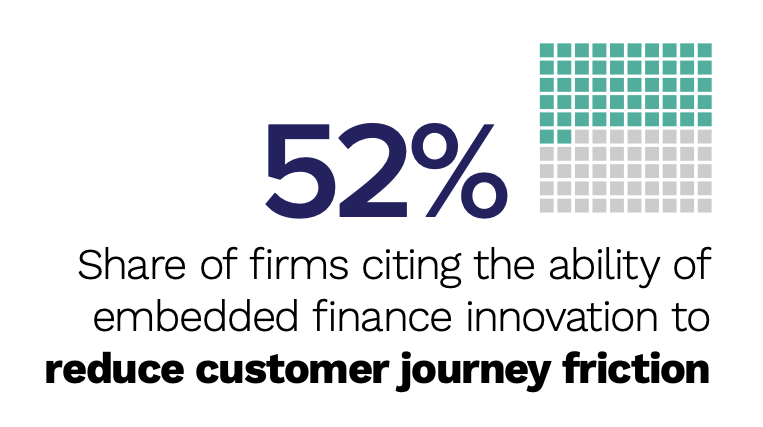
The report’s headline findings emphasize improved customer experience and operational efficiency. More than 8 in 10 retailers say embedded finance enhances the customer journey, and nearly 7 in 10 report efficiency gains.
But the deeper story is about governance and resilience. As embedded finance pulls retailers closer to regulated financial activity, success is no longer defined by incremental revenue alone. Instead, retailers measure progress by how well these systems manage fraud, meet regulatory expectations and protect consumer data while remaining flexible enough to support growth.
Advertisement: Scroll to Continue
Three data points illustrate how this shift is playing out across the sector:
- 68% of retailers report operational efficiency gains from embedded finance, reflecting benefits that extend beyond checkout to data visibility, internal coordination and faster product launches.
- 88% cite regulatory compliance as a challenge, a figure that rises to 100% among retailers offering subscription services, underscoring how recurring payment models intensify oversight demands.
- Only 11% measure success primarily by return on investment, signaling that risk management, compliance strength and customer experience now outweigh traditional financial metrics in evaluating embedded finance programs.
Taken together, these figures suggest that embedded finance has matured into a strategic capability rather than a revenue experiment. Retailers are using it to reduce friction for shoppers, but also to exert more control over payments data, loyalty mechanics and credit interactions that once sat outside their direct oversight. That control is increasingly valuable as consumers juggle multiple payment methods and expect seamless choices at the point of sale.
The report also highlights meaningful differences by retailer size. Smaller firms with under $750 million in annual revenue are more likely to see embedded finance as a way to catch up to larger competitors over the next year, while billion-dollar retailers focus more heavily on regulatory rigor and risk management. Across segments, fraud and compliance concerns cut through every embedded finance use case, from wallets and lending to payouts and co-branded cards.
Notably, the report frames these challenges as opportunities rather than barriers. Retailers that select partners with strong compliance capabilities and security-first architectures can simplify regulatory obligations while gaining competitive advantage.
The emphasis on collaboration between internal teams, clean data flows and clear accountability reflects a broader recognition that embedded finance touches far more than the payments function alone.
Other findings reinforce this operational lens. Retailers say embedded finance helps them gather richer customer data, personalize offers and accelerate time to market for new products. Many also report stronger customer trust and lower churn when financial tools are integrated directly into the shopping experience rather than routed through third parties. These benefits, the report suggests, accrue only when embedded finance is treated as core infrastructure.
The message is straightforward. Embedded finance is no longer about adding payment options. It is about designing commerce systems that balance flexibility with control. For retailers, that balance now defines success.