

This post was originally published on this site.
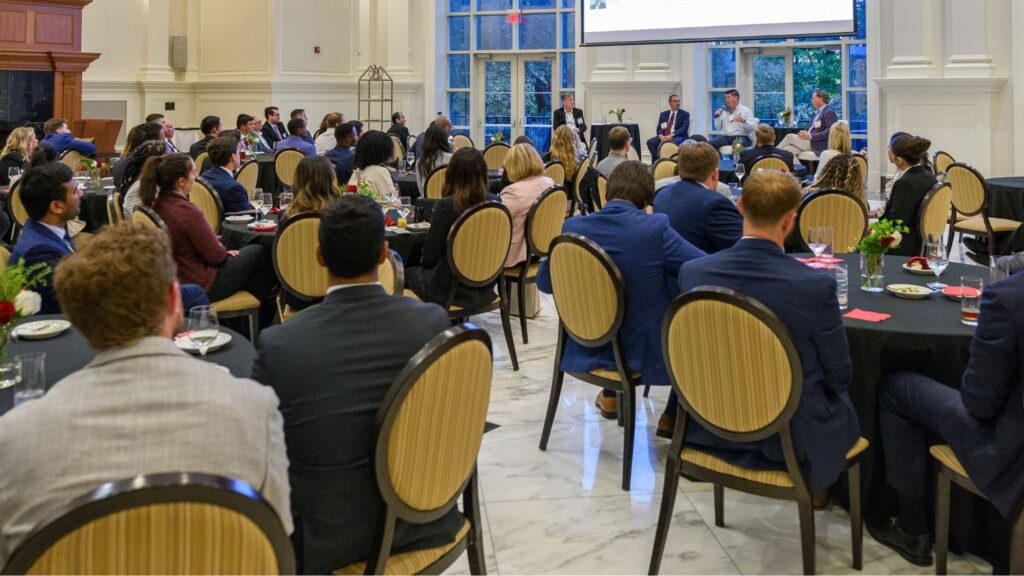
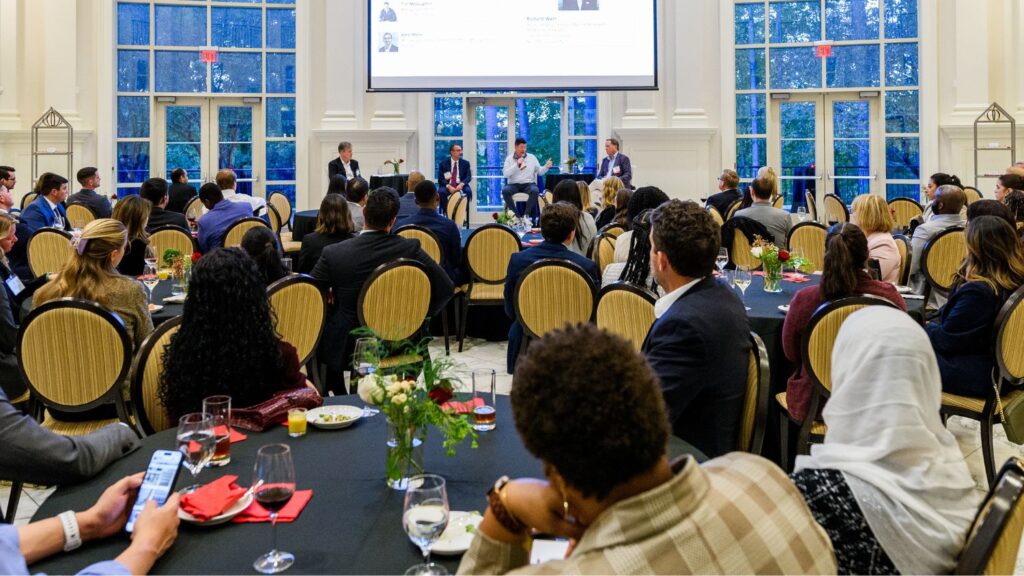
NC State’s Poole College of Management welcomed nearly 100 MBA and master’s students, faculty, alumni and industry partners to the Park Alumni Center this fall for its first annual Finance Sector Summit, an evening of discussion, insights and networking.
Hosted by the Poole College of Management Career Center, the event featured a panel of senior leaders spanning commercial banking, real estate, and venture capital to discuss the most significant shifts in the industry, emerging trends, and strategies for building successful careers.
The panel, moderated by Dr. Richard Warr, associate dean for faculty and research, included Jennings Glenn ’96, chief financial officer of Kane Realty; Amir Mehr ’92, managing director of portfolio management at Barclays and a member of the Poole College Advisory Board; and Timothy McLoughlin, managing partner at Cofounders Capital. The evening opened with remarks from Poole College Dean Frank Buckless and an overview of finance graduate statistics and trends presented by Summit emcee Dave Solloway, associate director of working professional careers.
Industry Shifts
The discussion began with panelists highlighting how the industry and finance roles have evolved over the last decade. Glenn emphasized the shift from reporting and compliance to strategic partnership and analytics, noting the growing role of technology and AI in financial decision-making. “Our finance departments are less about reporting and compliance and more about strategy. We’re focusing on the analysis: what platforms we use, how we’re leveraging AI. It’s a shift toward being strategic partners rather than just a reporting function.”
McLoughlin discussed changes in venture capital, adding that many firms are now taking a more measured approach to investments and risk management. Rounding out the discussion, Mehr emphasized regulatory and technological shifts in banking, saying, “if you’re not staying current every year, you’re literally behind.”
Hiring and Leadership in a Tech-Driven World
When discussing hiring and leadership, the panel shared insights on the importance of differentiating oneself in competitive environments and emphasized that in today’s finance landscape, technical skills alone are not enough. The group also explored how AI is reshaping workflows, hiring practices and competitive strategies, stressing that technology is most effective when paired with critical thinking and human judgment.
“You need to be able to communicate and present well. You can have the best ideas, but if you can’t articulate them, they won’t go anywhere. The world is hard. You need to be able to pivot, find a plan B, and solve problems rather than wait for someone else to fix them,” Mehr said.
Jennings cautioned that while the pace of innovation is accelerating, critical thinking matters more than ever.
“It’s easy to get enamored with new tech,” he said. “You have to believe in your tech first, understand what it can and can’t do, and decide if it’s the right tool for the job.”
He added that his own approach to leadership has been to surround himself with people who not only understand technology but also question it. “There are so many nuances. You have to do your research, and you have to ask why. If you hire people who ask that question, ‘Why are we doing it this way, how can we make it better?’, that’s where the real value of AI comes through.”
McLoughlin agreed, noting that the conversation around hiring is shifting as AI becomes more integrated into everyday finance work. “We were recently raising funds, and the plan was to hire two or three new analysts,” he said. “But with the help of AI, our current team can get the job done. That’s how hiring managers are thinking now: how can we do more with less? As we invest in tech, the question becomes: what is your competitive edge? AI can help, but some things only humans can do better.”
The panelists also shared that strong communication, curiosity and integrity were the key differentiators for those entering or advancing in the finance field, regardless of how technology continues to evolve. Jennings said, “Skill and excellence matter, but so does intellectual curiosity. The best people ask good questions. They’re not afraid of technology. They want to understand it and make it better.”
Navigating Uncertainty
As the conversation continued, the panel discussed how to lead through industry volatility and change. From real estate to banking, the group highlighted that success in uncertain times requires both strategic discipline and a willingness to evolve.
Jennings addressed the challenges facing real estate finance amid rising interest rates and shifting market demand.
“We’re evolving,” he said. “Our finance team is doubling down on relationships with investors and partners. The market is performing well, but it’s hard to get new projects moving right now. Capital is constrained, and costs are steadily climbing.”
“As we invest in tech, the question becomes: what is your competitive edge? AI can help, but some things only humans can do better.”
Despite those pressures, he noted that his firm has launched several new projects in recent months, crediting persistence and strong investor relationships. “You just have to put your head down and work harder; it’s what you have to do in real estate,” he added.
McLoughlin agreed that adaptability is key, especially when protecting existing assets in an unpredictable economy. “The last thing you want to do is take unnecessary risks with your current portfolio,” he said. “Everything changes every day, so your strategy has to be fluid. You have to be ready to pivot.”
Mehr shared that uncertainty is an inherent part of the banking industry and that sound decision-making depends on constant vigilance. “We’re watching health, consumer trends, corporations,” he said. “You make sure the lending you do doesn’t come back to bite you. It’s about lending to the right people and managing that risk appropriately.”
Across all three sectors, the panelists agreed that the ability to adapt, communicate and lead with discipline is what enables organizations not only to weather volatility but also to emerge stronger on the other side.
Advice for the Next Generation
As the panel drew to a close, each speaker reflected on what they’ve learned in their careers and what they wish they’d known when starting out. The conversation turned practical and personal, offering students insight into how to build meaningful, resilient careers in a rapidly evolving field.
Mehr encouraged students to stay curious about technology and to invest in communication. “If I were starting my career today, I’d make sure I knew how to use AI and machine learning tools,” he said. “But just as important: don’t underestimate personal relationships. Finance is about numbers, but it’s also about people.”
McLoughlin advised thinking beyond the short term, sharing, “When you graduate, consider not just your first opportunity, but what you want to do at scale, five or ten years from now,” he said. “And never underestimate the value of your network. You have to pick up the phone and call people, even outside your industry.”
“Never underestimate the value of your network. You have to pick up the phone and call people, even outside your industry.”
For Glenn, the lesson was about courage and connection. “Early on, I was hesitant to speak up,” he shared. “But in business, especially one as capital-intensive as real estate, you have to build trust and relationships, sometimes over years. Communication and confidence matter.”
When asked about mindset, all three echoed a similar theme: ask questions, stay humble and keep learning. McLoughlin noted that not knowing everything is part of the process and that you should never be afraid to ask for clarity. Mehr added that strong presentation skills and professionalism can help young professionals stand out.
Together, their insights reinforced that success in finance requires adaptability, authenticity, and an openness to technology and change, balanced by the values of curiosity, communication and human connection.
The Sector Summit Series supports the Poole College of Management Career Center’s goal to provide career education as a vibrant community to enable shared growth. When students, employers, alumni and faculty come together with shared interests and collaborate on real-world topics, they create an ecosystem of opportunity where learning, networking and mentorship naturally intersect. In this environment, students gain deeper insight into career paths and industry expectations; employers access emerging talent and fresh perspectives; alumni find renewed purpose; and faculty enrich their teaching with current, applied knowledge. This collective engagement transforms career development from a transactional process into a dynamic, relational journey.