
This post was originally published on this site.
Nadine YousifSenior Canada reporter

 Getty Images
With US-Canada trade talks still on hold, American officials have laid out their clearest demands yet for keeping free trade in place between the two countries.
The list includes further opening the Canadian dairy market to US farmers, and overhauling an online streaming law that the US says “discriminates” against American tech and media firms.
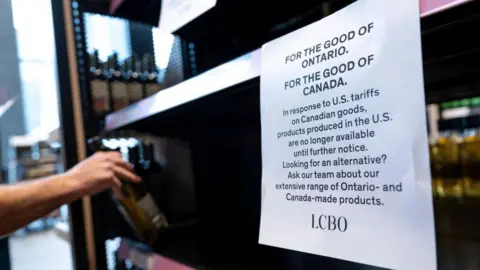
The US also wants Canadian provinces to lift their ban on selling American liquor, which was put in place earlier this year in response to the sweeping tariffs imposed by President Donald Trump.
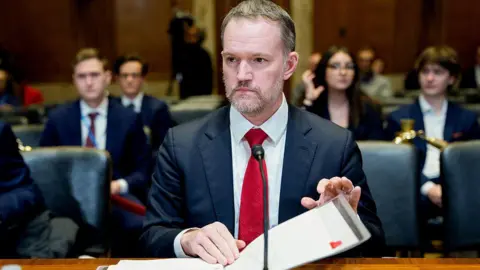
These demands and more were outlined by US trade representative Jamieson Greer before a Congressional committee on Wednesday, as part of a broader review of a North American free trade pact – known as the USMCA – that is now under way.
Both Canada and Mexico want it extended, although Trump has mused about leaving the agreement. Greer told Congress that the USMCA has been “successful to a certain degree” but changes must be made for it to continue.
Here is a breakdown of what the US wants from Canada.
Open up the market for US dairy farmers
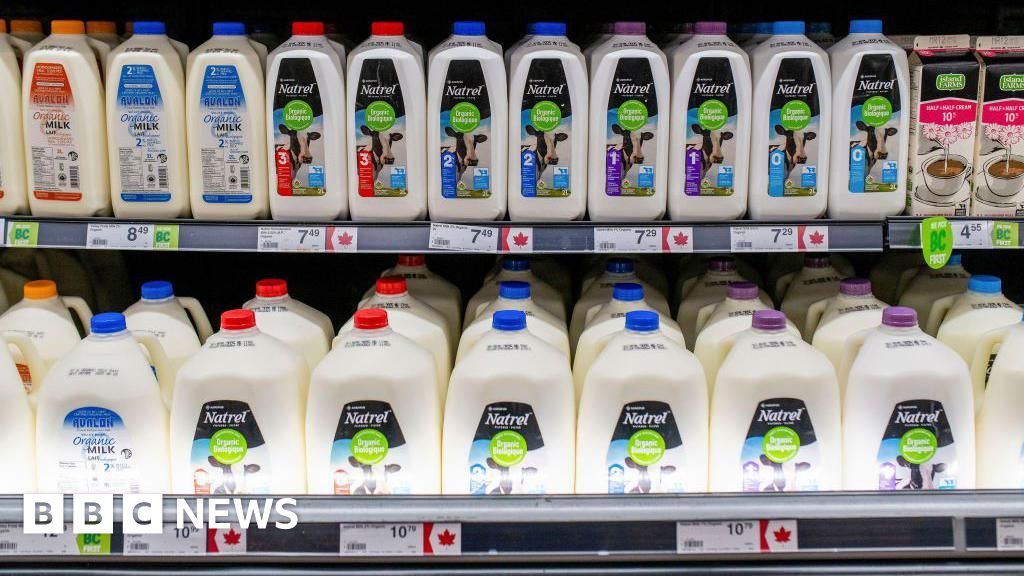
An enduring sore spot for the US has been Canada’s dairy supply-management system.
Trump himself has raised it several times, including in a letter earlier this year threatening Canada with a 35% blanket tariff rate. In it, he accused Canada of charging “extraordinary tariffs to our dairy farmers – up to 400 per cent”.
Canadian dairy is produced under what is known as a supply-management system, which strictly controls production quotas and imports to support local farmers.
The result is Canadians often paying higher prices for dairy products because of the restrictions.
 Getty Images
Some US dairy products are allowed in Canada tariff-free up to a certain limit. That limit has never been reached, however, meaning Canadian tariffs on US dairy have not been imposed.
Canada is among the top importers of US dairy, buying $1.1bn worth of products in 2024.
But the US believes the framework as it stands unfairly restricts market access for its dairy products in Canada, Greer said, and that Canada must bolster access under the USMCA.
Greer also wants Canada to address its exports of “certain dairy products” to America. The US has accused Canada of dumping nonfat milk solids to international markets at a low price, undercutting competition.
Carney said in August that dairy supply management is not “on the table” in ongoing trade talks with the US. But, in the last review of USMCA during Trump’s first term, Canada conceded and permitted greater access for US dairy products at low or zero tariffs.
Revise Trudeau-era policies on streaming
Another point of contention is a Canadian law called the Online Streaming Act, which was passed in 2023 by the government of former Prime Minister Justin Trudeau.
The law requires American media companies like Netflix and Spotify to pay to support Canadian content and promote it on their platforms.
It also gives Canada’s broadcast regulator powers to impose financial penalties on any companies that violate the act.
Its purpose is to protect Canadian media “to the benefit of future generations of artists and creators in Canada”, the government has said.
Greer told Congress that the legislation “discriminates against US tech and media firms” and that the policy needs to be revised, though he did not specify how.
He added the US is also looking for resolution on the Online News Act, a separate Canadian law that requires tech giants like Meta and Google to pay news outlets for content that appears on their platforms in Canada.
The law has been contentious, with Meta blocking news access for Canadian users on Facebook and Instagram since its inception to protest the changes.
 Getty Images
Put US liquor back on Canadian shelves
Trump’s blanket 35% tariffs on Canada, as well as his sector-specific tariffs on Canadian metals, lumber and automobiles, have been met with fierce pushback from provinces – the bulk of which removed US alcohol off their shelves in protest.
The move has been painful for American liquor producers, who say the boycott has contributed to a significant decline in sales.
Greer said the Americans want to see US liquor back on Canadian shelves if the USMCA were to be extended.
Most provinces, with the exception of Alberta and Saskatchewan, have stopped selling US liquor.
Canada’s largest province Ontario has been defiant in its boycott, with Premier Doug Ford saying the products will remain off the shelves until a tariff deal or a renegotiated USMCA is in place.
Solve Alberta-Montana electricity dispute
Greer’s note to Congress briefly mentions a few other irritants on the US side.
These include what Americans believe are “discriminatory procurement measures” in Ontario, Quebec and British Columbia, as well as “complicated customs registration” for US exports in Canada.
Greer also outlines one more issue – what he described as the “unfair treatment” of Montana electric power providers by Alberta.
This is tied to a report released in April by the Office of the US Trade Representative, which accuses Alberta’s non-profit electrical grid operator of blocking Montana-based electricity producers from accessing the Alberta market.
The Alberta government has denied this, saying in April that they do not treat generators in the US any differently.
Alberta Utilities Minister Nathan Neudorf told reporters at the time that it’s likely an issue for the US because Alberta has imported less energy from Montana in recent years.
Montana is still a net exporter of electricity to Alberta, according to a 2024 report by the Alberta Electricity System Operator, and Alberta imports more electricity from the US state than it does from nearby Canadian provinces.
Neudorf acknowledged earlier this year that it is “long-standing issue” between the two neighbours, but said that Alberta is committed to its trade obligations and relationship with Montana.