
This post was originally published on this site.
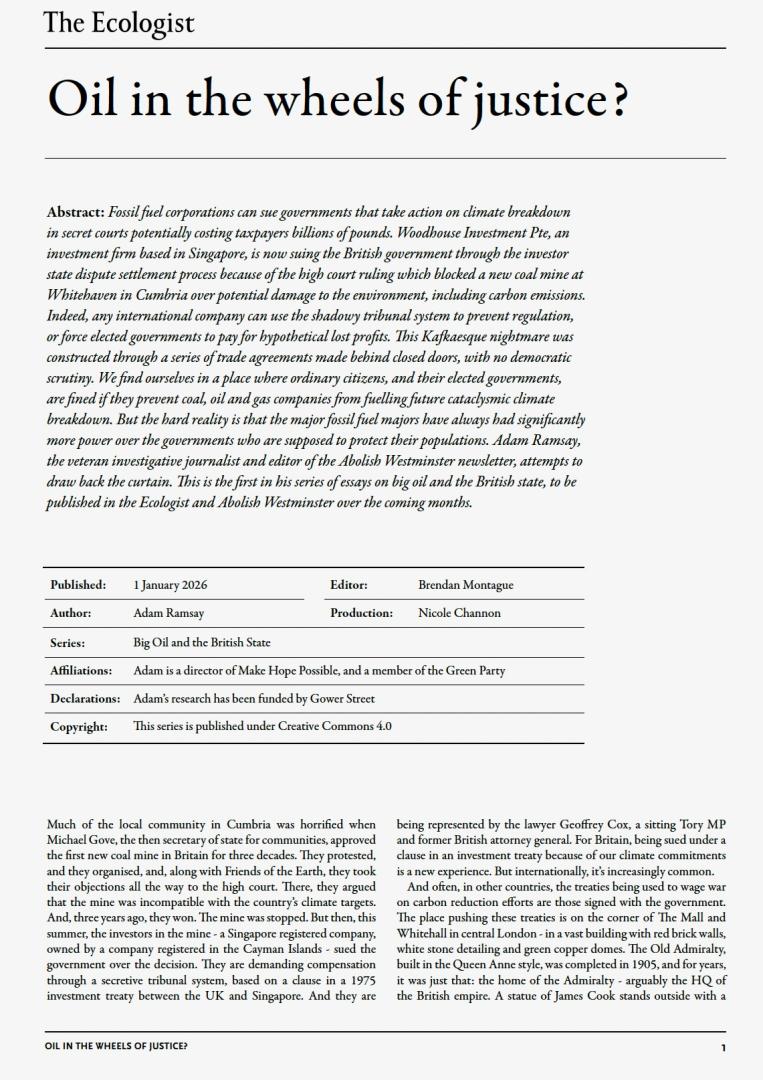
A fundamental lack of democracy in the formation of trade policy in Britain lets oil companies sue governments across the world if they take action on climate change, according to a new report from The Ecologist in partnership with Abolish Westminster.
The special issue looks at obscure legal clauses which the Department of Business and Trade (DBT) keeps putting into British trade deals.
READ THE REPORT: OIL IN THE WHEELS OF JUSTICE
These clauses mean governments can be sued by foreign companies if they pass laws which damage the future profits those companies hoped to get from any investments into their country.
Pollution
Britain is currently being sued under such a clause, because of a high court ruling which blocked a coal mine in Cumbria last year.
Adam Ramsay, the author of the report and editor of the Abolish Westminster newsletter, said: “All kinds of foreign businesses can use these treaties to sue governments which pass laws which damage their profits.
“But fossil fuel companies are the main companies which actually do so, often suing governments who are attempting to take action on climate change or pollution.”
Many countries around the world include these clauses – called Investor State Dispute Settlement (ISDS) mechanisms – in their trade deals.
However, the research last year showed that the treaties the companies use most often ones agreed by Britain. Indeed, Britain’s trade deals cause almost as much climate changing pollution as the country’s domestic economy. And elected MPs have almost no say over trade deals.
Accountability
The new report looks into why Britain is at the centre of a “spiderweb of treaties trapping the world in a fossil fuelled future”. The conclusion is that it results from a combination of imperial history, Whitehall inertia, and the fact Britain is “probably the least democratic of the world’s democracies.”
Ramsay, an investigative journalist, said: “The constitutional system of the ancient British state means that trade deals are signed under the ‘Royal Prerogative’ rather than parliamentary authority.
“This means there is pretty much no democratic accountability of how they happen. But in reality, everyone is accountable to someone, and British trade policy is being utterly shaped by big business.”
In Labour’s first year in power, meetings between government ministers at DBT and Shell and BP were more frequent than business secretary’s Question Time.
Scrutinise
The advisory committee known as the department’s Board of Trade, appointed under Labour, includes the chief executive of BAE Systems and senior lobbyists for the car and banking industries.
The report also highlights how Brexit has damaged accountability of trade policy, leading to what it calls ‘corporate capture’ of the process.
Caroline Lucas, the former Green Party MP and MEP, worked as a trade policy expert with Oxfam. She said: “UK trade policy remains cloaked in secrecy.
“Ironically, as a member of the European Parliament’s international trade committee, I had far greater opportunities to scrutinise European trade policy, and to hold decision makers to account, than I ever had as an MP over UK trade policy at Westminster.”
This Author
Brendan Montague is an editor of The Ecologist. Read the Oil In the wheels of justice report.