
This post was originally published on this site.
French President Emmanuel Macron has called for a massive increase in public investment, financed by joint EU borrowing, to secure Europe’s place in the global technological race, ahead of an informal meeting of EU leaders on February 12.
The meeting agenda includes a discussion on European competitiveness with Mario Draghi and Enrico Letta, the authors of two influential reports on competitiveness and the single market. But since their publication in 2024, the challenges facing Europe have only accelerated, Macron said.
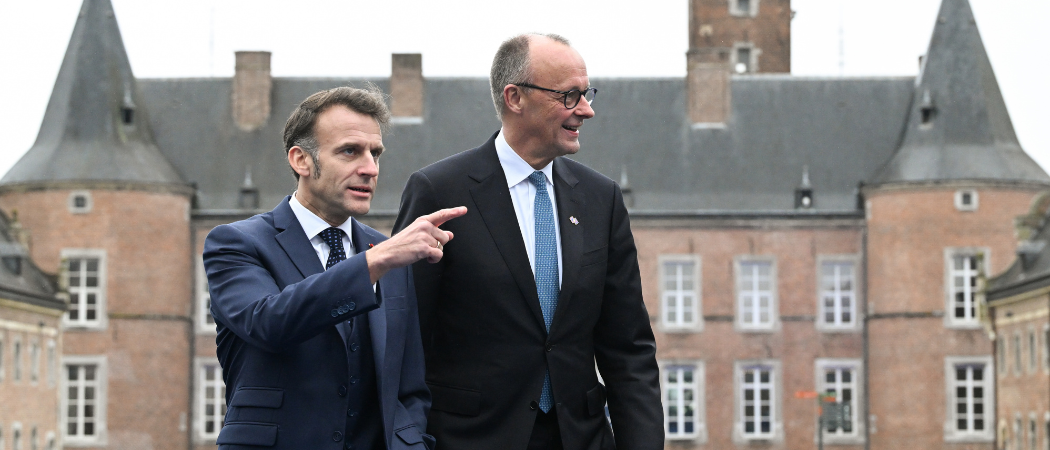
Faced with the loss of Russian energy, a swing in Europe’s balance of trade with China and an “increasingly confrontational” US administration, Europe must be in “emergency mode” to save its economy, he told the European Industry Summit in Antwerp on February 11.
Investment and innovation is one of four pillars in Macron’s proposed new industrial agenda. “On artificial intelligence, quantum computing, robotics, space, defence, clean tech, biotech, chemistry, chips, etc., we are at the beginning of a big revolution where both China and the US, privately and publicly, are investing much more than we are doing,” he said.
Macron pointed to Elon Musk’s Starlink as an example of a company that grew thanks not only to private funds, but to public subsidies and a US preference in procurement, calling claims that the company is a regular start-up “bullshit.”
To support strategic technologies, the next EU budget from 2028 “must significantly strengthen Europe’s financial firepower,” Macron said. This will require joint borrowing through eurobonds, as “there is no room to increase the European budget with additional taxes,” he said.
“If we want to have the right level of investment on space, defence and security, clean tech, AI and quantum, and to transform productivity and competitiveness, the only way is to have common issuance of debt,” he said.
Joint debt is not unprecedented; it’s how the bloc financed its €577 billion Covid pandemic recovery fund. But the issue divides member states, with Germany leading the opposition to the idea.
Two-speed Europe
When it comes to delivering other measures, notably a savings and investments union to boost investment and reduce fragmentation, both Macron and European Commission President Ursula von der Leyen opened the door to a possible use of enhanced cooperation, by which nine or more EU member states agree to closer integration without including unwilling countries.
“We want to do this by 27 [member states], but if this is not possible by the end of this year, I will propose to go with those who want to speed up in enhanced cooperation,” von der Leyen told the Antwerp meeting.
Macron, meanwhile, said this option would have to be considered if no progress has been made by the middle of the year. “2026 is the year where we have to finalise all the text,” he said.
Austria is likely to be part of any coalition. Chancellor Christian Stocker pointed out that every year, €300 billion of European savings flow to the US. “Imagine what it would mean for European innovation, entrepreneurship and jobs, if that money stayed in Europe,” he said.
Unlocking innovation
Another policy intended to further integrate the single market is the 28th regime, or EU-Inc, which the Commission will propose next month. The idea is to introduce an optional, EU-wide corporate regime, allowing companies to register within 48 hours in any member states and easing cross-border operations and access to finance.
Related articles
Germany is backing the idea. Chancellor Friedrich Merz said he would use the meeting of EU leaders on February 12 to advocate for setting a deadline to deliver the 28th regime by the end of the year.
At the European Council meeting in March, von der Leyen will propose adopting a joint single market roadmap to be completed by 2028, with a series of measures to be adopted by the end of this year.
Public procurement is another underexploited lever to support European technologies and industry. Von der Leyen said the Industrial Accelerator Act, due to be proposed next week, will include EU content requirements for strategic sectors. EU leaders, though, are haggling over whether to adopt a “made in Europe” approach, or a “made with Europe” strategy that is more inclusive of international partners.
Regulatory simplification also emerged as a common theme. “European companies tell us they spend almost as much on bureaucracy as on research and development. This cannot be,” Von der Leyen said in a speech to the European Parliament earlier in the day. Merz, meanwhile, called for a “true deregulation mindset.”
That message was echoed by Belgian Prime Minister Bart De Wever. He said rigid definitions of green technologies “slow down innovation rather than accelerating it,” and called for technological neutrality in the green transition to include technologies such as carbon capture and nuclear energy.
The slow pace of change was also highlighted by several EU leaders. “After one year, barely one in ten of Draghi’s recommendations have been implemented,” De Wever said.
At the 2024 edition of the industry summit, 73 business leaders signed the Antwerp Declaration, featuring ten recommendations for a European industrial deal. A monitoring report prepared by Deloitte ahead of this week’s summit suggested that across 83% of EU competitiveness metrics, there has been no improvement since the declaration was signed.
However, during Wednesday’s debate in the European Parliament on delivering on the Draghi report, MEPs from the Socialists and Democrats and the Greens insisted that competitiveness must not come at a cost of social and environmental deregulation.