
This post was originally published on this site.
So … does anybody actually want to win this thing?
In the wake of all the moves that happened at the NBA trade deadline — a record-shattering 28 for deadline week, actually — I don’t think we’ve paid quite enough attention to the moves that didn’t happen.
Namely, where the heck were all the contenders? Other than a handful of teams trying to acquire Giannis Antetokounmpo, the top-tier contenders were shockingly quiet.
Advertisement
With all due respect to Kevin Huerter, Ayo Dosunmu, Luke Kennard, Jared McCain and Jose Alvarado, there was only one deadline-week deal that had more than a marginal impact on the title chase. That was James Harden’s move to the Cleveland Cavaliers, and that trade was to a team that stood fifth in the Eastern Conference on deadline day. Otherwise, the top eight teams in each conference were crickets.
In fact, several teams there were either clearly in the title chase, or could at least make an argument to be on the fringes of it, nonetheless made moves that were the exact opposite of going for it. The Boston Celtics cut salary to get under the luxury tax, as did the Philadelphia 76ers. So did the Orlando Magic, who weren’t exactly tearing up the league but also entered the year going for broke, trading four first-round draft picks for Desmond Bane and carrying four near-max contracts.
The Miami Heat, normally leading the pack in go-for-it moves if they have any chance at all, sat out the trade deadline entirely. And the Houston Rockets, in the top four in the West with two All-Stars despite a murderous first-half schedule, seemed to decide it wasn’t worth chasing with Fred VanVleet and Steven Adams out of the season and that they’d try again next year.
Even the teams that made moves weren’t exactly burning through their asset pile to do it. The Detroit Pistons received a trade-up in the 2026 NBA Draft to turn Jaden Ivey into Huerter. Desperate for shooting, the Pistons also ended up with a guy in the midst of a three-year shooting slump and have hardly played him in non-garbage time since he arrived. Also, I mean … Kennard was right there. But I digress.
The Los Angeles Lakers, who did trade for Kennard, similarly stood out for things that they maybe could have done but didn’t. Boston, meanwhile, turned Anfernee Simons into a cheaper and bigger player in Nikola Vučević but pointedly did not turn him into the even less expensive Ivica Zubac.
Advertisement
Even a Toronto Raptors team itchy to go up another level didn’t complete anything noteworthy; one wonders about how a Jaren Jackson Jr. pursuit might have gone, as he’d seem to fit their roster perfectly. And whither the San Antonio Spurs, while we’re at it? Would a frontcourt of Jackson and Wembanyama ever give up a basket?
Individually, any of these teams could make a credible case for their course of action. And certainly, some of the top teams had their hands so firmly tied by the aprons and their own traded draft picks that anything beyond trading seconds for a backup was basically a backup.
As a group, however, the inaction of the league’s best 16 teams was absolutely stunning. Amazingly, all were either outbid or not interested in the two clear gems of this trade deadline: Zubac and Jackson. How is it possible that the Indiana Pacers and Utah Jazz came in with the winning bids on these guys? Wait, it gets better: The two next-best gets, Anthony Davis and Trae Young, both ended up on the 14-38 Washington Wizards.
Partly, I’m sure, there was a sense of keeping powder dry for a run at Giannis, one that might have extended beyond just the four teams reportedly directly involved in trade talks for the Milwaukee Bucks’ superstar. For instance, a team like Detroit, Houston or San Antonio might well think, “Let’s see what this looks like through one postseason cycle before we make a giant, aggressive move like that.”
More intriguingly, we didn’t see Orlando — whose current front office drafted Antetokounmpo in Milwaukee — make any stab at a Paolo Banchero-for-Antetokoumnpo concept. One wonders if we might this summer, if the Magic continue struggling like this the rest of the way.
Still, it’s shocking that none of those top 16 teams appeared to be a factor in the race for either Zubac or Jackson. Should a team such as Miami or the Golden State Warriors have pivoted to a move for Jackson right now rather than wait and hope on Giannis this summer? Would they have had enough to beat Utah’s offer if they did?
Advertisement
That last Jazz note (sorry) gets to the other half of the great trade deadline surprise: The non-contenders acted like contenders, even though they were making win-now moves for next year rather than this one. And once that happened, Indiana and Utah had better draft capital to put on the table than nearly any of the contenders. The LA Clippers have a great chance at turning Zubac into a lottery pick; no pick from the Celtics, to use one example, has anywhere near the same odds.
You might wonder: Was there something in the collective bargaining agreement that incentivized this behavior? Not especially, it seems. If anything, the shoot-money-from-the-firehose teams in the contender class might have been more tempted to chase Jackson while they were matching a $35 million salary now, rather than a $49 million salary this summer. (Jackson’s unusual renegotiate-and-extend deal in the summer of 2025 produced a much greater than usual hike in his cap number.)
One could argue that it was the reverse effect of all the aprons and the punitive repeater tax. Teams must now think very, very hard about which players are worth $50 million a year to their franchise, even the ones like the Clippers and Warriors that aren’t going to sweat writing luxury-tax checks.
That perhaps created the necessary conditions to help the Jazz, Pacers and Wizards win out in the bidding for the players they acquired, but it wasn’t the only piece. When looking at Utah’s and Washington’s willingness to jump in for expensive, veteran players, a different answer likely emerges: owners being just plain sick of losing.
Any rebuilding project has an inherent timeline. Telling an owner “we’ll stop once we get the exact right guy to build around” is probably the correct way to do it, but it’s ultimately an extremely unsatisfying (not to mention job-security-threatening) answer. That’s especially true when flattened lottery odds have made the tanking strategy less of a sure thing than it was during the halcyon days of The Process.
Ergo, the Jazz, after five years of competing for half a season and then shamelessly engineering a second-half tailspin, have decided they’re done with it. Washington, at 47-169 (.218) over the past three seasons, has similarly declared the rebuilding part over. And the Pacers, obviously, never intended to be this bad to begin with; theirs is a pure “gap year” strategy. It’s something to keep in mind as we track further rebuilds around the league: even a full teardown comes with a timeline.
Nonetheless, I’m wondering if we may end up looking back on this trade deadline in two or three years and asking a lot of questions about what might have been. It depends heavily on how the 2026 postseason turns out, to be sure, and certainly on what the endgame is for Antetokounmpo as well. But I’m wondering if at least a few teams near the top of the standings will rue their decision not to chase harder for the ring while they could.
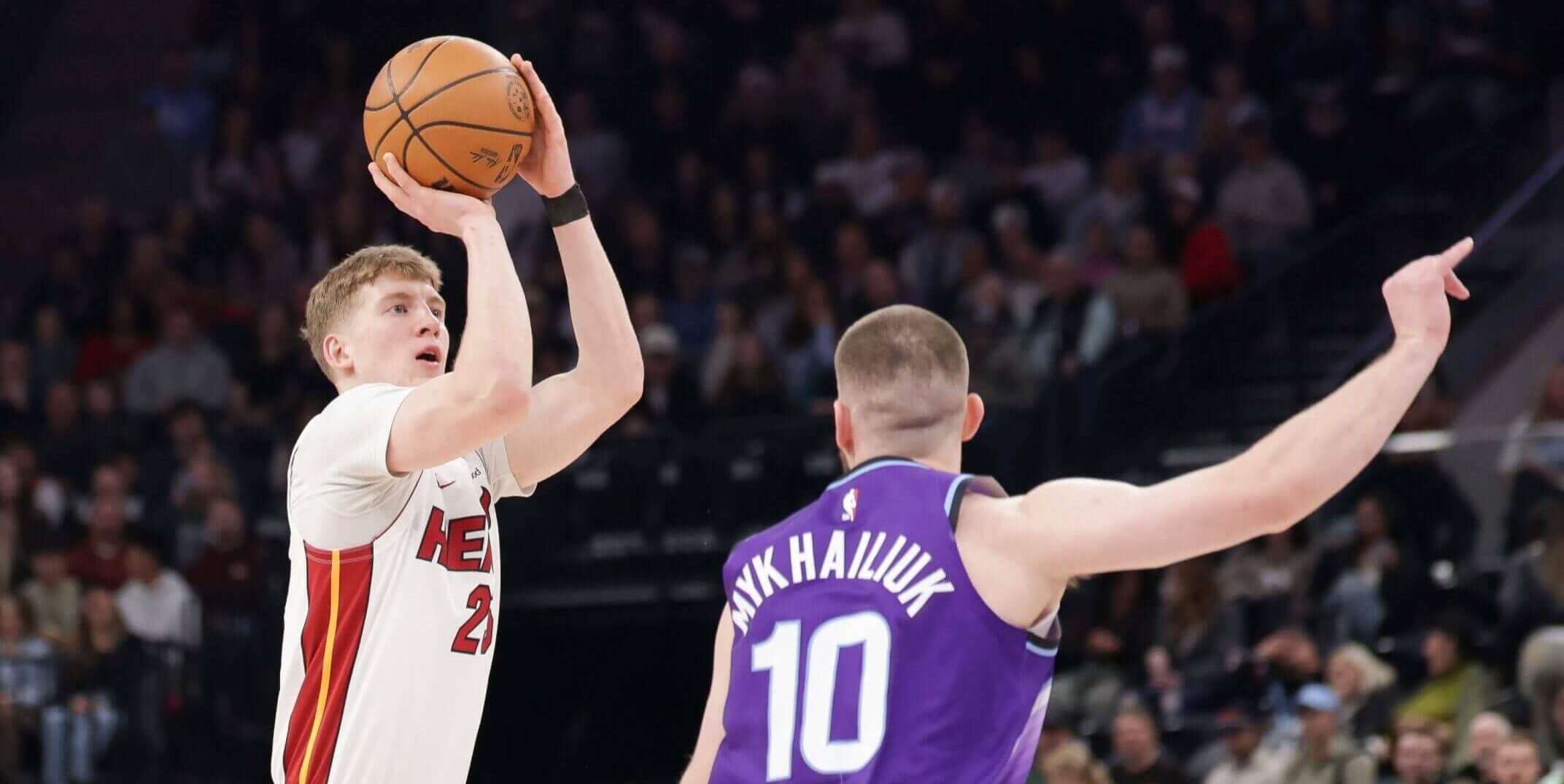
Kasparas Jakučionis has been launching a lot of 3s for the Heat recently. (Chris Nicoll / Imagn Images)
Rookie of the week: Kasparas Jakučionis, 6-5 PG/SG, Miami
(Note: This section won’t necessarily profile the best rookie of the week. Just the one that I’ve been watching.)
Advertisement
Who says player development has to be linear? After a groin injury delayed the start of his rookie season and left him behind the curve throughout the first half, Jakučionis unexpectedly broke out in the last 48 hours with his two highest-scoring games of the season.
Fresh off a DNP earlier in the week, the 20th pick in the draft from Illinois scored 22 and added six assists in the Heat’s blowout win over Washington on Sunday, and then came back with 20 more in a loss at home to Utah on Monday.
While he missed a potential game-tying 3 at the end of the second game, the fact he was even on the floor for that shot — and that he was seemingly the first option on the play — speaks volumes about his recent heater. Behind the arc, Jakučionis went 6-of-6 from 3 on Sunday and 6-of-10 on Monday.
The percentage is unsustainable, obviously, but the level of 3-point volume is the real key. He just hadn’t been letting it rip at anywhere near that frequency before last week. However, he got six attempts up on Jan. 31 and then 16 more in the last two games; he had only one game with more than four attempts before then. Some of that is playing-time driven, yes, but he has 27 3-point attempts in his last 118 minutes, putting him over the rate of eight tries per 36 minutes that marks one as a true bomber.
His rate before then? A measly 5.1.
On tape, what stands out is the speed of his release; he’s catching and flicking the 3 up from his shooting pocket with no ball dip and no hesitation, and it’s allowed him to get shots away before a closeout can reach him. At his size, that part is imperative going forward.
Defensively, Jakučionis also likely enjoyed his two blocks and one steal on Sunday — one of each came at the expense of his former Illinois teammate Will Riley, including a blocked 3 in which Jakučionis tracked back in transition and caught Riley from behind.
The Heat will still want to see more from Jakučionis inside the 3-point lane, where he is shooting a putrid 27.2 percent on the year, but this last week should help serve as proof of concept for the Heat that the 19-year-old Lithuanian can be a rotation-ready piece next to Giannis as Miami sets up its roster for next season.