
This post was originally published on this site.
Never miss an important update on your stock portfolio and cut through the noise. Over 7 million investors trust Simply Wall St to stay informed where it matters for FREE.
-
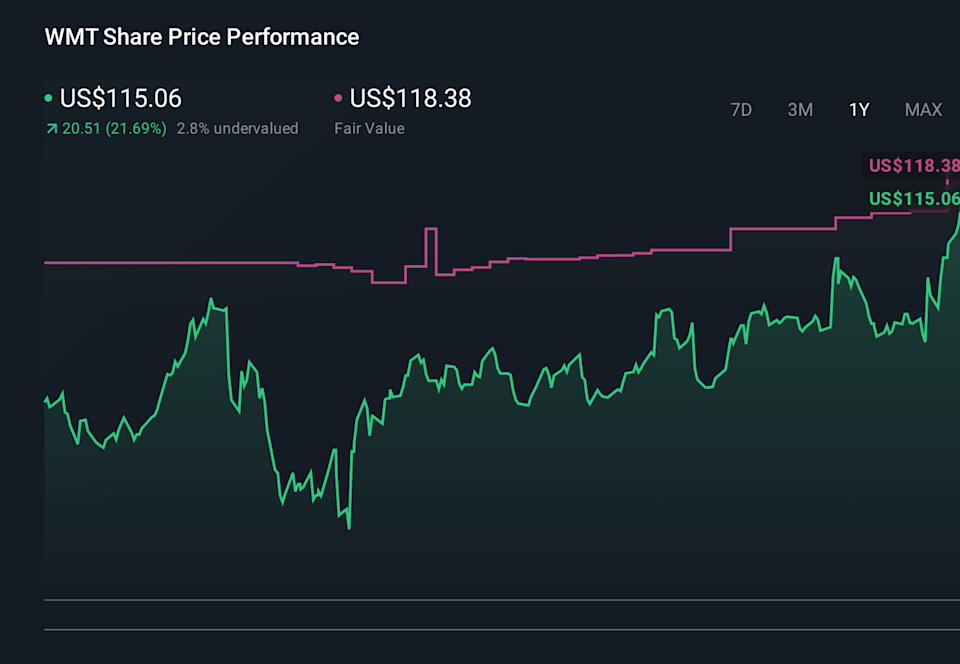
Walmart (NasdaqGS:WMT) has reached a market capitalization of about US$1t, becoming the first large brick and mortar retailer to cross this level.
-
The milestone comes as the company builds out its digital businesses, rolls out more automation, opens new formats such as its Jacksonville Supercenter, and prepares for leadership under incoming CEO John Furner.
For you as an investor, Walmart now sits alongside some of the largest public companies by equity value, even though its core is still physical retail. The company operates a broad mix of Supercenters, clubs, and e-commerce, and is active in areas like online grocery, marketplace services, and technology driven logistics. These business lines sit at the center of long running trends in omnichannel shopping and scaled supply chains.
The combination of a US$1t valuation, store expansion, automation spending, and a CEO transition gives you several angles to track in the months ahead. How Walmart balances capital allocation between digital initiatives, physical stores, and shareholder returns, and how John Furner sets priorities, may shape how investors think about the company over the longer term.
Stay updated on the most important news stories for Walmart by adding it to your watchlist or portfolio. Alternatively, explore our Community to discover new perspectives on Walmart.
Why Walmart could be great value
Walmart joining the US$1t club signals that investors are treating it less like a traditional retailer and more like a platform business that mixes physical stores, digital commerce, advertising and logistics. The recent Jacksonville Supercenter opening, growth in marketplace services and logistics integrations for sellers, and earnings up 35.2% year over year all feed a story that the market is willing to pay up for scale plus execution, not just store count.
The current move in the share price and valuation lines up with the long-running investor narrative that Walmart can use automation, AI and e-commerce to squeeze more profit out of its huge store base. Store projects like the Jacksonville next generation Supercenter, international efforts such as Flipkart and the Lane Bryant tie up in Canada all echo the thesis that Walmart’s brand, data and supply chain can support both low prices and higher margin services, alongside peers such as Amazon and Costco.
-
A 35.2% year over year earnings increase and profitable online business give investors tangible evidence of operating leverage from digital and automation investments.
-
The US$1t valuation, Nasdaq 100 inclusion and growing interest during recent tech volatility suggest some investors view Walmart as a relatively resilient alternative to pure tech names such as Amazon and Target’s parent company.
-
Retail theft, rising labor costs and ongoing store expansion and automation capex could pressure margins if efficiency gains or higher margin streams such as advertising and marketplace fees do not keep pace.
-
At this valuation, expectations around CEO John Furner, upcoming earnings on February 19 and continued e-commerce momentum are high, so any sign of slower growth or weaker consumer demand could trigger a sharp shift in sentiment.
From here, you may want to watch how quickly Walmart rolls out more next generation stores, the pace of automation investments across its 42 regional distribution centers, and how marketplace, advertising and Walmart+ contribute alongside core grocery. If you want to see how different investors connect these developments into a long term story, check out the community narratives for Walmart on this dedicated page.
This article by Simply Wall St is general in nature. We provide commentary based on historical data and analyst forecasts only using an unbiased methodology and our articles are not intended to be financial advice. It does not constitute a recommendation to buy or sell any stock, and does not take account of your objectives, or your financial situation. We aim to bring you long-term focused analysis driven by fundamental data. Note that our analysis may not factor in the latest price-sensitive company announcements or qualitative material. Simply Wall St has no position in any stocks mentioned.
Companies discussed in this article include WMT.
Have feedback on this article? Concerned about the content? Get in touch with us directly. Alternatively, email editorial-team@simplywallst.com