
This post was originally published on this site.
With the business potentially at an important milestone, we thought we’d take a closer look at Insmed Incorporated’s (NASDAQ:INSM) future prospects. Insmed Incorporated develops and commercializes therapies for patients with serious and rare diseases in the United States, Europe, Japan, and internationally. The US$32b market-cap company posted a loss in its most recent financial year of US$914m and a latest trailing-twelve-month loss of US$1.2b leading to an even wider gap between loss and breakeven. The most pressing concern for investors is Insmed’s path to profitability – when will it breakeven? We’ve put together a brief outline of industry analyst expectations for the company, its year of breakeven and its implied growth rate.
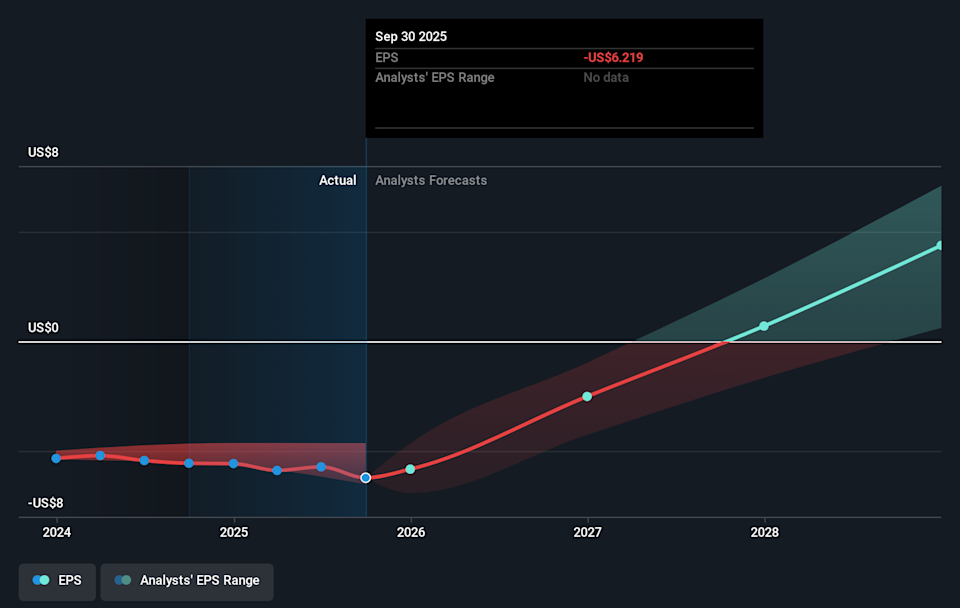
According to the 18 industry analysts covering Insmed, the consensus is that breakeven is near. They expect the company to post a final loss in 2026, before turning a profit of US$170m in 2027. The company is therefore projected to breakeven just over a year from now. How fast will the company have to grow each year in order to reach the breakeven point by 2027? Working backwards from analyst estimates, it turns out that they expect the company to grow 60% year-on-year, on average, which is extremely buoyant. If this rate turns out to be too aggressive, the company may become profitable much later than analysts predict.
Underlying developments driving Insmed’s growth isn’t the focus of this broad overview, though, keep in mind that by and large biotechs, depending on the stage of product development, have irregular periods of cash flow. So, a high growth rate is not out of the ordinary, particularly when a company is in a period of investment.
View our latest analysis for Insmed
One thing we would like to bring into light with Insmed is its relatively high level of debt. Generally, the rule of thumb is debt shouldn’t exceed 40% of your equity, which in Insmed’s case is 74%. A higher level of debt requires more stringent capital management which increases the risk around investing in the loss-making company.
There are key fundamentals of Insmed which are not covered in this article, but we must stress again that this is merely a basic overview. For a more comprehensive look at Insmed, take a look at Insmed’s company page on Simply Wall St. We’ve also put together a list of important aspects you should look at:
-
Valuation: What is Insmed worth today? Has the future growth potential already been factored into the price? The intrinsic value infographic in our free research report helps visualize whether Insmed is currently mispriced by the market.
-
Management Team: An experienced management team on the helm increases our confidence in the business – take a look at who sits on Insmed’s board and the CEO’s background.
-
Other High-Performing Stocks: Are there other stocks that provide better prospects with proven track records? Explore our free list of these great stocks here.
Have feedback on this article? Concerned about the content? Get in touch with us directly. Alternatively, email editorial-team (at) simplywallst.com.
This article by Simply Wall St is general in nature. We provide commentary based on historical data and analyst forecasts only using an unbiased methodology and our articles are not intended to be financial advice. It does not constitute a recommendation to buy or sell any stock, and does not take account of your objectives, or your financial situation. We aim to bring you long-term focused analysis driven by fundamental data. Note that our analysis may not factor in the latest price-sensitive company announcements or qualitative material. Simply Wall St has no position in any stocks mentioned.