
This post was originally published on this site.
As AI overviews and shopping agents divert clicks away from traditional search results, Google Discover may provide a new and growing source of organic traffic for ecommerce merchants.
Discover is Google’s personalized, query-less content feed similar to those on X and Facebook. The Discover feed appears in Google’s mobile applications and on the main screens of Android devices. It shows articles, videos, and content that presumably interests users.
How Google selects a given article or video to appear in the Discover feed is something of a mystery, with some marketers admitting that Google Discover Optimization — GDO, if you need another three-letter acronym — is significantly different from traditional organic search.
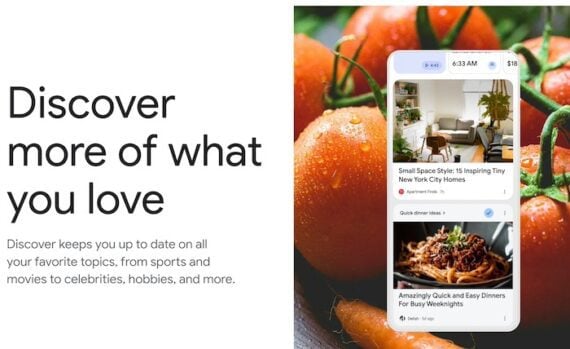
Discover is a personalized, query-less content feed similar to those on X and Facebook. Image: Google.
Core Update
Google’s February 2026 Discover Core Update marks the first time the search engine giant changed its algorithm for Discover alone.
Google says the update improved quality. It aimed to reduce the presence of clickbait and low-value content while surfacing more in-depth, original, and timely material from sites with demonstrated expertise.
Some published reports speculated that the update devalued AI-generated content, yet Google’s concern is probably not artificial intelligence per se. Rather, it is scaled, thin, or risky AI-generated content that degrades trust.
Discover’s content is not in response to a query. Google chooses what to show folks. That choice raises the bar for accuracy, usefulness, and credibility in ways that differ from classic search results.
In a sense, the Discover update is less about ranking tweaks and more about editorial standards. Google may be limiting sensational, misleading, or mass-produced content to protect the tool’s long-term viability.
Therein lies the content marketing opportunity.
Discover’s Future
Discover launched in 2018. Until recently, it has been, for most marketers, a secondary way to boost traffic.
News publishers in particular could see significant traffic spikes when an item made its way into the feed. But optimizing for Discover did not compare to the steady, regular flow of site traffic that organic search could deliver.
As AI Overviews have siphoned off that traffic, some marketers have emphasized Discover.
Google’s apparent focus — both in this update and in previous moves — has prompted widespread speculation about Discover’s future.
Discover as a home feed. Discover could become a personalized home feed for the Google ecosystem. Imagine something akin to an individualized MSN or Yahoo home page.
This home feed might include articles, videos, social content, and even data from other Google products, such as Gmail or Docs. The goal might be to keep users engaged across Google properties.
What’s more, both MSN and Yahoo have shown that such pages drive significant ad revenue.
Personal and local experience. In its February update, Google noted that Discover would favor local or regional content. Users in the United States will see content from domestic publishers.
That could benefit retailers with physical stores, as very local content might beat out similar articles from nationwide competitors.
Multi-format, creator-centric. The Discover feed has recently featured relatively more video and creator content, especially from YouTube and social platforms.
While publishers often frame this as competition, ecommerce marketers could benefit. Product explainers, buying guides, and similar content already perform well in video and visual formats. Discover’s expansion beyond text may favor brands and retailers that invest in rich, creator-led content.
Yet merchants without creators can mimic the style and potentially win on Discover.
An interest graph, not just a feed. Some have suggested that Google treats Discover as part of a broader interest graph that informs search, recommendations, and AI-assisted experiences.
Thus content that performs well in Discover may shape Google’s understanding of user intent over time beyond the feed itself.
Discover could be upstream from traditional and AI-driven search. GDO may precede and inform SEO, GEO (generative engine optimization), and AEO (answer engine optimization).
Optimize
If it’s becoming a meaningful traffic channel, Google Discover deserves attention.
Start with Google’s recommendations, which include descriptive headlines, large images, and “people-first” content. From there, marketers can experiment.
A practical approach is a testing framework. Publish consistently and track Discover performance separately in Search Console. Over time, look for editorial traits, formats, or topics that predictably earn Discover visibility and thus inform a long-term strategy.