
This post was originally published on this site.
The NHL’s Olympic freeze, which will prohibit teams from making trades until 11:59 p.m. Eastern on Feb. 22, has officially kicked in. Besides the Artemi Panarin trade, the league’s pre-freeze trade activity was fairly tame.
That isn’t entirely surprising, given the growing sentiment that teams wanted to wait until after the Olympics to complete business. After all, a buying team’s trade needs could shift if one of its own players or outside trade targets is injured at the Olympics.
Advertisement
Once the freeze is lifted, we should see plenty of moves (even if they don’t necessarily involve many big names) in the 12 days leading up to the March 6 deadline.
Which teams should we expect to make moves by the deadline? Here are the seven clubs — four of them buyers and three of them sellers — that are most likely to wheel and deal before the deadline. Others will make trades too, but these are the teams with the most urgent need to consider a move.
St. Louis Blues
The Blues (31st-place) are the only bottom-four team in the NHL standings that has yet to trade away a core player. Vancouver (Quinn Hughes), New York (Artemi Panarin), and Calgary (Rasmus Andersson) have already made a seismic selling move. We expect St. Louis to join that group before the deadline; five Blues players were on Chris Johnston’s most recent trade board: Robert Thomas, Brayden Schenn, Justin Faulk, Jordan Kyrou and Jordan Binnington.
St. Louis is in a unique position because all five of those players are non-rentals with term beyond this season. I’m not privy to the exact trade conversations and leaguewide market for those five players, but here’s how I’d consider approaching their futures:
• Justin Faulk (15-team no-trade list): He’d be near the top of the list for who the Blues should be most motivated to trade because his value isn’t going to be any higher than it is right now. He’s having a nice bounce-back year that the Blues should capitalize on. There’s a shortage of top-four defenseman on the market. He’s signed through next season, so as a non-rental, he could be extra attractive to a team such as Detroit. Since his contract expires at the end of next season, the Blues should be willing to retain a small portion of his $6.5 million AAV to further juice his trade value.
• Brayden Schenn (15-team no-trade list): Schenn turns 35 this summer and has two years left beyond this season at a $6.5 million AAV. He’s an excellent leader and means a lot to the organization as a captain, but his age and contract make him a depreciating asset (we’re already seeing evidence of his on-ice decline this season), and I’d be motivated to shop him while he still presumably has value. It might not be a bad idea for the Blues to wait until the offseason to trade him because the free-agent center market is bleak (which means teams could be more desperate to trade for centers), and there’s usually more demand for players on hefty contracts in the offseason when teams have more cap flexibility. Overall, though, this is a trade that the Blues should make at some point before next season begins.
Advertisement
• Robert Thomas (full no-trade clause): I would keep him unless a team massively overpays for him with a can’t-refuse offer. First-line centers don’t grow on trees, and at 26, Thomas is still young enough to be part of the Blues’ long-term future.
• Jordan Binnington (14-team no-trade list): He’s probably not worth much right now, considering his brutal season and sizeable $6 million cap hit. I would hold onto him and hope he can rebuild his trade value, as Tristan Jarry did. Binnington’s contract expires at the end of next season, so if he bounces back, he could become a significantly more valuable trade chip at next year’s deadline as a rental, especially if the Blues retain salary on him.
• Jordan Kyrou (full no-trade clause): I’d be open to possibly trading him for the right deal, but the Blues shouldn’t accept a low-ball offer for him based on his down season (13 goals in 47 games). He’s on a big-ticket long-term contract and owns a full no-trade clause, so this type of move would be complicated to pull off midseason. I’d be comfortable keeping him next season and beyond if no offer impresses me.
It’s unlikely we’ll see the Blues pull off a massive fire sale ahead of the deadline, given the contracts and trade protections surrounding these players. However, they’ll almost certainly make one or two notable selling moves before March 6.
Carolina Hurricanes
Four years in a row, the Hurricanes have been eliminated in the playoffs by either the Florida Panthers or the New York Rangers. With the Rangers hopeless and the Panthers sitting eight points back of a wild-card spot, those obstacles are likely out of the way this year. Couple that with Carolina standing out as the only true Cup contender in the Metro division — Washington and New Jersey have regressed significantly, and though the Penguins and Islanders are feel-good stories, they aren’t threats to win a championship — and this year represents the Hurricanes’ best chance of reaching the Stanley Cup Final with this core.
Advertisement
With this potentially easier playoff path in mind, Carolina should be highly motivated to buy ahead of the deadline. The Hurricanes have an endless pit of cap room, which isn’t true for every contender and is especially valuable now that double-retention transactions are no longer permitted under the CBA rule changes. They have more trade chips to wield than most contenders, as they’re armed with all of their future first-round picks and have an extra one in 2028 from Dallas.
Carolina’s biggest need is to add a true second-line center behind Sebastian Aho. Logan Stankoven is an adequate middle-six center stopgap, but come playoff time, he would ideally shift back to the wing. In the past, the Hurricanes have gone after star wingers at the deadline (Mikko Rantanen, Jake Guentzel), but Nikolaj Ehlers’ arrival from free agency has partially checked that box, not to mention that the club has an overall glut of wingers. A reunion with Vincent Trocheck could be an interesting idea, but it’s a fool’s game to guess who specifically Carolina will chase, because its front office often has smart outside-of-the-box ideas up its sleeve.
Dallas Stars
An arms race is brewing in the Central Division.
Minnesota is a Cup contender after acquiring Hughes and is likely not done shopping. The Avalanche, who are already the best team in the NHL, will surely be looking to add as well. The Stars can’t afford to sit on their hands, as reaching a third consecutive Western Conference Final will likely require beating both teams in a playoff series.
Tyler Seguin’s uncertain future adds another layer of mystery and urgency to Dallas’ approach to the deadline. Seguin tore his ACL in December, and the club announced that his timeline will be evaluated after the Olympic break. If Seguin is ruled out for the playoffs, the Stars will be able to place his $9.85 million cap hit on season-ending LTIR, which would open up a ton of cap flexibility ahead of the deadline. This feels like the most likely scenario because the odds of a player recovering from ACL surgery to play in hyper-intense Stanley Cup playoff games in less than six months seem slim.
Dallas has a couple of weaknesses that it should address. Up front, the Stars would benefit from adding a middle-six forward — they lost a decent chunk of their forward depth in the summer as Mikael Granlund, Mason Marchment and Evgenii Dadonov all departed last summer. Seguin’s injury has further exacerbated that gap, forcing the club to rely on less proven players such as Sam Steel, Mavrik Bourque and Justin Hryckowian in elevated roles, with mixed results this season.
On the back end, the Stars also need to add a top-four right-shot defender. This has become an annual trade deadline requirement, as the club traded for Chris Tanev in 2024 and for Cody Ceci last year. Finding an upgraded partner will be crucial to unlocking the best version of Thomas Harley. Harley, a top-20 defenseman in the NHL, is having a down year, earning only 44.9 percent of shot attempts and 47 percent of expected goals at five-on-five this season. He’s been saddled with one of Nils Lundkvist or Ilya Lyubushkin for most of the season, which just isn’t going to cut it come playoff time.
Advertisement
Dallas’ asset pool is limited — GM Jim Nill is without his 2026 and 2028 first-round picks — so I’d expect the team to aim for a couple of savvy depth additions to solve these needs rather than an expensive home-run swing.
Toronto Maple Leafs
The Leafs are entering the Olympic break on a mini three-game winning streak, which has kept them alive on the fringes of the Eastern Conference playoff race, but that shouldn’t change their posture ahead of the deadline. It’s time to sell.
Toronto is still six points back of a playoff spot, but even if it did go on an unlikely charge back into a wild-card spot, this isn’t a team that can realistically challenge for the Stanley Cup. The Leafs have regressed massively defensively; their back end is shaky without Chris Tanev, and their forward group isn’t very imposing.
In 2016-17, the Blues traded Kevin Shattenkirk away for a first-round pick despite being in a playoff spot. A year later, they boldly traded Paul Stastny away for another first-round pick despite only being one point back of a playoff position. The reasoning was simple: Doug Armstrong knew his team wasn’t a threat to go deep in the playoffs, even if it qualified, so he was willing to sell when many other teams in his position would have been satisfied with keeping the team together and squeaking into a playoff spot. Toronto would be wise to take the same approach.
The Leafs should be especially motivated to sell because they need to restock the cupboards after years of trading away picks and prospects. Bobby McMann, a pending UFA on pace for 28 goals, should have similar trade value to Kiefer Sherwood, who fetched the Canucks two second-round picks. Scott Laughton is also on an expiring contract and should have decent trade value.
On the blue line, Toronto should be listening to offers on Brandon Carlo and/or Oliver Ekman-Larsson. Carlo only has one year beyond this season, and while the Leafs won’t be able to recoup all of what they surrendered for him, he should still be a valuable commodity. Ekman-Larsson, meanwhile, could present an interesting opportunity to sell high on a player who turns 35 this summer.
There are other players, such as Nicolas Roy, to consider, but the overall point is that the Leafs should be honest with themselves about how significant a step back they’ve taken and make an aggressive pivot ahead of the deadline.
Advertisement
Minnesota Wild
The Hughes trade immediately vaulted the Wild to Cup contender status. Since acquiring Vancouver’s former captain in mid-December, Minnesota is 16-5-5, which is the best record in the Western Conference. The Wild were 24th in the league in goals scored per game before the Hughes trade; now they’re the highest scoring team in the NHL since his arrival. Hughes, who is finally surrounded by elite talent, has racked up 34 points in 26 games, which would be a 107-point pace over 82 games.
All of this is exciting, but the Wild can’t afford to be complacent. Their roster isn’t perfect, and because they’re in the vaunted Central Division, they’re projected to face an elite Dallas Stars team in the first round of the playoffs. If they get past Dallas, the Colorado Avalanche will likely be waiting for them in Round 2. There’s organizational pressure to finally get over the first-round playoff hump, as they haven’t won a playoff series since 2015. The stakes are especially high because a long postseason run would boost their odds of being able to convince Hughes to re-sign when he’s extension-eligible this summer.
It’s no secret that Minnesota’s biggest need is adding another top-six center to complement Joel Eriksson-Ek. Danila Yurov has had a solid rookie campaign, and Ryan Hartman can adequately fill in at center, but their one-two-three punch down the middle pales in comparison to Dallas (Wyatt Johnston, Roope Hintz, Matt Duchene) and Colorado (Nathan MacKinnon, Brock Nelson, Jack Drury).
The Wild spent a lot of assets in the Hughes trade, but they still have a fair bit of young trade chips, including their 2027 first-round pick, high-scoring NCAA center Charlie Stramel, and David Jiricek, among others. Because Filip Gustavsson is signed through 2031, there’s even a possibility that Jesper Wallstedt could be available if a true No. 1 center (not for a Vincent Trocheck-level player) became available.
The debate now is whether it’s worth taking another big, expensive swing at the deadline, or chasing a cheaper middle-six center stopgap for now and saving their best assets for the summer, when better players could become available. Regardless of what path they choose, though, the Wild will have to add up front ahead of the deadline, even if it ends up being a less splashy name.
Edmonton Oilers
Edmonton’s roster has multiple flaws/question marks.
The team’s defensive play has been shaky, and their blue line has some good pieces, but can be exposed at times because of Darnell Nurse’s struggles. Their goaltending situation is still somewhat worrying, as Tristan Jarry has posted an .870 save percentage in 11 games as an Oiler. However, it’s very unlikely they seek another goaltending move given what they just invested in the position. On the back end, they’re stuck with Nurse and their other top-four defenders, Evan Bouchard, Mattias Ekholm and Jake Walman, are quality players, so it’s unlikely we’ll see a major defense shake-up.
Advertisement
That leaves a top-nine forward as the most realistic need that the club can address ahead of the deadline.
During last year’s Stanley Cup Final, the difference between Florida and Edmonton’s forward depth was stark. The Panthers were so deep that they were rolling Brad Marchand and Anton Lundell on their third line; meanwhile, the Oilers were far too reliant on Connor McDavid and Leon Draisaitl. Florida had nine forwards who contributed at least four points in that Cup Final, while the Oilers only had four (McDavid, Draisaitl, Vasily Podkolzin and Corey Perry).
The Oilers can be flexible regarding the forward’s position; if they land a center, it will give them the luxury of using Ryan Nugent-Hopkins as a full-time winger, and if they land a winger, they can deploy RNH as a full-time 3C.
Edmonton owns all of its future top picks, except this year’s first-rounder, so the front office has trade chips to play with. The largest constraint will be cap space — the Oilers are pressed up against the ceiling, which means they’ll need to shed a contract such as Andrew Mangiapane’s to afford taking on a significant salary.
Calgary Flames
The Flames have moved several veterans as part of their teardown in recent years, including Noah Hanifin, Elias Lindholm, Jacob Markstrom, Tyler Toffoli, Chris Tanev, and, most recently, Rasmus Andersson. Calgary has accumulated excess draft picks and some intriguing young players, but there’s still a lot of work to be done to execute a successful rebuild.
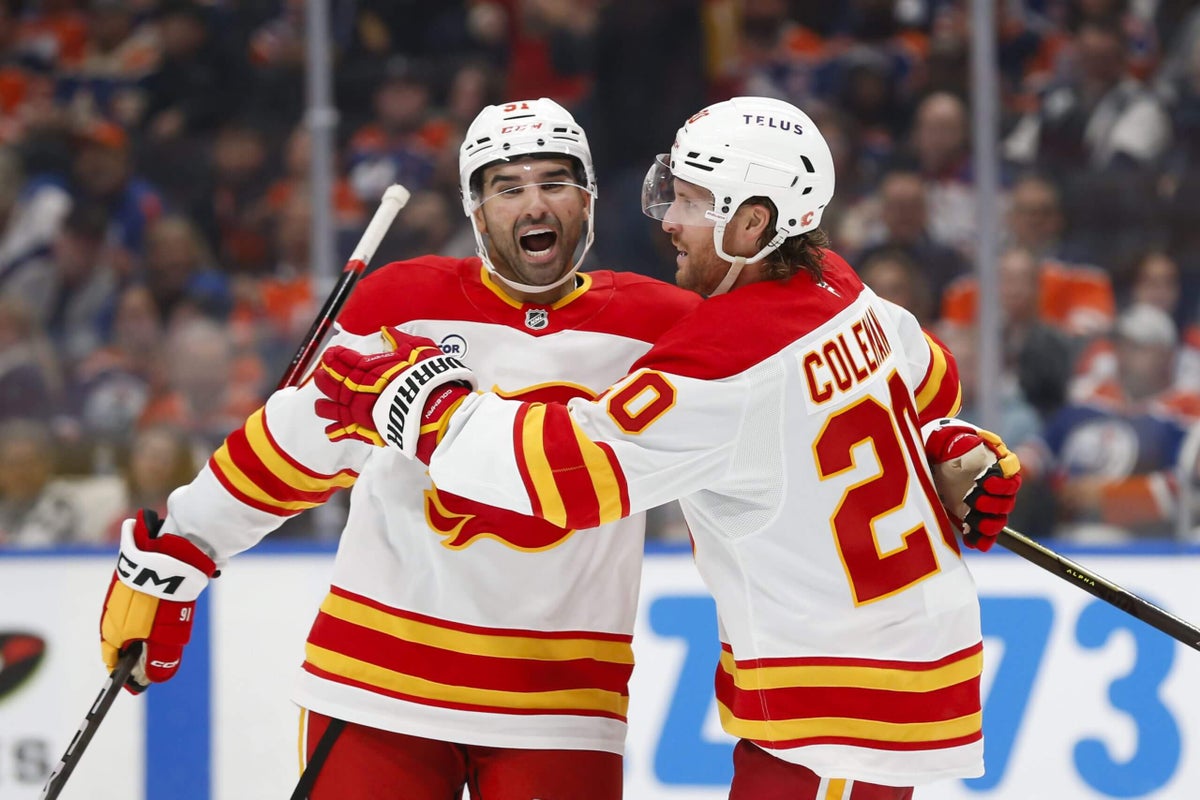
Nazem Kadri, in particular, stands out as a chip that the Flames should be trying to cash in on for several reasons. At 35, Kadri is too old to fit the timeline of a realistic Flames turnaround. The demand for top-six centers is high, and the supply is thin, which should drive prices up in Calgary’s favor. The Flames shouldn’t wait too long to pull the trigger on a Kadri trade because the older he gets, the greater the chance that his performance and trade value could decline. We’re already seeing signs of that this year — Kadri is on pace for 15 goals and 57 points, which is a notable dip from the 35 goals and 67 points he racked up in 2024-25.
If the Flames move Kadri, you’d imagine they’ll be looking for something similar to what they got for Lindholm or what Brock Nelson fetched for the Islanders last year. The Lindholm trade netted Calgary a first-round pick, a legit B-grade prospect in Hunter Brzustewicz, and a lesser prospect in Joni Jurmo. That first-rounder became Matvei Gridin, who’s having a phenomenal season as a first-year pro. The 19-year-old winger has scored at nearly a point-per-game clip in the AHL and has six points in 13 NHL games, which is very impressive age-adjusted production.
Advertisement
Nelson went for even more than Lindholm: He returned the Isles a first-round pick, high-end prospect Calum Ritchie, and a conditional third-round pick.
Lindholm and Nelson were rentals, whereas Kadri has three years remaining on his contract after this season. I’m not sure the extra term significantly boosts Kadri’s trade value, though, because he’s signed through his age-38 season, which carries some risk. If anything, it’ll be fascinating to see how amenable the Flames are to retaining a portion of Kadri’s $7 million AAV, which could affect how high the demand and price for his services are.
Kadri’s the main chip that should go, but Blake Coleman (signed through 2026-27 at a $4.9 million cap hit) and Zach Whitecloud (signed through 2027-28 at a $2.75 million cap hit) could be possible assets as well.
Honorable mentions: Detroit Red Wings, Colorado Avalanche, Vancouver Canucks, Tampa Bay Lightning, Buffalo Sabres