
This post was originally published on this site.
Track your investments for FREE with Simply Wall St, the portfolio command center trusted by over 7 million individual investors worldwide.
-
Strategy (NasdaqGS:MSTR) reported one of the largest net losses ever recorded by a U.S. public company, driven by unrealized Bitcoin mark to market losses.
-
The company highlighted that the loss stems primarily from accounting treatment of its sizable Bitcoin holdings rather than cash outflows.
-
Management, including Michael Saylor and CEO Phong Le, reiterated a long term commitment to holding Bitcoin and pointed to significant cash reserves.
-
Strategy also announced a Bitcoin security initiative aimed at emerging risks, including potential future threats from quantum computing.
For you as an investor, the key context is that Strategy operates as both a software company and a corporate Bitcoin holder, with its equity often trading as a proxy for Bitcoin exposure. The latest results underline how closely the company’s reported earnings and balance sheet are tied to crypto asset price swings and evolving digital asset security risks.
Looking ahead, the investment case around NasdaqGS:MSTR will likely focus on how the company manages this dual identity as an operating business and a large Bitcoin holder. The new security program signals management attention to long term technical risks such as quantum computing, which could be an important theme for investors tracking crypto related equities.
Stay updated on the most important news stories for Strategy by adding it to your watchlist or portfolio. Alternatively, explore our Community to discover new perspectives on Strategy.
Why Strategy could be great value
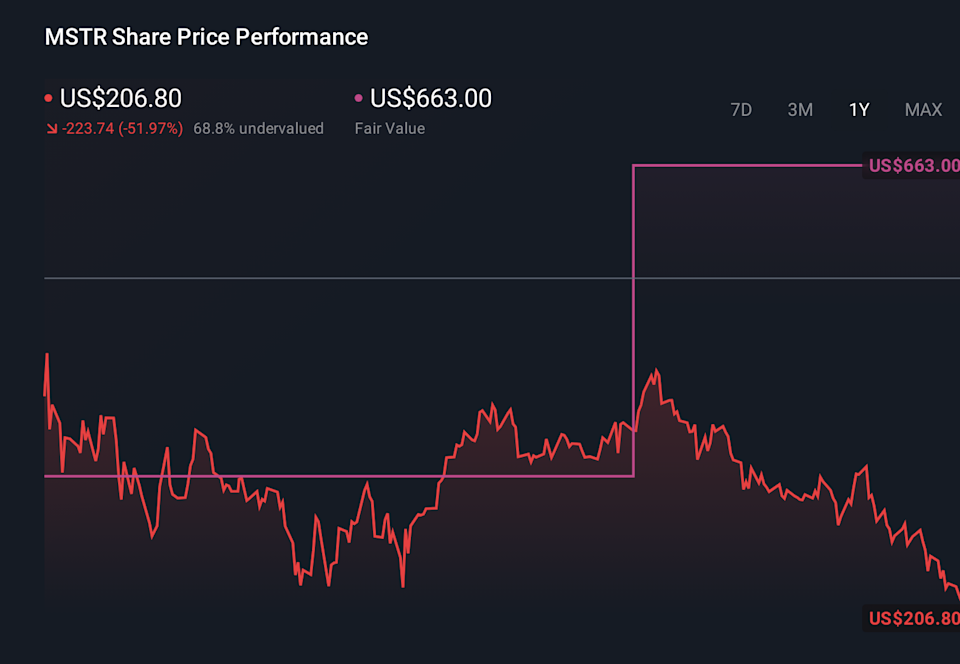
The headline figure is the Q4 net loss of US$12.4b and a full year loss of US$3.8b, but management is framing this as largely an accounting effect from fair value marks on 713,502 Bitcoin rather than a cash drain, pointing instead to US$2.25b of cash and detailed stress tests down to a Bitcoin price of US$8,000. For you, the key question is not just the size of the loss but whether Strategy can keep funding its Bitcoin-first model through equity, preferreds and debt in a market where the share price has already seen sharp swings.
This update is very much in line with the existing narrative of Strategy as a leveraged Bitcoin treasury and financing platform, where the software business and digital credit products are secondary to the goal of growing Bitcoin per share. The reported losses, large unrealized swings and continued accumulation through a US$84b multi year plan all reinforce the idea that investors are effectively choosing a high beta Bitcoin proxy rather than a traditional software peer like Microsoft, Oracle or Salesforce.
-
⚠️ Large unrealized Bitcoin losses flowing straight through earnings highlight how volatile reported results can be from quarter to quarter.
-
⚠️ The model depends heavily on ongoing access to equity and credit markets, so share price weakness or tighter funding could make future Bitcoin purchases harder and increase dilution risk.
-
🎁 Management points to sizeable cash reserves and no Bitcoin pledged as collateral, which reduces the risk of forced selling if crypto prices stay weak.
-
🎁 The new Bitcoin security program and attention to quantum computing risk may appeal to investors who care about long term asset protection in crypto exposed companies.
From here, it is worth tracking how closely Strategy’s share price continues to move with Bitcoin, whether capital raising activity slows or continues at pace, and how often the company updates on its Bitcoin security initiative compared with software and subscription metrics. If you want a broader sense of how different investors are thinking about this Bitcoin heavy model and its trade offs, take some time to check community narratives on Strategy’s dedicated page.
This article by Simply Wall St is general in nature. We provide commentary based on historical data and analyst forecasts only using an unbiased methodology and our articles are not intended to be financial advice. It does not constitute a recommendation to buy or sell any stock, and does not take account of your objectives, or your financial situation. We aim to bring you long-term focused analysis driven by fundamental data. Note that our analysis may not factor in the latest price-sensitive company announcements or qualitative material. Simply Wall St has no position in any stocks mentioned.
Companies discussed in this article include MSTR.
Have feedback on this article? Concerned about the content? Get in touch with us directly. Alternatively, email editorial-team@simplywallst.com