
This post was originally published on this site.
© HSE University
How are investment decisions changing under conditions of inflationary shocks and the application of machine learning methods? Can financial risks be predicted using new metrics? What is the role of banks’ climate resilience, and how do geopolitical upheavals affect global value chains? These questions were at the centre of discussion at the 14th International Moscow Conference on Financial Economics held on November 28 and organised by the International College of Economics and Finance (ICEF) at HSE University.
Bringing together researchers from universities in South Korea, China, Italy, Switzerland, the USA, and Russia, the conference served as a platform not only for presenting new scientific ideas but also for discussing the challenges facing the modern financial system.
In his opening remarks, Vladimir Sokolov, Chair of the Conference Organising Committee and Head of the ICEF Laboratory in Financial Economics at HSE University, noted that the current agenda in financial economics is increasingly shaped by instability, technological shifts, and institutional challenges.
‘Many of the studies presented at the conference directly address contemporary challenges, from climate risks to trade wars. We are glad that our conference continues to serve as a meeting point for both leading international researchers and early-career scientists, emphasised Vladimir Sokolov.
Prediction Markets, Cryptocurrencies, and Rethinking Investment Strategies
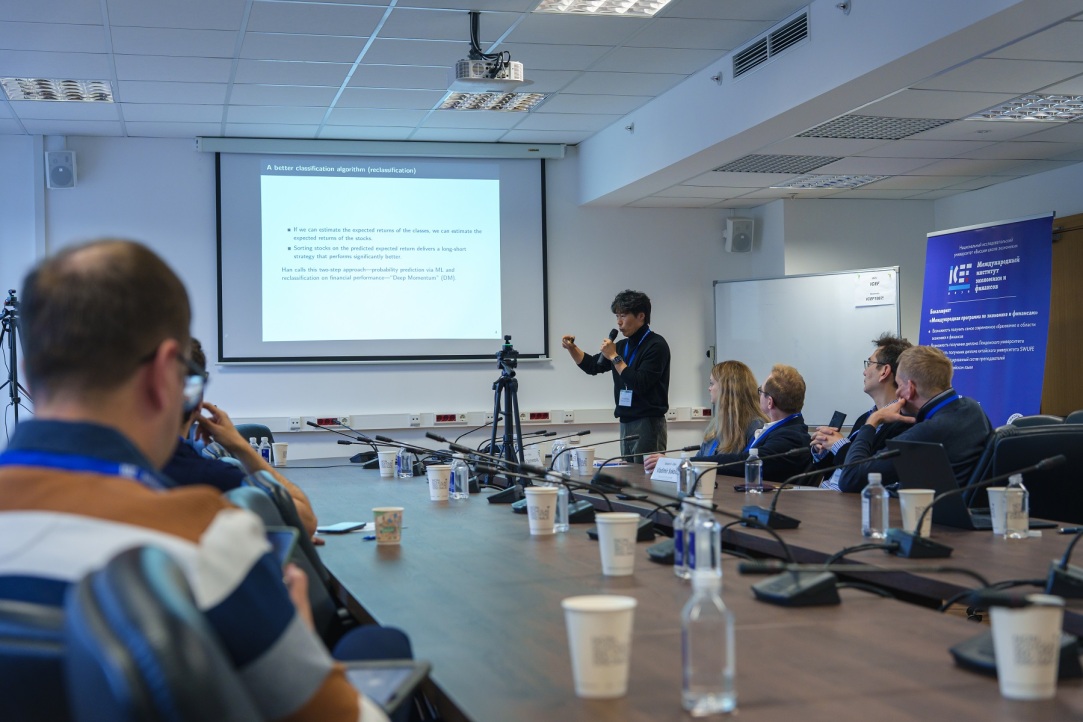
The first session focused on new empirical methods for analysing financial markets. Prof. Chulwoo Han (Sungkyunkwan University, South Korea) presented research using machine learning to predict returns. The results showed the superiority of a new ‘deep momentum’ method over traditional investment strategies.
The paper by Lorenzo Schönleber (University of Turin, Italy) delivered a comparative analysis of the Polymarket prediction market and Bitcoin derivatives. His work demonstrated that prediction markets can effectively aggregate information, creating alternative pricing mechanisms.
Trade Wars and Income Risks: How Shocks Change Investor Behaviour
The session on global shocks showed how structural changes in world trade and income inequality shape investor behaviour strategies.
The research by Yan Dong (Southwestern University of Finance and Economics, China) demonstrated how tariff barriers are forcing Chinese production chains to relocate abroad. Tai Lo Yeung (University of Lugano, Switzerland) showed that labour income volatility affects investors’ risk appetite: portfolio decisions become asymmetric under positive and negative income shocks.
From Inflation Risks to the Reliability of Diversification: A Changing Perspective on the Banking Sector and Derivatives
The conference’s final session was devoted to new approaches to assessing bank strategies, derivative pricing, and managing inflation risks.
Jasper Pan (TCNJ School of Business, USA) proposed a new metric for bank diversification, which, according to his results, better predicts stability compared to existing indicators.
Jitendra Tayal (Ohio University, USA) demonstrated that short-sale risk negatively affects put option returns, calling into question the efficiency of pricing in this market.
Meanwhile, Han Xiao (The Chinese University of Hong Kong, China) showed how mutual funds adjust portfolios based on inflation forecasts, thereby reducing their investors’ exposure to market risk.
Climate Risks and Bank Resilience: The Perspective of Allen Berger
The highlight of the conference was the keynote speech by Prof. Allen N. Berger (University of South Carolina, USA), one of the world’s most highly cited scholars in banking research.
In his lecture, he presented a conceptual model of the transmission channels of climate risks including risks associated with the transition to a low-carbon economy and those caused by natural disasters into asset valuation, regulatory policy, and the resilience of banking system stability. According to Berger, climate change is no longer an external threat but a central factor transforming the financial sector.
All presentations were followed by active discussion and comments from colleagues at HSE University, the New Economic School, and the University of South Carolina. The organisers emphasised that the conference was a venue not only for exchanging ideas but also for strengthening international academic collaboration. The next, fifteenth, International Moscow Finance Conference is scheduled for November 2026.