
This post was originally published on this site.
US Vice President JD Vance announced plans to establish a critical minerals trade bloc with allies and partners, proposing coordinated price floors as Washington escalates efforts to loosen China’s grip on materials crucial to advanced manufacturing.
The Trump administration intends to employ tariffs to maintain minimum prices and shore up supplies of critical minerals used to make semiconductors, electric vehicles and advanced weapons.
What did JD Vance say?
Vance said the US-China trade war of the past year has exposed how dependent most countries are on critical minerals, the sale of which Beijing largely dominates. Therefore, collective action is needed to make the West self-reliant, he stressed.
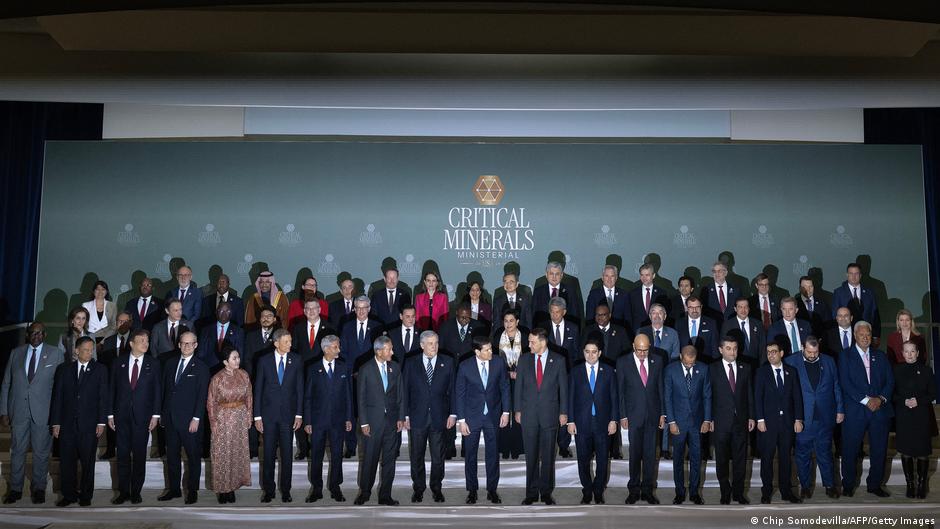
“We want members to form a trading bloc among allies and partners, one that guarantees American access to American industrial might while also expanding production across the entire zone,” Vance said at the opening of a meeting that Secretary of State Marco Rubio hosted with officials from 55 European, Asian and African nations.
“We want to eliminate that problem of people flooding into our markets with cheap critical minerals to undercut our domestic manufacturers,” Vance told a gathering without mentioning China.
“We will establish reference prices for critical minerals at each stage of production, … and for members of the preferential zone, these reference prices will operate as a floor maintained through adjustable tariffs to uphold pricing integrity,” Vance said.
Who attended the meeting?
Rubio said that 55 countries, including South Korea, India, Thailand, Japan, Germany, France, Britain, Australia, and the Democratic Republic of Congo, attended the talks in Washington. These countries have varying refining and mining capabilities.
According to Rubio, the minerals are “heavily concentrated in the hands of one country,” though he did not reference China. He added that the situation had become a “tool of leverage in geopolitics.”
At the meeting, US Trade Representative Jamieson Greer announced bilateral plans with Mexico and trilateral agreements with the European Union and Japan to strengthen critical mineral supply chains, setting the stage for broader agreements with other allies.
Separately, Argentina’s Ministry of Foreign Affairs announced an agreement with the United States to strengthen and diversify supply chains. The South American nation hopes to boost its exports of copper and lithium.
Meanwhile, Greenland and Denmark, the NATO ally with oversight of the mineral-rich Arctic island, did not attend the meeting.
Edited by: Sean Sinico