
This post was originally published on this site.
Find winning stocks in any market cycle. Join 7 million investors using Simply Wall St’s investing ideas for FREE.
-
Jackson Financial (NYSE:JXN) has reported shrinking pre tax profit margins over a four year period, despite growth in net annuity premiums.
-
The company is seeing higher expenses that are offsetting the benefits of increased premium volume.
-
This divergence between premium growth and profitability is drawing attention from investors focused on long term value.
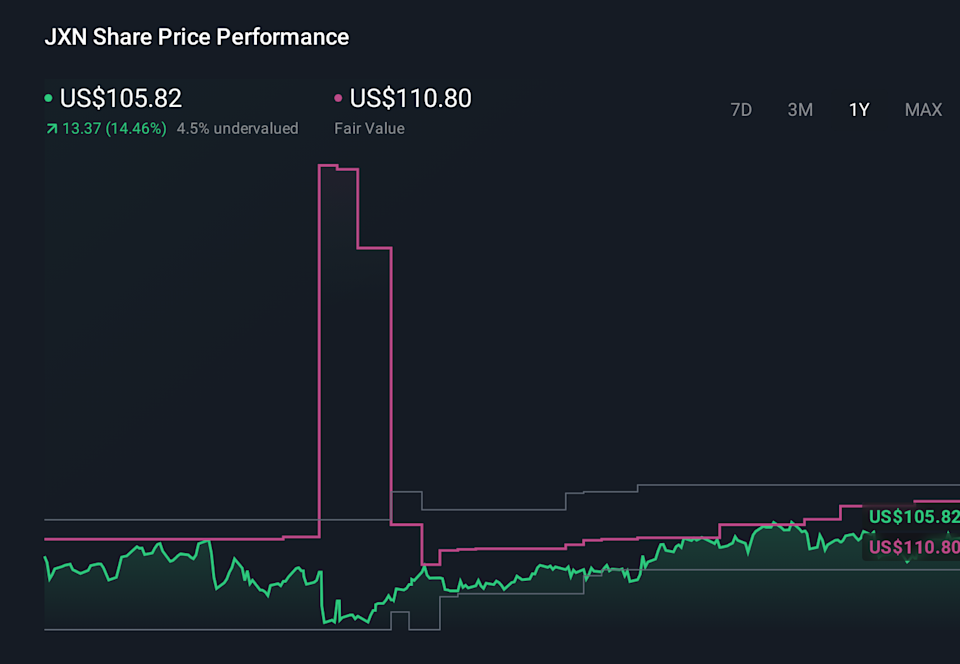
For you as an investor, the key tension at Jackson Financial is simple: the business is writing more annuity premiums but keeping less profit on each dollar. Shares of NYSE:JXN recently closed at $118.44, with the stock up 2.7% over the past week, 10.2% over the past month, and 34.8% over the past year. Over three years, the return is 193.2%, which sets a high bar for how the market judges any pressure on margins.
This mix of historical share performance and weaker pre tax margins puts the focus on costs and business mix. As you assess NYSE:JXN, a central question is how effectively the company can balance growth in net premiums with more disciplined expense trends and capital allocation so that top line progress supports long term profitability.
Stay updated on the most important news stories for Jackson Financial by adding it to your watchlist or portfolio. Alternatively, explore our Community to discover new perspectives on Jackson Financial.
Why Jackson Financial could be great value
Jackson Financial’s shrinking pre tax profit margin, despite net premiums growing at 2.5% annually over the last two years, points to investor activity that is increasingly focused on quality of earnings rather than just top line volume. For you, this raises questions about how much of the recent share-price strength reflects confidence in sustainable profitability versus optimism that cost and hedging pressures can be brought under control.
The margin pressure sits in the middle of two existing storylines: one that highlights steady annuity demand, digital investments and capital returns as long term supports for earnings, and another that focuses on tail risk from variable annuity guarantees and higher day-to-day expenses. When you compare Jackson with peers like MetLife and Prudential Financial, the market appears to be weighing its annuity scale and capital partnerships against the complexity of its guarantees and the recent drag on pre tax margins.
-
⚠️ Shrinking pre tax profit margins signal that higher expenses and hedging or reserve costs may be eating into each dollar of premium written.
-
⚠️ Ongoing variable annuity outflows and regulatory focus on capital and captives could influence how investors think about future capital strength and valuation multiples.
-
🎁 Expanding net annuity premiums and ongoing demand for retirement-income products provide a base of recurring business that some investors view as a long term positive.
-
🎁 Existing narratives point to capital returns, product diversification and external asset management partnerships as potential supports for earnings quality over time.
From here, the key things to track are whether management starts to stabilize or improve pre tax margins, how quickly expenses grow versus premiums, and what future disclosures say about variable annuity risk and capital. If you want to see how different investors and analysts are framing these trade offs, check the community narratives on Jackson Financial’s dedicated page and compare your own view with theirs.
This article by Simply Wall St is general in nature. We provide commentary based on historical data and analyst forecasts only using an unbiased methodology and our articles are not intended to be financial advice. It does not constitute a recommendation to buy or sell any stock, and does not take account of your objectives, or your financial situation. We aim to bring you long-term focused analysis driven by fundamental data. Note that our analysis may not factor in the latest price-sensitive company announcements or qualitative material. Simply Wall St has no position in any stocks mentioned.
Companies discussed in this article include JXN.
Have feedback on this article? Concerned about the content? Get in touch with us directly. Alternatively, email editorial-team@simplywallst.com