
This post was originally published on this site.
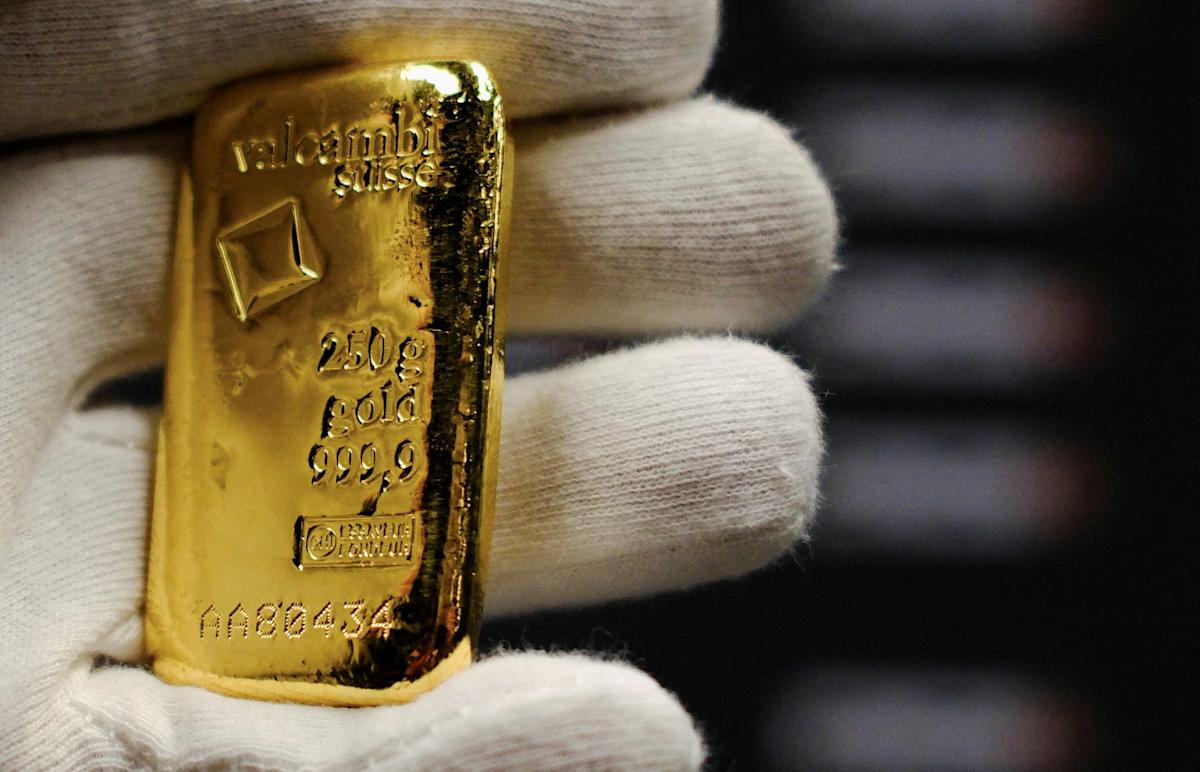
Gold prices plunged on Monday, extending losses after a sharp reversal of a rally that had pushed the precious metal to record highs last week.
Gold futures (GC=F) fell 3% to $4,599.50 a troy ounce, while spot prices dropped 6% to $4,618.00 at the time of writing. Prices had touched a fresh all time high of $5,594.82 last Thursday.
Donald Trump’s nomination on Friday of Kevin Warsh, a former Federal Reserve governor and respected central banker, as the next chair of the US central bank has eased concerns that Jay Powell’s successor would be pressured into aggressive interest-rate cuts by the president.
The sell-off accelerated as European markets opened, with analysts pointing to the speed and scale of the move as unusual even by recent standards.
IG analyst Tony Sycamore said: “Gold is diving sharply once again as European markets open, hitting a fresh intraday low of $4402. That is ~10% below Friday’s close of $4895 and $1200 (~ 21%) below last week’s record high of $5602.”
“In just three brutal sessions, gold has officially flipped from a raging bull market into a bear market according to the technical definition (a drop of 20% or more from recent highs). This kind of velocity and magnitude is extraordinary, even in a year that’s already seen parabolic gains and extreme volatility.”
Read more: UK house prices rise in January as affordability improves
The decline of more than 20% from last week’s peak has technically pushed gold (GC=F) into a bear market, the term used by investors to describe a prolonged period of falling prices.
Despite the sharp correction, some analysts argued that the move did not signal the bursting of a speculative bubble.
Emmanuel Cau at Barclays said the “volatility has been extreme”, adding that the market looked “stretched”.
Cau said: “Whilst gold’s allure still glitters as a hedge to left-tail risks, in the short term, a pull back and positioning reset after its sharp ascent look warranted.”
He added: “Despite screens flashing ‘overvalued,’ a certain amount of premium to gold’s fair value (c. $4000 on our model) looks durable, suggesting gold is not a bubble.”
Other banks remained optimistic on the longer term outlook. JPMorgan said late on Sunday that it expected continued demand from central banks and investors to drive gold (GC=F) prices to $6,300 per ounce by the end of the year.
Oil prices fell sharply as tensions between the US and Iran showed signs of easing, while broader selling gripped global markets.
Brent crude (BZ=F) futures dropped 4.9% to $65.92 a barrel, while West Texas Intermediate (CL=F) fell 5.2% to $61.79 at the time of writing.
The move came after Trump said he was hopeful of reaching a deal with Tehran, following warnings from the Iranian leadership that any attack on the Islamic republic would trigger a regional conflict.
Washington has criticised the country’s leadership in recent weeks over its deadly response to anti-government protests, with Trump threatening military action. He has also pressed for an agreement over Iran’s nuclear programme.
Supreme leader Ayatollah Ali Khamenei on Sunday described the recent protests as a “coup” and warned that a US attack would trigger a regional conflict.
Read more: Stocks to watch this week: Alphabet, Amazon, Palantir, Novo Nordisk and Shell
Asked about Khamenei’s comments, Trump told reporters: “Of course he is going to say that. Hopefully we’ll make a deal. If we don’t make a deal, then we’ll find out whether or not he was right.”
Trump’s remarks, together with reports that the naval forces of Iran’s Revolutionary Guards had no plans for live-fire exercises in the Strait of Hormuz, were taken as signs of de-escalation, said IG’s Sycamore.
“The crude oil market is interpreting this as an encouraging step back from confrontation, easing the geopolitical risk premium built into the price during last week’s rally and prompting a bout of profit-taking,” he added.
Sterling was steady against its major peers as a sea of red spread across commodities and stocks across the globe.
The pound was steady against the dollar at $1.3692 and similar against the euro at €1.1537.
The US dollar index (DX-Y.NYB), which measures the currency against a basket of six major peers, rose 0.1% to 97.08.
Ipek Ozkardeskaya, senior analyst at Swissquote, said: “The US dollar has been better bid since Friday, with the dollar index rebounding around 1% off four-year lows following news that the Federal Reserve may have a new chair. Kevin Warsh was chosen to be the next Fed President and will replace Jerome Powell if confirmed.”
Stocks: Create your watchlist and portfolio
On the UK front, the Monetary Policy Committee voted 5-4 to cut the bank rate in December, marking the fourth quarter-point reduction of 2025. Most policymakers indicated that the pace of future rate cuts could slow. The Bank of England is expected to keep its benchmark rate at 3.75% on Thursday.
In equities, the FTSE 100 (^FTSE) was in the red on Monday morning, down 0.4% to 10,180 points.
Download the Yahoo Finance app, available for Apple and Android.