

This post was originally published on this site.
Toronto’s weird success has it circling big ideas—and bigger names
I’m never surprised by the outcome of a Toronto Raptors game. Give up 138 points in a gut-punch loss to the Washington Wizards? Naturally. Throw a blanket on the Thunder in Oklahoma City to take down the defending champs? Right on. Nearly 50 games into the season, and less than a week out from the trade deadline, I can’t tell if being completely unfazed by these results is a good or bad thing—whether it speaks to some strange kind of resilience or a structural inconsistency.
Either way, the Raptors are massive (albeit confusing) overachievers, currently in fourth place, and only one victory away from tying last year’s 30-win total. This is an endearing, flawed, unpredictable team that has had its opening-night starting five for just 12 games all season Somewhat remarkably, they’ve exceeded expectations, boasting the league’s fifth-best defense, ranking first in fast-break points, and trailing only OKC in turnover differential At the same time, their offense is about average, only two teams have enjoyed a luckier schedule health-wise, and their outside shooting is a big problem; they rank near the bottom of the league in both 3-point percentage and rate.
Nothing they do offensively is a harbinger of postseason success, and none of it should be dismissed. Yet Toronto is one of this season’s biggest success stories, with a sensibly rabid style of play, an abundance of talent, a smart coach, and a bunch of intriguing options before next week’s trade deadline.
For those who believe the Eastern Conference is up for grabs—a.k.a. anyone who has been following the Eastern Conference this season—it’s time to ask whether the Raptors can actually steal it. It’s a tricky question, prompted by a Rorschach test résumé that can inspire either optimism or alarm. But, without a primary bucket getter who can single-handedly create looks for himself in high-leverage situations, history says the answer is no.
Scottie Barnes and Brandon Ingram are their two leading scorers. Neither ranks in the top 30 in points per game, neither is inside the top 25 in usage rate, and neither is suited to consistently take over playoff games, separating Toronto from rival playoff teams that employ Jaylen Brown, Cade Cunningham, Tyrese Maxey, Donovan Mitchell, and Jalen Brunson. Instead, as awesome as they are, these are low-volume, below-average 3-point shooters who don’t draw a ton of fouls or get to the rim at will.


This is all fair criticism and, for some, might end any debate over Toronto’s ability to win three playoff series. I’m not saying that’s probable, but I also think it’s too reductive to rule them out, knowing they’ve bought into such a selfless brand of basketbal that has the potential to make their whole greater than the sum of its parts. Barnes is a uniquely skilled control tower whose game makes more sense when paired with someone exactly like Ingram, who takes and makes tough shots. According to BBall Index, only four players have seen their true usage drop more from last year than Scottie’s has this season. The result has been a more efficient campaign by someone who, sans the weight of regularly having to create shots for himself, is also making smarter decisions.
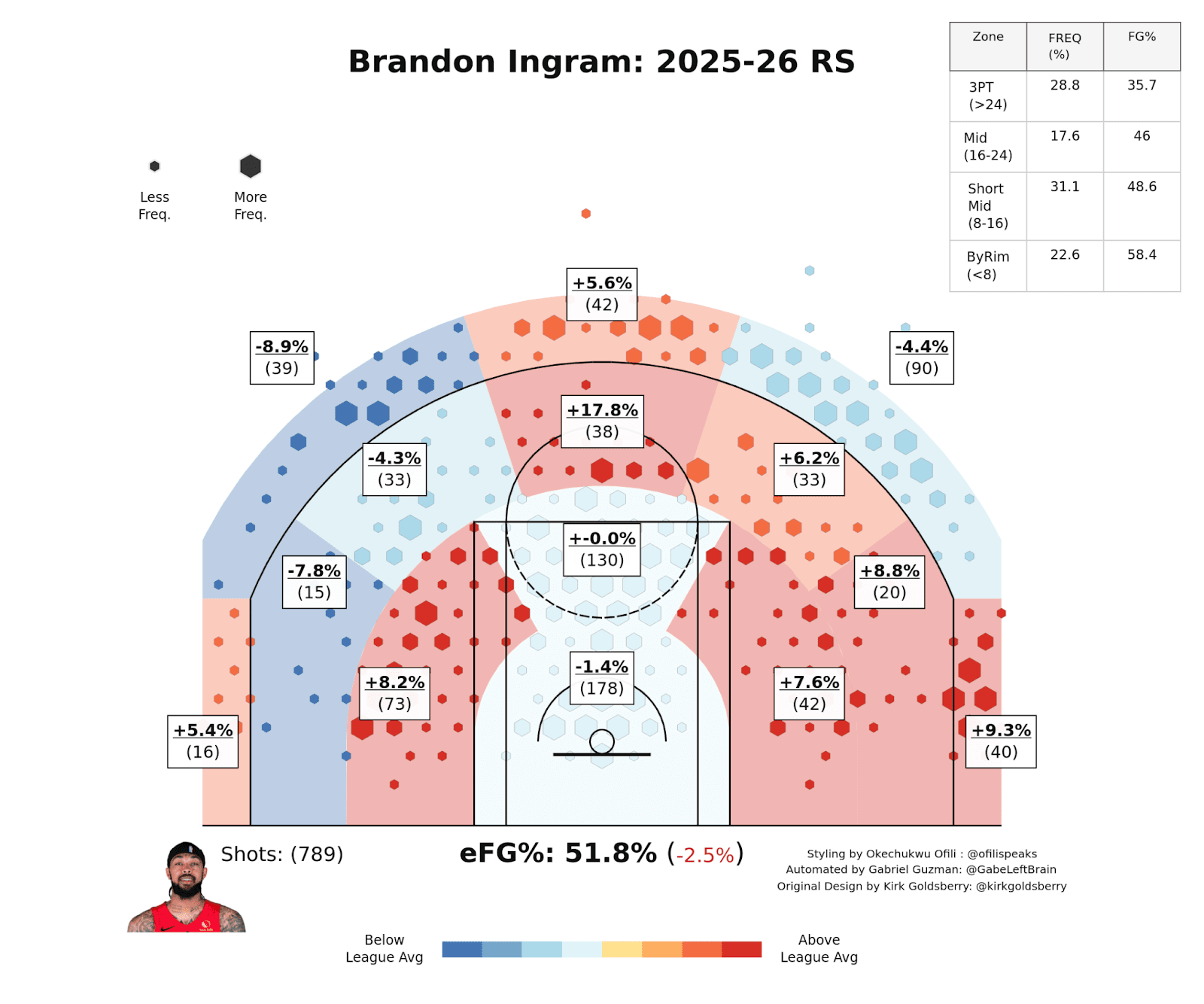
Ingram, for his part, is pretty much right in line with his career shooting splits and per-game production. The midrange is still his happy place—necessary for a Raptors team that’s desperate for difficult, one-on-one shotmaking. As has been a theme since the beginning of time, Ingram could stand to launch a few more 3s, though. The shot diet isn’t detrimental, but it does help explain why his true shooting is currently 1.4 percentage points below league average.
When supported by a healthy RJ Barrett, reigning Eastern Conference Player of the Wee Immanuel Quickley, and a turnover-triggering defense that gets them out in the open floor, the Raptors can score at a rate that keeps their head above water. In 360 minutes with Barnes, Ingram, Barrett, and Quickley on the court, Toronto’s offensive rating is 1.9 points above league average.
That doesn’t sound like the makeup of a dominant team that can reach the NBA Finals, but there are other parts of Toronto’s identity that rationalize a bullish view on what they can do in the playoffs. Namely: defense. The only team in the East that’s better on that end is the top-seeded Detroit Pistons, and no team allows fewer points per 100 possessions in crunch time, where the Raptors hold the third-highest winning percentage.
“You’re going to have ups and downs, and what we’re trying to do is always to find a way to be in the game in the fourth quarter and really to focus on our execution and to focus defensively on what we’re doing,” Raptors head coach Darko Rajakovic recently said. “Obviously, we don’t go in a game and have the same game plan over the whole game. We’re trying to make adjustments.”
That ability to get stops, especially with the game on the line, is powered by a swarm of long arms and quick feet—intuitive, physical, jumpy in all the best ways. The absence of any weak link on defense has become a borderline prerequisite for postseason success. When the offense doesn’t have anyone obvious to pick on, its attack is more likely to procrastinate. When the offense has no one obvious to pick on and is getting suffocated by full-court pressure, the quality of its looks, naturally, goes down. (The Raptors lead the league in defensive pace, which essentially means they’re the best at forcing offenses to work deep into the shot clock.)
As a whole, the Raptors’ positioning away from the ball is intentional and aggressive. They shrink the floor, spring double-teams, and shift together on a string. In the event Toronto does get caught in a mismatch and has to put two on the ball, the backside help is always there to rotate over and cover the open man:
Offenses are coerced into contingency plans that weren’t ever meant to actually happen, largely thanks to a bunch of qualities found in most championship-level defenses: trust, anticipation, length, and versatility. There are no cracks, let alone holes; they’re better than every team outside of Oklahoma at slicing off transition opportunities.
So much of this is thanks to Barnes, a near-flawless defender who can guard every position anywhere on the floor. He’s an elite on-ball stopper, rebounder, help-side rim protector, and disruptive presence in passing lanes. Barnes is one of just a few players in the entire league who can capably execute any pick-and-roll coverage, guarding the ball handler or the screener. His 131 stocks (steals and blocks) lead the league, and he’s the only player who’s even close to having more than 60 in each category. It’s been a Draymond Green/Bam Adebayo level of dominance, a marriage between 1-5 switchability and a Spidey-Sense feel off the ball. To sum it up, Barnes consistently makes breathtaking plays pretty much nobody else can:
Barnes isn’t alone. Ingram, Barrett, Quickley, Ja’Kobe Walter, and Ochai Agbaji (to name just a few!) have been able to guard up or down a position while consistently making hard closeouts to the 3-point line. And if you don’t know who Jamal Shead is, do yourself a favor and get familiar. It’s impossible to write about the Raptors and not highlight this catalyzing speed demon off the bench who personifies the entire team’s personality: inefficient scoring, excellent playmaking, inconsistent shooting, and, most importantly, merciless defense. Altogether, the good manages to outweigh the bad. It’s no coincidence that Toronto looks like its most realized self when Shead is on the court—he leads the team in on/off net differential—and not surprising to see Rajakovic start and close games with Shead beside Quickley, deploying über-small five-man lineups that don’t actually play that way thanks to Shead’s two-way aggression.
The unsung heroes don’t end there. If Defensive Rookie of the Year were an award, Collin Murray-Boyles would win in a landslide. He’s a wide body with quick hands and tremendous balance who hustles his absolute ass off. Among all starters, the ninth overall pick ranks in the 95th percentile in defensive role versatility, per BBall Index, and in the 397 minutes when Murray-Boyles is beside Barnes, Toronto’s defensive rating is a whopping 10 points better than the league average. That’s not at all surprising when you see how hard it is to run any two-man action against a pair of extremely large human beings who move like cats and never need immediate help:
The 6-foot-7 rookie became Toronto’s starting center earlier this month, solidifying a perma-small-ball frontcourt that includes Sandro Mamukelashvili and Barnes. This brings us to the team’s largest variable: Jakob Poeltl’s lingering back pain. Toronto (needlessly) signed the 30-year-old big man to a three-year, $84.5 million extension in July, but he’s been out of the lineup since December 21 and remains out indefinitely. The injury not only complicates a rotation that could use another stabilizing inside presence, but it also muddies what exactly the Raptors should do before the trade deadline. How aggressive can they be without knowing the status of their starting center?
The Raptors have been linked to several big names of late, including Giannis Antetokounmpo, Ja Morant, and Domantas Sabonis. jAll come with a certain amount of risk and, if I’m being honest, either don’t make a ton of sense or are not worth the cost. Barnes’s limitations as a shooter make pairing him with any of them a tough sell, considering that none of them can shoot, either. Barrett and Quickley often find themselves in trade rumors, but neither is on a plus contract, and there’s enough evidence to suggest that Toronto is pretty good when both are on the court.
And then there’s Giannis. If the Raptors believe that they can win the title with him either right now or next season, don’t count them out. They control all their own first-round picks through 2032, and they have matching salaries and a couple of intriguing young players. An example of what a Raptors offer might look like: Ingram, Barrett, Murray-Boyles, four unprotected first-round picks, and three pick swaps for Giannis and Bobby Portis.
The Bucks should be able to find a better package elsewhere, but this isn’t the worst scenario in the world, assuming Milwaukee embraces a full rebuild. Murray-Boyles rules, and there’s a decent enough chance that at least two of those picks will end up in the lottery. If Milwaukee counters by asking for Barnes instead of Ingram, then maybe Toronto would reduce the pick count to three. For what it’s worth, I would not trade Barnes for Giannis, but I can understand the temptation. A Quickley, Gradey Dick, Ingram, Antetokounmpo, and Mamu starting five is not bad!
Don’t rule Toronto out. We’re talking about the same organization that traded for Kawhi Leonard, knowing that it was a one-year rental. The price then was significantly lower than what it would take to get Giannis now, but if the Raptors are confident in both their ability to re-sign him and dramatically improving their outside shooting elsewhere, why not?
Far more realistic, though, is a much smaller move that’s financially motivated. This team is currently a little over $900,000 above the luxury tax. Ducking it doesn’t take precedence over getting better, but the Raptors will almost definitely seek a smaller deal that kills two birds with one stone. Something simple like Ochai Agbaji for Nick Richards would do the trick, giving Toronto another big man and allowing it to get out of the luxury tax.
Would they attach something juicy to Agbaji’s expiring contract and call the New Orleans Pelicans about Yves Missi? (I sort of understand why Joe Dumars would shop Missi, but that dude is relentless energy, just 21 years old, and on a cheap deal. He’d be a fantastic fit in Toronto.) Or maybe the Raptors will disregard the tax and make an aggressive win-now move that would seemingly assuage their biggest concerns—say, trading RJ Barrett to the Dallas Mavericks for Klay Thompson and Daniel Gafford—but I wouldn’t bet on it.
At the top of this column, I wrote that nothing the Raptors do can surprise me. That outlook also applies to whatever happens the rest of this season. I wouldn’t be shocked if they tumbled out of a top-six seed and were eliminated in the first round after barely escaping the play-in. I also wouldn’t blink if they won 50 games, entered the playoffs with home-court advantage, and advanced to the conference finals.
Their lack of shooting makes the former far more likely than the latter—the Indiana Pacers could not have been a Cinderella story last year if they didn’t drill every other shot they took for two months. But Toronto is also grounded by an anarchic defensive mindset that doesn’t yield an inch and can match up well with just about any opponent.
In pretty much any other year, I would not write a piece in January about a team that ranks 13th in net rating as a potential Finals spoiler. But you really can’t say enough about how vulnerable the Eastern Conference is right now. It creates a perfect opportunity for these funky Raptors to prove even more people wrong. Anything is possible.