
This post was originally published on this site.
AI Replacing Search in eCommerce: Key Findings
AI-led discovery is replacing traditional search, showing brands that visibility now depends on how well machines read intent, not how well pages rank.
Retailers are embedding AI across journeys and operations, signaling to agencies that future strategy must unify UX, data, and infrastructure.
Loyalty is shifting from recognition to relevance, proving that marketers must optimize for fit, not just brand.
Anyone paying attention knows the way people shop online is changing.
But what many don’t realize is how quickly consumers are turning to AI tools that suggest products instantly, without ever using a search bar.
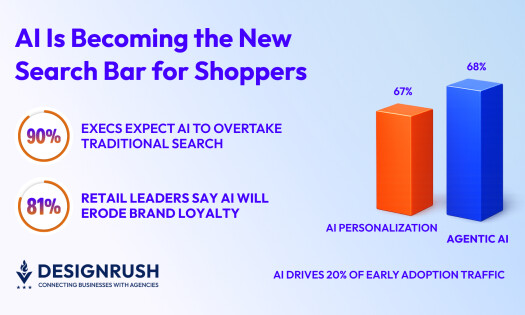
Deloitte’s 2026 Retail Industry Global Outlook reports nearly 90% of retail executives expect AI-driven discovery to surpass traditional search engines soon.
This shift in shopper behavior has flipped digital visibility on its head, forcing brands to rethink how they show up.
Jeff Nordstedt, Director of User Experience at eDesign Interactive, an award-winning digital agency specializing in web design, branding, and digital marketing, says AI is redefining the connected shopping experience.
As a result, brands can no longer rely on keywords alone. Visibility now depends on how effectively machines interpret and contextualize product data.
“Showing up now depends on how well machines understand your product,” Nordstedt says.
“What once required multiple steps – searching, clicking, and comparing – has been compressed into a single, AI-driven interaction.”
These systems pick up on intent fast, whether through chat interfaces like ChatGPT, personalized feeds, or voice assistants.
They filter and recommend in real time, bringing the right options to consumers without the need to hunt.
Editor’s Note: This is a sponsored article created in partnership with eDesign Interactive.
How AI Is Reshaping Shopping
For retailers, AI’s impact on search is redefining the entire path to purchase.
The same Deloitte report referenced earlier found that about half of retail executives expect the traditional multi-step shopping journey to collapse by 2027.
They anticipate it will be replaced by a single AI-powered experience that manages discovery, decision-making, and checkout.
“AI simplifies the journey,” Nordstedt says.
“But it cuts out the moments where brands used to earn attention. If you’re not integrated into how the system thinks, you’re invisible.”
AI is redefining what discovery means.
Capturing attention now depends on delivering the right answer at the right time.
So, what role should your website play in this new discovery model? eDesign Interactive explains how websites are evolving into agentic AI systems, built to understand intent, make decisions, and take action:
AI Discovery Demands Structured Data
Just as AI is reshaping how consumers find and evaluate products, retailers must rethink how they present themselves online or risk becoming invisible to the systems that act as shoppers’ first stop.
To this end, if product data isn’t structured clearly, AI can’t recommend it.
This means that brands must design high-performing websites and content that machines can read just as well as humans.
eDesign Interactive’s Kevin Cale explains how AI-powered design keeps brands visible across fragmented digital journeys:
AI Is Weakening Brand Loyalty
Emotional branding is no longer a guarantee. AI chooses products based on logical criteria such as price, availability, and fit; not just name recognition.
So much so that, according to Deloitte, 81% of retail leaders believe AI will weaken brand loyalty in the near future.
“The new battleground may not be convincing a shopper to choose your brand,” Nordstedt says. “It may be convincing the AI that your product best answers a specific need.”
Lasting brand connection now depends on experiences that adapt, respond, and resonate across every interaction:
How Retailers Are Adopting AI Across Operations
Retailers aren’t waiting around. They’re integrating AI across logistics, service, and experience to boost speed, accuracy, and relevance.
- 68% plan to embed agentic AI into operations in the next two years
- 67% aim to launch AI-powered personalization within a year
And some are already witnessing the impact firsthand. AI chat tools now drive up to 20% of traffic for early adopters. Still, 44% say outdated systems are slowing their ability to keep pace.
Traditional eCommerce Tactics Are Failing
Your typical eCommerce strategies, including optimizing for search, building funnels, and relying on category pages, are losing ground.
A pretty site with weak backend logic won’t cut it anymore. AI needs structured, relational data.
“This shift demands more than a new tag or keyword strategy,” Jeff Nordstedt says.
“It’s about how product information is structured, how context is conveyed, and how assets communicate with systems that may never show a traditional page view.”
As AI changes how brands stay visible, eDesign Interactive’s James Gibson explains why ranking today takes more than SEO and how Generative Engine Optimization is reshaping the approach
How Brands Can Prepare for AI-First Commerce
AI is already reshaping the way consumers discover products. To stay visible, Nordstedt says that brands need to align their digital ecosystems with how AI systems search, interpret, and recommend.
1. Clarify Product Info
Use consistent formatting. Ensure all titles, tags, and attributes are easy to scan and interpret.
2. Speak Like a Human
Use natural, straightforward language. Avoid jargon that confuses AI or customers.
3. Strengthen Infrastructure
Apart from ensuring that websites are built with great UX in mind, make sure your data and content are connected across systems. AI works best when it sees the full picture.
When your systems speak the same language, customers experience a seamless journey.
Today’s consumers expect connected digital experiences that feel intuitive, connected, and consistent across every touchpoint:
What’s Next for Retail Brands?
AI-led discovery is no longer emerging; it’s the new default in digital interactions.
In the next 12 to 24 months, brand visibility will depend entirely on how well systems, and not just people, can find, understand, and recommend your products.
This digital shift reaches far beyond marketing. It’s reshaping everything from content and UX to inventory and supply chain logic.
Retailers that treat AI-readiness as a strategic priority, and not just a tech upgrade, will move faster, surface more often, and win consumer attention at scale.
“If your product isn’t structured for machines, it won’t be discovered,” Nordstedt says.
“The brands that act now by refining language, tightening data, and connecting systems, won’t just adapt – they’ll define the future of commerce.”