
This post was originally published on this site.
The National Internet Finance Association of China, the China Banking Association, the Securities Association of China, the Asset Management Association of China, the China Futures Association, the China Association for Public Companies, and the Payment and Clearing Association of China issued the warning on Dec. 5.
They urged all member institutions to refrain from participating in the issuance or trading of virtual currencies and real-world asset tokens, Xinhua News Agency reported.
“Recently, the concept of virtual currencies has become widespread, and some criminals have exploited it to promote trading and speculation,” the statement read.
“They use the guise of stablecoins, valueless coins (like Pi Coin), real-world asset tokens, and ‘mining’ to engage in illegal fundraising, pyramid schemes and transfer of profits from these illegal activities through virtual assets.
“This severely infringes on public property security and disrupts the normal economic and financial order.”
 |
|
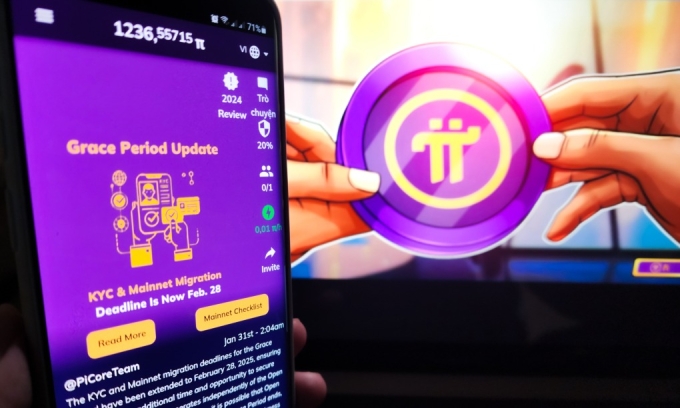
Pi Network’s smartphone app next to Pi Network logo. Photo by VnExpress/Bao Lam |
According to the alert, virtual currencies are not issued by monetary authorities, lack legal tender status, and therefore cannot be circulated or used as currency in China. It also urged the public to stay vigilant and report all suspicious activities to authorities.
China has banned cryptocurrency trading since 2021. But meanwhile, Hong Kong has put in place a regulatory framework for stablecoins though it has yet to grant any issuance licenses.
Last month the People’s Bank of China (PBOC) reaffirmed its stance, warning of a resurgence in speculation. The central bank also pledged to intensify its crackdown on illegal activities involving stablecoins.
“Virtual currencies do not hold the same legal status as fiat currency and cannot be used as legal tender in the market,” it said in a Nov. 28 statement, adding that virtual currency-related business activities are “illegal financial activities.”
Launched in 2019 Pi Network promoted itself as a way for users to mine the crypto for free by tapping a button in its mobile app daily. Vietnam is among the countries with the most miners. The project has been controversial, taking nearly six years to launch its mainnet before finally allowing users to transfer Pi to exchanges for trading on Feb. 20 this year.
But the project is still viewed as an incomplete blockchain initiative, lacking smart contract functionality and open-source transparency.
To date the development team has only introduced limited updates, including a domain name auction feature, the PiFest shopping campaign and a few small-scale applications.
The project has drawn scathing criticism from several prominent figures in the crypto space. Bybit CEO Ben Zhou called Pi “more dangerous than meme coins” and said his exchange would not list it. Justin Bons, founder of Cyber Capital and a well-known crypto analyst, has labeled Pi Network a “scam” and warned users to avoid it.