
This post was originally published on this site.
Effects of Bots on eCommerce: Key Findings
66% of online shoppers now lose purchases to bots, turning eCommerce into a competitive disadvantage instead of a convenience.
53% of shoppers are considering shifting back to in-store buying, signaling real revenue risk for digital-first retailers.
Bot-driven artificial scarcity is corrupting inventory data and misleading demand forecasts.
Shopping online was supposed to make buying easier. Instead, for many customers, it has now become a race against a machine.
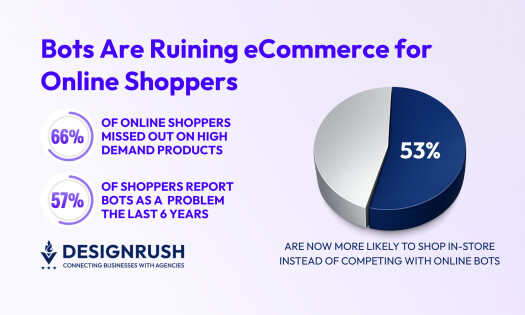
According to a recent 2025 study by World, a nonprofit that tracks bot abuse and online fraud, 66% of online shoppers report regularly losing out to automated bots when trying to purchase limited-edition or high-demand products.
Likewise, 57% of online shoppers claim that bots have been a huge issue for them, especially over the last six years.
This is a significant problem, as the study also revealed that 53% of shoppers admit they are now more likely to shop in-store instead of trying to compete with online bots.
Such a scenario would pose a significant problem for retail brands that rely heavily on eCommerce.
In fact, experts like Bighorn Web Solutions, which specializes in enterprise-grade eCommerce, say this issue is no longer something brands can afford to ignore:
“When shoppers repeatedly lose to bots, they don’t just abandon a cart. They abandon the channel,” says Caleb Bradley, Founder and CEO at Bighorn Web Solutions.
At scale, that shifts demand back to physical retail, weakens digital loyalty, and quietly erodes lifetime value.
In other words, bot mitigation has suddenly become a vital retention strategy eCommerce brands need to adopt quickly.”
The real damage, however, goes far beyond who gets the last pair of sneakers.
How Bots Distort eCommerce Performance and Customer Trust
Bots do not simply buy faster than humans. They warp the entire retail environment.
When automated scripts flood product pages, they create the illusion of explosive demand.
In turn, inventory systems react to artificial spikes, forecasting tools misread interest levels, and marketing teams celebrate sell-outs that never represented real customer behavior.
When this happens, brands can face several consequences:
- Artificial scarcity becomes routine. Bots buy in bulk, draining inventory before real shoppers even load the page.
- Inventory data loses credibility. Forecasting models learn from distorted demand signals.
- Checkout performance degrades. Automated traffic clogs payment flows and strains site infrastructure.
- Human customers walk away. After repeated failures, many stop trying altogether.
Of course, this goes well beyond just performance metrics, Bradley notes:
“More than just products, bots also steal confidence in the buying experience. And that confidence matters more than many brands realize.”
When shoppers feel the system is rigged, frustration spills into social media, review platforms, and word-of-mouth conversations.
Over time, this erosion shows up as lower repeat purchase rates and weaker brand attachment.
Identify the Security Measures Brands Must Implement Now
Simple CAPTCHAs and static rate limits are rarely able to keep up with the more sophisticated bots of today.
As such, Bighorn Web Solutions advises brands to look into the following steps:
1. Deploy Behavior-Based Detection Systems
Bots leave subtle fingerprints that traditional filters miss.
Monitoring cursor movement, navigation speed, session patterns, and interaction timing allows brands to identify automation even when IP addresses rotate or scripts mimic browsers.
This approach separates genuine customers from scripted traffic, all without disrupting legitimate buyers.
2. Enable Real-Time Mitigation During High-Demand Events
Overloaded launches due to increased bot activity can never be used as an excuse.
Brands should activate dynamic rate limiting, real-time challenge escalation, and behavior-based blocking as traffic climbs.
Instead of shutting down access broadly, these features can isolate malicious behavior while keeping checkout lanes open for humans.
3. Integrate Inventory and Fraud Systems
Bot defense becomes far more effective when it is tied directly to inventory logic rather than treated as a separate security layer.
When suspicious traffic is detected, brands should block stock reservations, limit checkout quantities, and flag transactions for automated review before fulfillment.
This prevents artificial sell-outs while keeping demand signals clean for forecasting and replenishment.
4. Monitor and Audit Bot Activity Continuously
Bot defense only works if it is measured.
Brands should log attempted bot checkouts, track repeat IP or device patterns, and review attack timing after major drops or campaigns.
These insights make it possible to pre-load stricter rules before predictable spikes and reduce reaction time during live events.
Treat Bot Defense as a Competitive Advantage
Bots have become indispensable in eCommerce. However, there’s also no denying that they’ve become a bit of a double-edged sword.
For every bot used to aid online shoppers with product discovery and recommendations, some bots just make highly anticipated launches a miserable experience.
Given this, bot protection has quickly become a competitive lever for both B2C and B2B eCommerce brands.
The ones that invest in fair access, behavioral intelligence, and real-time mitigation protect more than inventory.
They preserve customer goodwill, stabilize demand signals, and maintain predictable revenue during high-traffic moments.
In contrast, companies that ignore the problem quietly hand loyal buyers to competitors who offer smoother, fairer purchasing experiences.